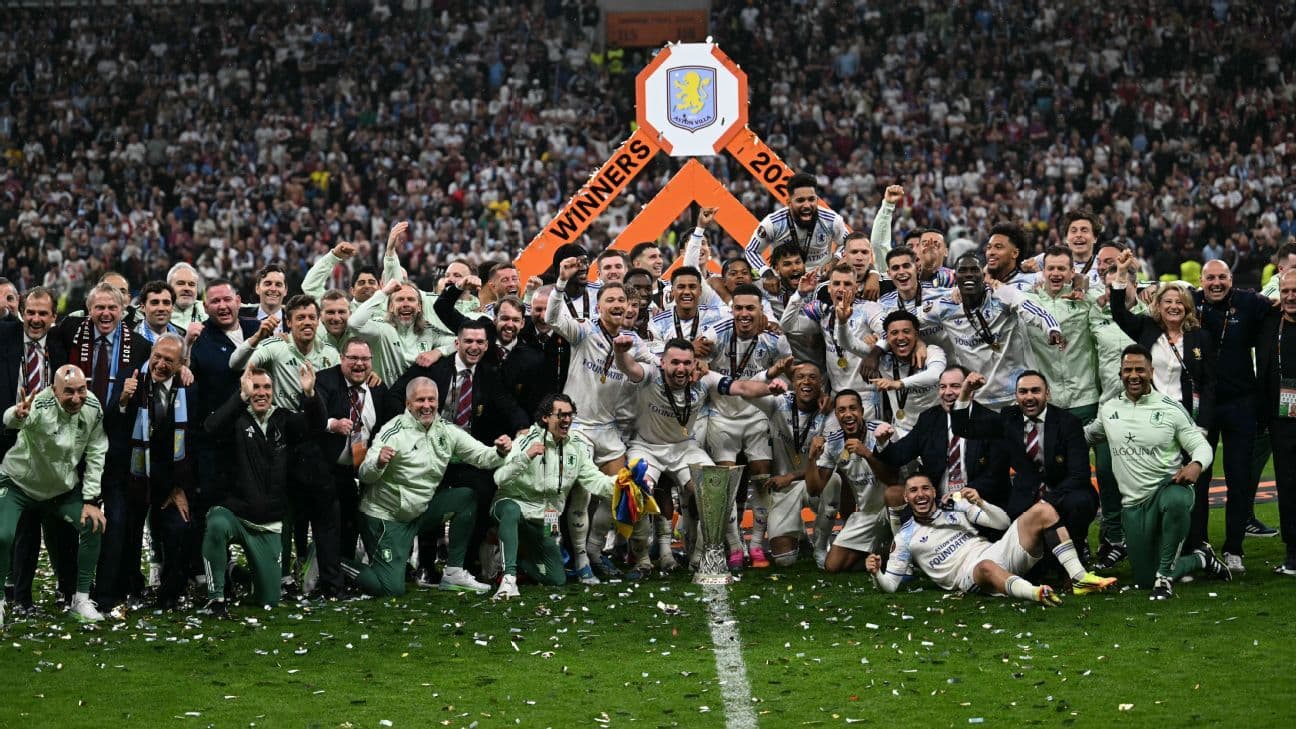
Aston Villa Triumphs in Europa League Final in Istanbul
Forty-four years after Peter Withe and company stunned Bayern Munich, Aston Villa are kings of Europe again. Different era, different competition, same sense of disbelief. The club that once slid out of the Premier League in embarrassment has climbed all the way back to a continental title, and at the heart of it stands Unai Emery – the man who has turned the Europa League into his personal playground.
The 54-year-old has now won this tournament five times with four different clubs. Numbers that sound almost fictional until you watch nights like this. Freiburg were not just beaten in Istanbul; they were dismantled 3-0 by a Villa side that played like a team utterly sure of what it was doing and where it was going.
Youri Tielemans set the tone with a thunderous volley. Emi Buendía added a finish of rare elegance. Morgan Rogers applied the final cut. Three goals, no reply, and a performance that felt like a full stop at the end of Villa’s long, chaotic rebuild.
From Preston Nights to European Silverware
For John McGinn, this was the culmination of a journey that started a long way from the Bosphorus. Seven years ago he was the heartbeat of the side that beat Derby County in the Championship playoff final to drag Villa back into the Premier League. Now he is the first Scotsman since Barry Ferguson in 2008 to captain a team in a major European final, and the first to do so for an English club since Graeme Souness in 1984.
The image of McGinn hoisting the Europa League trophy, claret-and-blue ribbons spilling around him, will live with Villa supporters for a generation. This is a squad that remembers midweek trips to Preston and the grind of the second tier. Some, like McGinn, Tyrone Mings and Tammy Abraham, were there for that Wembley afternoon in 2019. Others – Ezri Konsa, Emi Martínez, Ollie Watkins, Matty Cash – arrived as the club tried to turn survival into something more ambitious.
Together they have flirted with a breakthrough without quite grasping it. Conference League semifinalists in 2024. Champions League quarterfinalists last season, undone by eventual winners Paris Saint-Germain. Hints of something bigger, but no defining moment.
That changed in the Turkish capital. Here, Villa took everything they had learned in those near-misses and applied it with cold precision. Freiburg were kept at arm’s length, their running – 2.5 kilometres more than Villa over the 90 minutes – a statistic that spoke of effort without incision. Villa, by contrast, were ruthless. They picked their moments and when the chances came, they did not blink.
By the final whistle, the 30-year wait for a major trophy was over. A club starved of silverware since the 1996 League Cup had its new reference point, its new folklore. Names like McGinn, Martínez, Tielemans, Buendía and Rogers now sit alongside Paul McGrath and Peter Withe in the club’s European story.
Emery, the Europa League Specialist Who Just Keeps Winning
Thomas Tuchel once joked that UEFA might as well rename this trophy after Emery. Nights like this make the line feel less like a quip and more like a suggestion.
On the banks of the Bosphorus, Emery lifted the 47kg trophy for a fifth time, adding Aston Villa to a list that already included Sevilla (three titles) and Villarreal. Only Carlo Ancelotti, with his five Champions League wins, can match that tally in major European competitions. No one else has done it with as many different clubs.
Emery insists he is not the “king” of this tournament. Try telling that to the 11,000 Villa supporters packed into the claret-and-blue end of Beşiktaş Park, among them Prince William, who watched the coach complete a four-year transformation from a team sitting 17th in the league to champions of Europe’s second tier.
He also claimed his past record meant nothing for this final. His game plan said otherwise. Freiburg pressed, fouled, tried to disrupt. Villa simply stepped over the mess. They went long to Watkins, bypassing the press, turning the match into a series of duels in areas they preferred. It wasn’t pretty early on. It was calculated.
It is easy to forget how this season began: no wins in the first four games, no goal until late September. From that position, Emery has driven Villa into the Champions League places and now delivered a major European trophy. This is not just a specialist at work; this is the résumé of a modern great.
Tielemans Cracks It Open, Buendía Paints the Picture
For 40 minutes, the final was a grind. Fouls, half-attacks, broken rhythm. Freiburg couldn’t quite get hold of the ball, Villa couldn’t quite do anything convincing with it. The spectacle sagged.
Then Austin MacPhee’s set-piece notebook opened, and everything changed.
A short corner from Lucas Digne caught Freiburg napping. Instead of whipping it in, he nudged it to Rogers, who took a moment to survey the scene. He floated a teasing ball towards a pocket of space just inside the box. Tielemans arrived like a hammer. One clean, brutal volley. Noah Atubolu barely moved before the net shook.
The pressure had finally told. Freiburg looked stunned. Villa looked liberated.
And once this Villa side finds a taste for the spectacular, it rarely stops. Their goals all season have outstripped the underlying numbers, a team living off high-quality moments rather than relentless volume. Istanbul offered another perfect example.
Buendía, drifting at the edge of the box, collected the ball on his weaker left foot. No hesitation. He wrapped his boot around it and sent a vicious, curling strike arcing beyond Atubolu’s outstretched hand and into the top corner. Side netting, top shelf, pure artistry.
The ball hit the net and, almost in the same breath, referee François Letexier blew for half-time. Curtain down on 45 minutes that had lurched from attritional to exquisite in the space of two shots.
Rogers Finishes the Job, History Takes Note
The third goal lacked the same postcard quality but carried its own significance. Rogers, at 23 years and 298 days, became the youngest Englishman to score in a major UEFA final since Steven Gerrard’s famous 2001 UEFA Cup performance for Liverpool against Alavés.
His finish sharpened the scoreline to 3-0, matching the pattern of recent Europa League deciders: the last three finals with a two-goal half-time lead have all ended by that margin – Atlético Madrid in 2012, Atalanta in 2024, now Villa in 2026. Once a side gets that cushion, this competition rarely forgives the chasers.
Around Rogers, a web of milestones took shape. Jadon Sancho, starting for Villa, became the first player ever to feature in the final of three different major European competitions in three consecutive seasons – Champions League in 2023-24, Conference League in 2024-25, Europa League in 2025-26. Villa’s 44-year gap between major European finals now ranks as the third-longest in history, behind only Manchester City’s 51-year wait and West Ham United’s 47.
English clubs, too, are riding a wave. With Tottenham Hotspur lifting this trophy last season, this is the first time since the early 1970s that English sides have claimed the UEFA Cup/Europa League in back-to-back campaigns. Back then it was Spurs and Liverpool. Now it is Spurs and Villa.
For Villa, though, this night stands alone. From relegation in 2016 to European champions in 2026, from the nervous grind of the Championship to a serene, almost icy, dismantling of Freiburg on one of the game’s grandest stages.
They once ruled Europe in 1982. They rule a part of it again now. The question is no longer whether Aston Villa belong back at this level.
It is how far Emery and this group intend to go from here.