
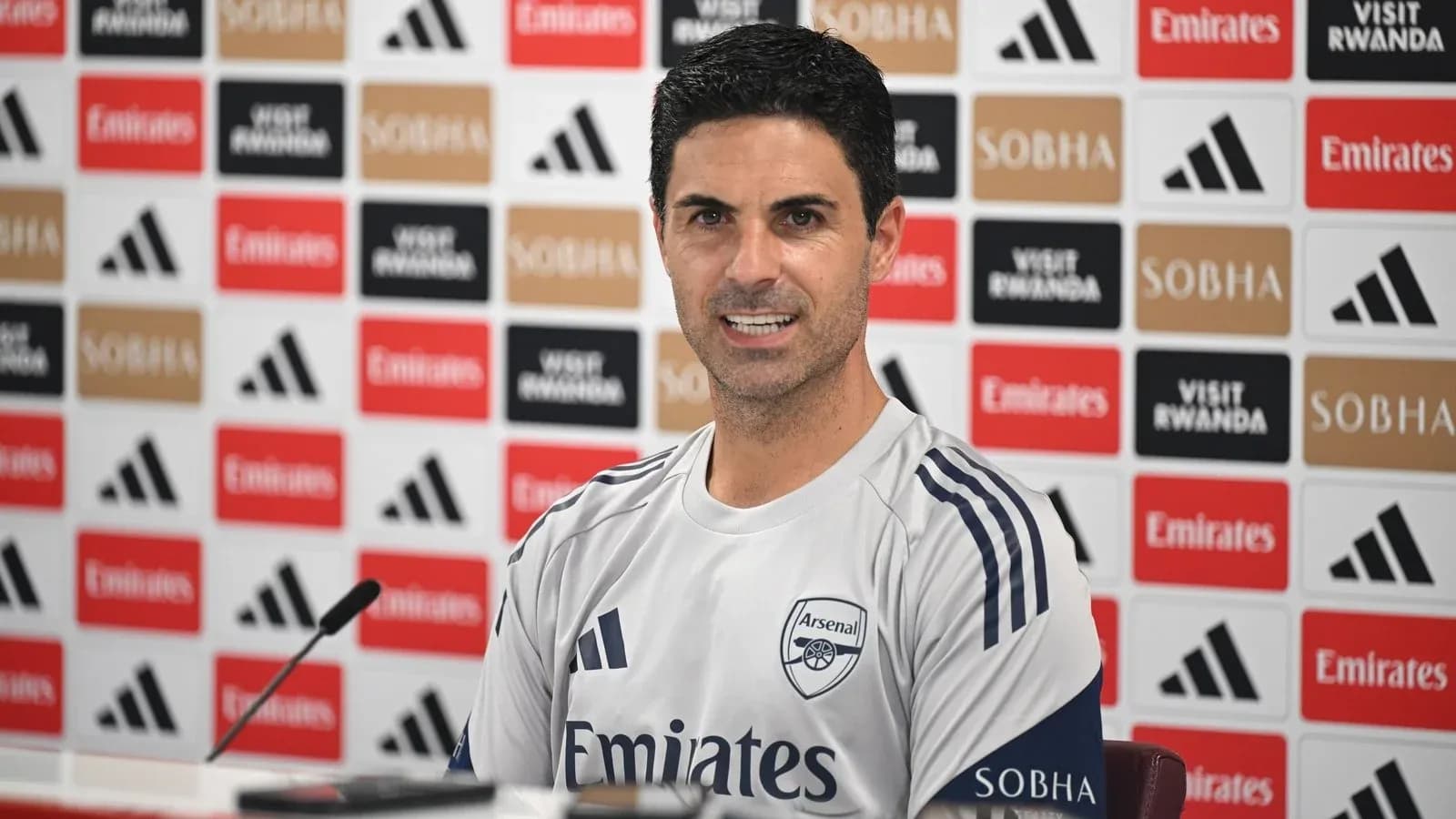
Arteta Focuses on West Ham Amid Champions League Final
Mikel Arteta walked into his pre-West Ham press conference with a Champions League final on the horizon and a title race raging around him. He treated both the same way: as noise to be pushed aside until the next job is done.
Sunday’s trip across London to the London Stadium, he made clear, is that job.
No new injuries – but no Merino or Timber
The first piece of good news for Arsenal: there are no fresh injury concerns from their last outing.
“Everybody finished the game well and nothing to add,” Arteta said, before immediately cooling any optimism over two long-term absentees. There will be “no chance” of seeing Merino or Jurrien Timber this weekend, and their involvement before the end of the season remains uncertain.
“There’s still a fair bit to do,” he admitted. For either to feature, their recovery would have to be “so smooth and quick” that any minutes would be a bonus rather than a plan.
Paris on hold
Arsenal’s reward for their European run is a Champions League final against PSG, but Arteta refused to let the glamour of that fixture bleed into the build-up for West Ham.
“It is what it is,” he said of drawing the French champions. Bayern Munich or PSG, the level was always going to be elite. He acknowledged their quality, then shut the door on the subject.
“We’re also very confident that when we get to that moment, we’re going to deliver what we need to.” Not now. Not this week. West Ham first.
Unity as a weapon
If Arsenal are to navigate the final four league games and a European final, Arteta believes the club’s emotional core – players, staff, supporters – will decide how far they go.
“It’s crucial, immense and needed,” he said of the unity around the team. He described the atmosphere at home as something players “never had that feeling before in the stadium,” a connection that lifts performance levels and sharpens belief.
The manager is leaning on that bond now, with the season poised on a knife edge.
Celebration criticism brushed aside
The mood music around Arsenal’s celebrations after beating Atletico Madrid has divided opinion in some quarters. Arteta, though, barely blinked when asked about those who felt they went too far.
“I didn’t know about it,” he said. “You have to respect every opinion and place them where they belong.”
Pressed on where that is, he repeated: “Where they belong.” Then he moved on.
What does matter to him is how his players respond to all forms of judgement. Positive and negative criticism, he argued, drives standards higher if you want to compete for “the two most prestigious competitions in Europe.” Arsenal are in that fight, and he expects scrutiny to follow.
West Ham, not Wembley
Arteta’s message to his players after booking their place in the Champions League final was blunt.
“This is great. What a moment, we earned it,” he told them. Then he immediately flipped the page: “Now the focus, the attention, the detail, the energy, everything has to be put into West Ham, there is nothing else there, and we made it very clear.”
He wants everyone – players and supporters – to “stay present, live the moment” and bring the same, or even greater, energy, hunger and desire that has carried them this far. With the finish line in sight, “everything that we do now is going to matter to win it or not.”
The London derby, he knows, is loaded with jeopardy for both sides. “Understanding the context of the game for both clubs, it’s huge,” he said. Arsenal know exactly what they need and “what we have to do to win the game.”
Inside Arteta’s decisions: Lewis-Skelly, Eze and intuition
Arteta has been praised for the timing of his calls with Myles Lewis-Skelly in midfield and Eberechi Eze on the left at Manchester City. He framed those choices as the product of a long process rather than a sudden flash of inspiration.
On Lewis-Skelly, he spoke of a manager and a teenager learning each other.
“It’s been a process of probably understanding him better, him understanding as well the standards that are required when you play or don’t play that much at this level,” Arteta said. The youngster’s attitude has been “exceptional” – in training, in how he supported team-mates when he was out of the side, and in the way he grabbed his chance when it came.
To come in, having barely played, and look “that confident, that energetic, playing with that determination,” surprised even his manager.
The journey has not been straightforward. Arteta detailed Lewis-Skelly’s rapid rise from under-18s and under-21s – sometimes not even playing, or playing out of position – to first-team sensation and international recognition. Then came the reality check: back from pre-season and suddenly no longer a guaranteed starter.
“You need to go through those emotions,” Arteta said, noting the influence of those around a young player when the spotlight dims. The temptation, when things go against you, is “to start to point to people.” Arteta made it his job to explain, repeatedly, why the minutes weren’t coming.
“Not the first one,” he admitted, but “after three or four times” Lewis-Skelly accepted that if he didn’t adapt, “I don’t think it’s going to happen.” The response since has delighted him.
As for the tactical tweaks – Eze wide at City, Lewis-Skelly in midfield against Fulham and Atletico – Arteta pointed to a blend of planning and instinct.
“There is something related to your intuition – what the game is going to require, the state of the players, the way you can imagine the game and where the players will have the most impact,” he said. You can be right or wrong, but if you follow your work and your feel, “at least you have the certainty that you’ve done the preparation.”
Saka, Rice and leaders growing into the moment
Arteta’s admiration for Bukayo Saka has been clear for years, but his words carried extra weight this week.
“A joy,” he called working with him. He feels “extremely lucky” to have a player he can lean on “at any level”, certain that Saka’s heart, values and principles align with the club’s. On the human side and the football side, what Saka has given Arsenal – and what he produced “the other night” – he described as “remarkable.”
Declan Rice, returning to his former club this weekend, drew similar praise. Arteta insisted the midfielder arrived already “really well developed”, but has since become “one of our leaders, one of the main players without a doubt.” What Rice is doing “for the club, for the team, is just very powerful.”
On the right flank, Arteta is also pleased to finally have Ben White and Saka regularly in tandem again. He noted how few minutes that unit has had together this season for various reasons, and how obvious their “really good connection” is when they do play. Years together have built an understanding that shows.
Gyokeres’ graft, Raya’s standards
Viktor Gyokeres’ hold-up play has drawn attention, but Arteta insisted the improvement has been months in the making.
He said he noticed it “from the beginning,” stressing that development at this level rarely happens “a day or two days before” a big performance. Gyokeres has been “working extremely hard,” setting “extremely high” demands on himself, constantly asking questions, doing extra work and seeking connections with team-mates “in the canteen, in the dressing room or on the pitch.” With that behaviour, Arteta argued, “you get rewards.”
At the other end of the pitch, David Raya continues to anchor Arsenal’s defensive record. Arteta hailed his goalkeeper’s “exceptional” consistency since joining the club, reaching a level “that is incredibly high.”
Sometimes, he suggested, the team take Raya’s saves for granted when they are anything but routine. He has stepped up in “crucial moments,” while the collective defensive effort has underpinned a push for the Golden Glove for a third consecutive season – a statistic Arteta clearly values.
Bigger weeks than ever – but the same daily grind
Arteta did not shy away from the scale of what lies ahead. The next few weeks, he accepted, are “the biggest” of his career. Yet he repeatedly dragged the conversation back to the everyday work that underpins it all.
“I enjoy every day,” he said. He loves the job, the time with his players and staff, and especially the preparation: picking the right topics, reading his squad, anticipating how a game might unfold and how to change it if needed.
The so-called five-phase plan, drawn up six years ago, was parked until the season ends. “Can we speak about it at the end of the season?” he replied when asked. Which phase are Arsenal in now? “I don’t know, I’m lost! It doesn’t matter, the phase.”
What matters, he insisted, is what they do “today” and “tomorrow” to be in the best physical and mental state for Sunday’s battle.
One advantage he does have now is depth. Arteta highlighted the “quality that we had on the bench the other night,” comparing it to a year ago and calling it “a very different picture.” More players are fresher, the squad feels stronger, and with that comes a greater chance “to achieve the goals.”
He doesn’t see the remaining league fixtures as auditions for the Champions League final. The real test, he said, is “every single day in training,” where players have been giving the staff selection headaches all season, especially in recent weeks.
Arsenal stand four league games and one final away from turning a long-term vision into silverware. For Arteta, though, the story hasn’t reached Paris yet. It runs through East London first, and he intends to make that chapter count.



