Arsenal Secures Narrow 1–0 Victory Over Newcastle in Premier League
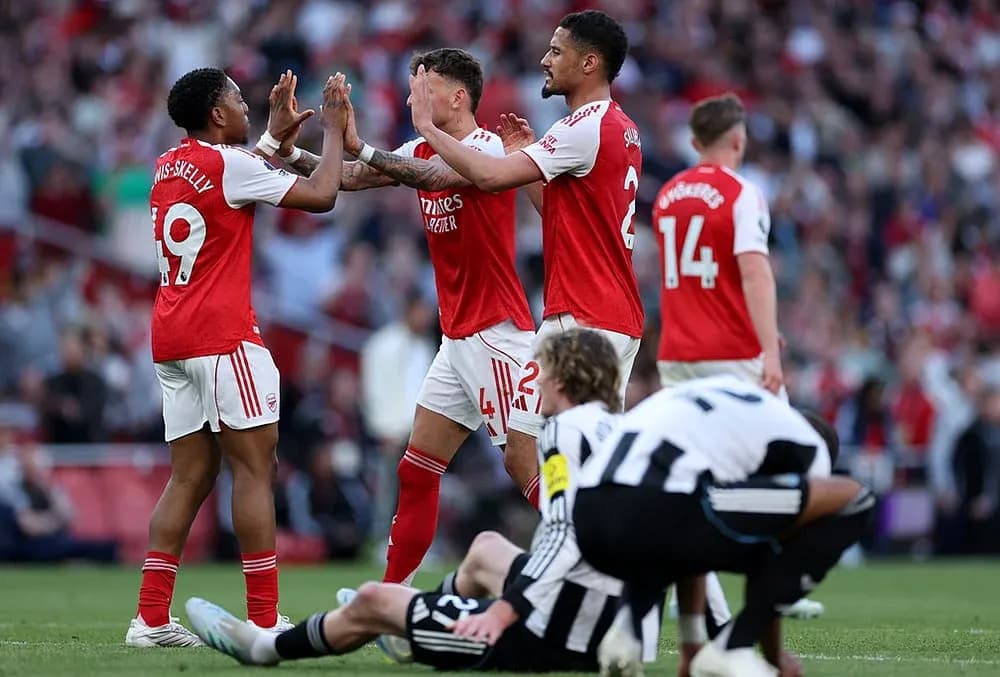
Arsenal edged a finely balanced Premier League contest 1–0 over Newcastle at Emirates Stadium, decided by an early Eberechi Eze strike in the 34th round of the season. Despite ceding 55% possession and facing a marginally higher xG (0.91 to 0.64), Mikel Arteta’s side controlled the key zones without the ball and managed the game maturely once ahead. Newcastle’s 4-1-4-1 structure circulated the ball more cleanly and produced more total shots (13–11), but they were repeatedly forced into low-quality efforts and wide deliveries. In a match of small margins, Arsenal’s compact 4-3-3 block, plus precise early combination play in the left half-space, proved decisive.
Scoring Sequence
The scoring sequence was simple but tactically revealing. On 9', Arsenal exploited Newcastle’s advanced full-backs: Kai Havertz dropped between the lines from the nominal centre-forward role, combining with Eberechi Eze on the left. Havertz’s timing and weight of pass split the channel between Sven Botman and Dan Burn, allowing Eze to arrive from the wing into the inside-left lane and finish a normal goal for 1–0. That pattern—Havertz as a connector, Eze attacking the half-space—set the tone for Arsenal’s most dangerous phases.
Disciplinary Log
The disciplinary log began only after the interval. The first card came on 57', when Dan Burn received a yellow card for a foul, reflecting Newcastle’s growing urgency to disrupt Arsenal counters down their right side. Arsenal’s first caution followed on 71', with Gabriel Martinelli booked for a foul shortly after coming on, an indicator of Arsenal’s willingness to break Newcastle’s rhythm in transition. On 74', Nick Pope was shown a yellow card for a foul, likely linked to a delayed restart or challenge as Newcastle pushed higher and risked more in rest defence. The final booking arrived on 86', when Declan Rice was cautioned for argument, underlining the rising tension as Newcastle chased an equaliser and Arsenal protected their narrow lead. No red cards were issued, and there were no VAR interventions noted; the 1–0 stood unchallenged from 9' onward, with the halftime score also 1–0.
Arsenal's Defensive Structure
Arteta’s 4-3-3 was built on a stable back four of Ben White, William Saliba, Gabriel, and Piero Hincapie in front of David Raya. With only three saves required, Raya’s performance was more about positioning and command than shot-stopping heroics. Arsenal’s Defensive Index on the day was defined by structure: a narrow front three of Noni Madueke, Havertz, and Eze curved their pressing to screen Sandro Tonali, forcing Newcastle to build via the full-backs and wide midfielders rather than through Bruno Guimaraes between the lines.
Midfield Dynamics
In midfield, Martin Odegaard and Rice alternated pressing jumps, with Martin Zubimendi initially anchoring and later replaced by M. Lewis-Skelly at 81' (M. Lewis-Skelly (IN) came on for M. Zubimendi (OUT)) to add fresh legs in the screening role. Odegaard’s higher positioning in the right half-space allowed Arsenal to threaten on turnovers, even with only 45% possession and 397 passes at 81% accuracy, compared to Newcastle’s 480 at 85%.
Personnel Changes
Personnel changes were carefully timed. On 34', Arteta adjusted his forward line: V. Gyökeres (IN) came on for K. Havertz (OUT), swapping a hybrid false nine for a more orthodox reference striker. This shifted Arsenal’s attacking dynamic from combination-heavy central play to more direct runs against Botman and Malick Thiaw. On 53', G. Martinelli (IN) came on for E. Eze (OUT), maintaining the threat in the left half-space but with a more vertical, dribble-focused profile. Later, at 81', B. Saka (IN) came on for N. Madueke (OUT), giving Arsenal a more secure outlet on the right to relieve pressure and hold the ball deeper in Newcastle’s half.
Newcastle's Formation
Eddie Howe’s 4-1-4-1 had Nick Pope in goal, backed by a back four of Lewis Miley, Thiaw, Botman, and Burn, with Tonali as the single pivot. The advanced line of Jacob Murphy, Joe Willock, Bruno Guimaraes, and J. Ramsey supported W. Osula. Despite Pope making three saves—matching Raya numerically—Newcastle’s defensive structure was more exposed in the early phase, particularly when their full-backs pushed high. Substitutions aimed to increase attacking punch: on 66', Y. Wissa (IN) came on for W. Osula (OUT), and H. Barnes (IN) came on for J. Murphy (OUT), shifting towards more direct running and 1v1 threat. On 75', N. Woltemade (IN) came on for Bruno Guimaraes (OUT), a bold move that traded some central control for an extra forward profile. Finally, at 86', A. Elanga (IN) came on for J. Willock (OUT), leaving Newcastle with multiple forwards between the lines but less midfield ballast, which Arsenal managed through deeper lines and aggressive duels, epitomised by Rice’s late booking.
Statistical Overview
Statistically, the contest was almost inverted in feel versus numbers. Newcastle led in possession (55–45), total shots (13–11), and passing volume (480–397), and generated the higher xG at 0.91 to Arsenal’s 0.64. Yet the quality of Arsenal’s defensive organisation—reflected in limiting Newcastle to three shots on target and forcing many attempts from outside the box (7 of Newcastle’s 13)—meant that the raw xG gap did not translate into clear territorial dominance.
Overall Form
Arsenal’s Overall Form in this match was that of an efficient, game-state aware side: an early goal, then controlled risk, with 7 corners to Newcastle’s 2 and only 13 fouls committed despite extended defending. Their Defensive Index was underlined by zero goals conceded, three saves from Raya, and disciplined spatial control, even as late-game cards (Martinelli for a foul, Rice for argument) showed the emotional cost of protecting a slim lead.
For Newcastle, the Statistical Verdict is more frustrating: higher xG, more possession, and equal goalkeeper saves, but no breakthrough. Their Overall Form suggested a team comfortable circulating the ball and reaching the final third, yet lacking the final precision against a compact 4-3-3 block. The Defensive Index was compromised by the early concession and the need to chase, which opened spaces that Arsenal exploited just enough to secure a narrow but tactically coherent 1–0 victory.