Arsenal Defeats Brighton 1–0 to Maintain Premier League Lead
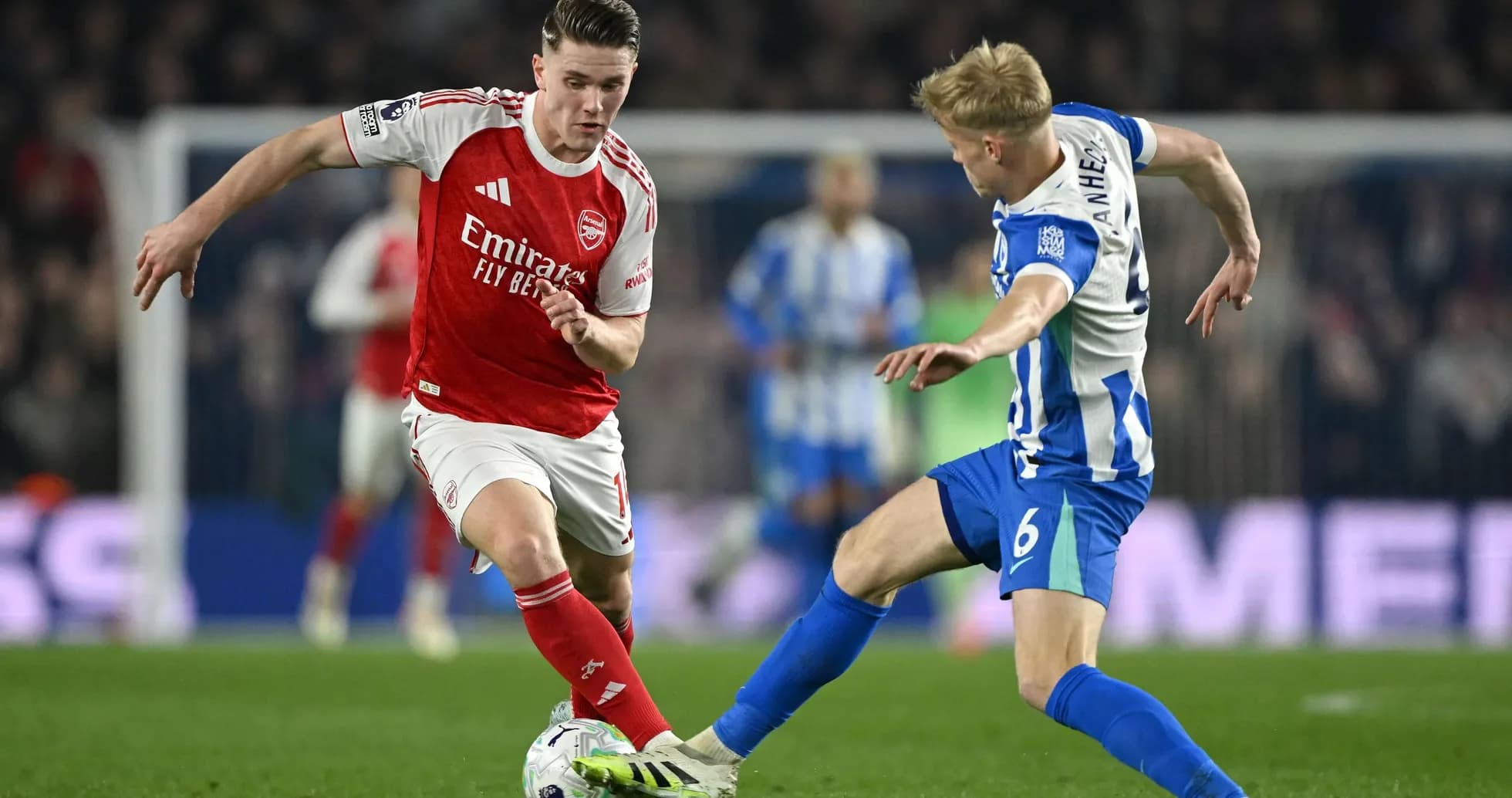
Under the Amex Stadium floodlights on Wednesday night, league leaders Arsenal ground out a 1–0 win over Brighton to preserve first place in the Premier League. Bukayo Saka’s early goal from open play proved decisive in a contest that pitted Brighton’s territorial dominance against Arsenal’s structural control and defensive resilience. Brighton remain 13th on 37 points, their mid-table status unchanged, while Arsenal, on 67 points at the summit, underlined their credentials in a tight title race by winning without ever fully hitting attacking fluency.
First Half Analysis (0–45')
The match’s decisive moment arrived early. On 9', Arsenal sliced through Brighton down the right, with Jurriën Timber advancing from full-back and picking out Bukayo Saka. The winger, finding a pocket of space, finished clinically from open play to give the visitors a 1–0 lead with Arsenal’s first clear sight of goal.
Brighton initially responded with composure, circulating possession from their 4-2-3-1 base and trying to draw Arsenal’s midfield line out of shape. Pascal Groß and Carlos Baleba dropped deep to orchestrate, while Kaoru Mitoma and Jack Hinshelwood looked to attack the half-spaces. Yet, despite their neat combinations, Brighton struggled to turn territory into genuine chances, with Arsenal’s centre-backs Gabriel Magalhães and Cristhian Mosquera largely in control of Georginio Rutter.
On 11', Mosquera collected a yellow card for a foul, a reminder of the physical edge in Arsenal’s defending. Still, the visitors were largely comfortable once ahead, happy to concede possession and protect the central corridor. Brighton’s five blocked shots in the match began with Arsenal bodies repeatedly getting in the way of efforts around the box, a pattern that defined the half. The interval arrived with Arsenal 1–0 up and Brighton yet to truly stretch David Raya despite their share of the ball.
Second Half & Tactical Shifts (46'–90+4')
Brighton made an aggressive change at the restart, with Yankuba Minteh replacing Kaoru Mitoma on 46'. The switch kept the shape intact but added more direct running on the flank, signalling a push to unsettle Arsenal’s back line. The hosts’ intensity spiked briefly, yet frustration soon crept in. Diego Gómez was booked for a foul on 52', the first of a series of cautions that reflected Brighton’s increasingly ragged chase.
Mikel Arteta responded with his own adjustments. On 59', Kai Havertz came on for Viktor Gyökeres, a like-for-like change up front but with a different profile: more link play, more ability to drop into pockets and help Arsenal retain the ball. A minute later, Leandro Trossard replaced Gabriel Martinelli on 60', adding fresh legs and a more possession-friendly outlet on the left. The visitors continued to focus on structural control rather than chasing a second goal, content to slow the tempo.
The defensive reshaping continued on 64' as Riccardo Calafiori replaced the booked Mosquera, shoring up the left side of Arsenal’s central defence. Brighton, by contrast, went for broke. Danny Welbeck came on for Jack Hinshelwood on 69', an attacking gamble that left Pascal Groß and Baleba (soon to be withdrawn) more exposed in midfield. At 77', Joël Veltman replaced Mats Wieffer, and Harry Howell came on for Diego Gómez, followed a minute later by Yasin Ayari for Baleba on 78' as Brighton completely refreshed their central units.
The late stages grew scrappy. Olivier Boscagli was booked for dissent on 80', protesting a decision as Brighton’s frustration boiled over. Arsenal simultaneously tweaked their midfield balance, with Christian Nørgaard replacing Martín Zubimendi on 80' to add fresh defensive energy in front of the back four. Ferdi Kadıoğlu picked up a yellow card for an off-the-ball foul on 82', and deep into stoppage time Yasin Ayari was cautioned on 90+4' for another foul, capping a fraught finale.
Despite Brighton’s late pressure and a flurry of crosses, Arsenal’s back line held firm. Raya was called into only two saves all evening, and the league leaders saw out the final minutes with controlled possession phases and smart game management.
Statistical Deep Dive
The numbers told a story of contrasting approaches. Brighton enjoyed 60% of the ball, completing 385 of 470 passes at 82% accuracy, but much of it was in front of Arsenal’s compact block. Arsenal, with just 40% possession and 226 accurate passes from 322 (70%), focused on structural control, dropping into a disciplined 4-4-2 without the ball and picking their moments to press.
In terms of attacking output, Brighton’s 11 total shots to Arsenal’s 7 suggested initiative, but only 3 of those efforts were on target. Arsenal managed 2 shots on goal from 7 attempts, yet their xG of 0.47 was not far off Brighton’s 0.82, underlining how few clear openings either side created. Brighton’s five shots blocked owed much to Arsenal’s commitment to defending the box, while Arsenal’s single blocked effort reflected Brighton’s attempts to protect the central areas.
Discipline also played a role in the game’s rhythm. Brighton committed 14 fouls to Arsenal’s 12 and collected four yellow cards, including one for dissent and another for an off-the-ball incident, illustrating how their chase for an equaliser spilled over into frustration. Arsenal, by contrast, received just one booking – Mosquera’s early foul – and otherwise managed the contest with relative composure.
Standings & Implications
For Brighton, remaining 13th on 37 points with a goal difference of +2 keeps them in mid-table, but their form line of LWWLL now hints at inconsistency that could yet drag them towards an anxious run-in if not corrected. Arsenal, still top on 67 points with a +37 goal difference and an imposing record of 20 wins from 30, continue to strengthen their grip on first place and their push for Champions League qualification. Winning tight, low-xG away games such as this is precisely the habit that sustains a title challenge.