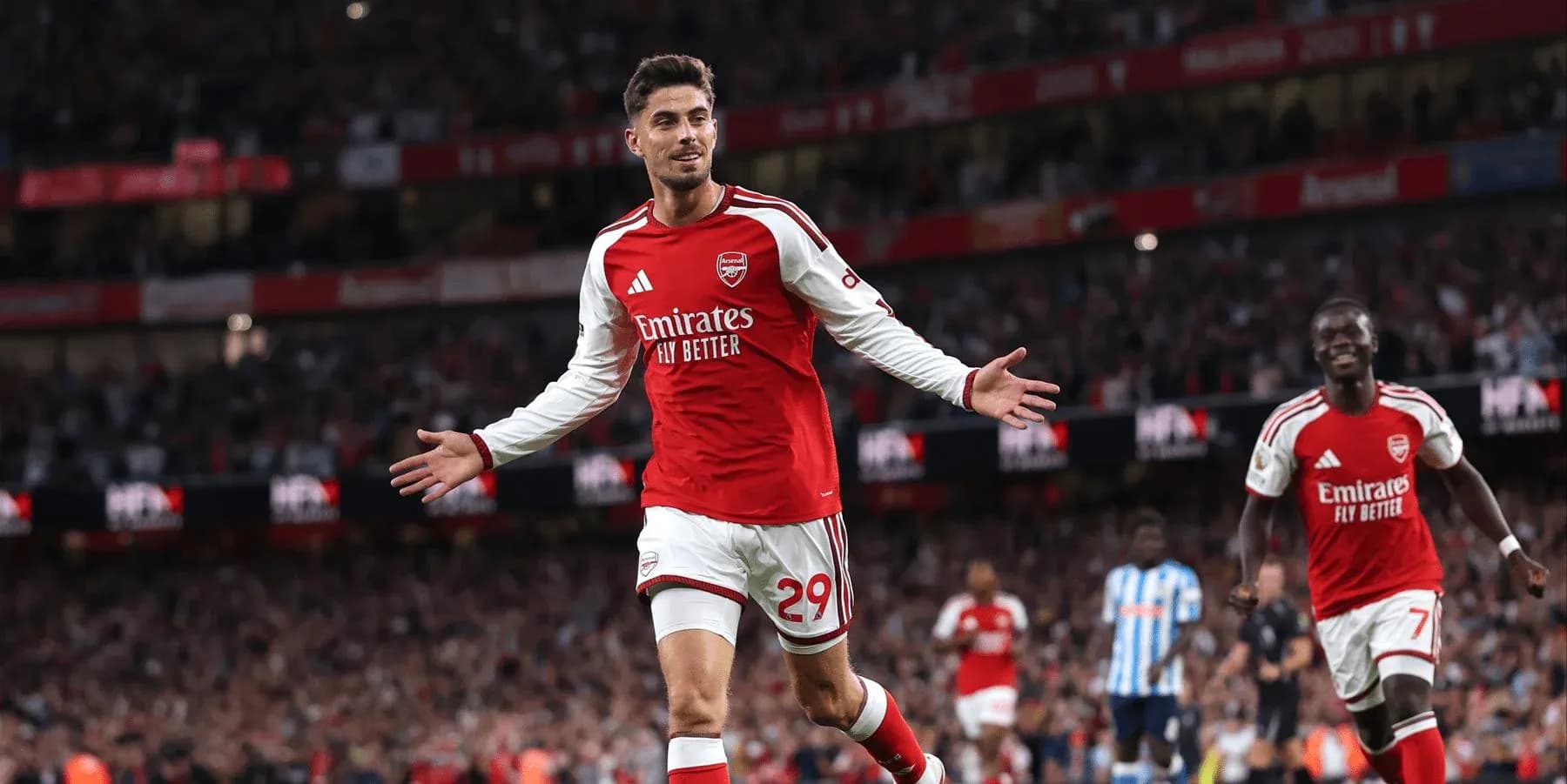
Arsenal's Tactical Mastery in 3-0 Win Over Coventry
Under the Friday night lights at Emirates Stadium, Arsenal opened their 2026 Premier League campaign with a statement: a 3–0 home win over newly promoted Coventry that felt as much like a tactical manifesto as it did a routine victory. Following this result, Arsenal sit 2nd with 3 points and a goal difference of +3 (3 goals scored, 0 conceded), while Coventry find themselves 19th, still searching for their first top-flight goal and carrying a goal difference of -3 (0 scored, 3 conceded).
I. The Big Picture – Arsenal’s new spine, same control
Mikel Arteta stayed loyal to a 4-2-3-1 that already looks finely tuned. David Raya anchored the build-up, with Ben White and Riccardo Calafiori as the full-backs, Gabriel and C. Mosquera forming the central pairing. In front, Declan Rice and M. Lewis-Skelly operated as a double pivot, with Bukayo Saka, Martin Ødegaard and Christos Tzolis supporting Kai Havertz as the lone forward.
Statistically, Arsenal’s early-season identity is clear. At home they have played 1 league match, winning it with a 3-0 scoreline. At home they average 3.0 goals for and 0.0 against; overall the same 3.0 goals scored and 0.0 conceded from 1 match. The minute split of their goals is revealing: one in the 0–15 window (33.33%), another between 16–30 (33.33%), and a third between 46–60 (33.33%). This is a side that starts fast, then reasserts control straight after half-time.
Coventry, under Frank Lampard, lined up in a 4-1-4-1 that was meant to compress the centre and spring forward through E. Simms. C. Rushworth started in goal, behind a back four of M. van Ewijk, B. Thomas, A. Amenda and J. Dasilva. Matt Grimes sat as the single pivot, with L. Tchaouna, C. Yirenkyi, F. Onyeka and B. Thomas-Asante forming the advanced line behind Simms.
On their travels, Coventry have played 1 league match, losing it 3-0. Away they average 0.0 goals for and 3.0 against; overall they mirror that: 0.0 scored, 3.0 conceded from 1 match. Their goals against profile is almost a negative mirror of Arsenal’s strengths: they conceded one goal between 0–15 (33.33%), another between 16–30 (33.33%), and a third between 46–60 (33.33%). The timing overlap is brutal: Arsenal’s offensive peaks are exactly where Coventry’s defensive shell is cracking.
II. Tactical Voids – Injuries and discipline shaping the contest
Arsenal’s clean, controlled performance is even more striking given who was missing. W. Saliba, J. Timber and Bruno Guimaraes were all ruled out with injuries, stripping Arteta of a first-choice centre-back, a versatile defender, and a high-calibre midfielder. In their absence, Mosquera and Lewis-Skelly were thrust into responsibility. The numbers and structure suggest Arsenal insulated them smartly: overall they have yet to concede a goal, and they have 1 clean sheet at home and 1 in total.
Coventry were without L. Woolfenden and H. Wright, robbing Lampard of depth at the back and a muscular attacking option. That lack of defensive continuity was evident in the way Arsenal repeatedly found pockets between Amenda and B. Thomas.
Disciplinary trends also underlined the power dynamics. Arsenal’s season card map shows a single yellow, issued in the 31–45 minute range, accounting for 100.00% of their bookings so far. Gabriel, already among the league’s notable card recipients with 1 yellow, embodies Arsenal’s willingness to defend on the front foot. Coventry’s caution problems flared earlier: their only yellow so far arrived between 16–30 minutes, also 100.00% of their bookings, with Caleb Marfo Yirenkyi committing 2 fouls in 62 minutes. It was a sign of a midfield struggling to get close enough to press without fouling.
No player on either side has yet missed a penalty; both clubs have taken none, with 0 scored and 0 missed in total.
III. Key Matchups – Hunter vs shield, engine room vs resistance
The “Hunter vs Shield” duel belonged to Arsenal’s attacking core against Coventry’s fragile away defence. Saka, Ødegaard and Havertz each scored once, and all three sit among the league’s early top scorers. Saka needed only 1 shot on target to find the net, adding 2 key passes and 1 successful dribble. Ødegaard orchestrated with 56 passes at 92% accuracy and 3 key passes, while Havertz provided the focal point, winning 5 of 10 duels and finishing his sole effort.
Behind them, Calafiori and White quietly shaped the game. Calafiori, already among the top assist providers with 1 assist, used his 24 passes (83% accuracy) and 1 key pass to step into midfield and overload Coventry’s right. White, also on 1 assist, completed 78 passes at 94% accuracy and added 2 key passes, repeatedly pinning Coventry back with high positioning and secure recycling.
For Coventry, the “Shield” was overstretched. Away from home they have conceded 3.0 goals per game, and overall their defensive minute distribution shows a consistent vulnerability in the opening half hour and just after the restart. Grimes, as the single pivot in the 4-1-4-1, was asked to screen an area too wide for one man, especially with Yirenkyi and Onyeka being dragged towards Ødegaard and Rice. Simms, isolated up front, rarely had the platform to threaten a back line that has not yet been breached this season.
In the “Engine Room” battle, Rice and Lewis-Skelly outmanoeuvred Grimes and Onyeka. Arsenal’s overall figures – 0.0 goals conceded, 1 clean sheet in total, and no match yet where they have failed to score – underline how secure that base looked. Coventry, by contrast, have already failed to score once overall, and their central lanes looked stretched every time Arsenal broke the first line of pressure.
IV. Statistical Prognosis – What this result tells us going forward
Following this result, Arsenal’s early-season metrics are the profile of a contender: 1 win from 1, 3 goals scored, none conceded, and an attacking pattern that reliably strikes in the first 30 minutes and just after half-time. Their preferred 4-2-3-1 has been used in all their league matches so far, and the synergy between Saka, Ødegaard, Havertz and the advancing full-backs suggests that this structure will remain the foundation.
Coventry, meanwhile, have a clear problem to solve. On their travels they concede an average of 3.0 goals while scoring 0.0, and overall they have yet to register a goal or a clean sheet. The overlap between when they concede and when Arsenal (and likely other top sides) are strongest is a tactical red flag: the 4-1-4-1 must either become more compact in the opening phases or be reshaped entirely against elite opposition.
From an xG-style perspective, even without explicit figures, all directional indicators point one way: Arsenal are creating high-quality chances early and managing games from a position of control, while Coventry are allowing too many dangerous moments in precisely those windows. If these patterns persist, Arsenal’s trajectory is towards the upper reaches of the table and a sustained Champions League push, while Coventry’s immediate battle will be to tighten their away structure to avoid the relegation fight their current 19th place and -3 goal difference already foreshadow.