
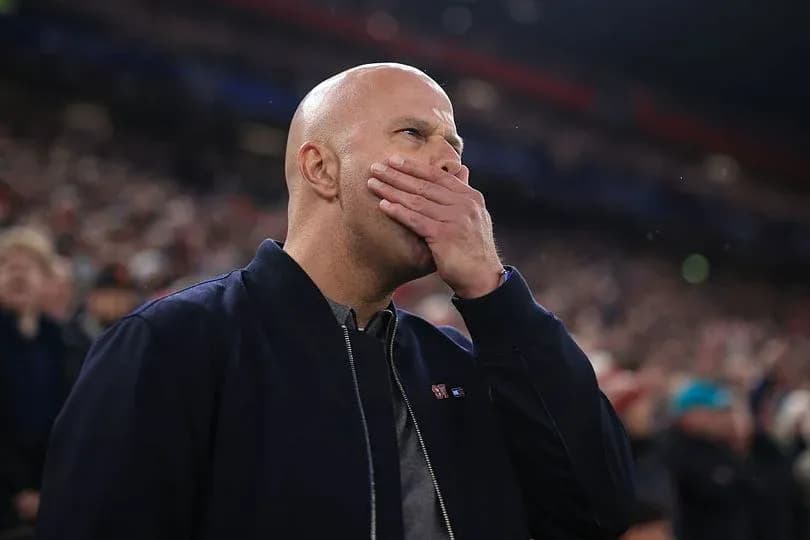
Arne Slot’s Season of Excuses: Liverpool’s Year of Discontent
The numbers should have told a different story. Over £450 million poured into a squad refresh, a new era under Arne Slot, a fanbase primed for lift-off after the Jurgen Klopp years.
Instead, the 2025-26 campaign has sagged under the weight of missed targets and meandering explanations. Liverpool have crashed out of the Champions League and drifted away from a meaningful top-four fight in the Premier League, and as the results have turned, Slot’s post-match rhetoric has become a running theme of its own.
One subject he has refused to lean on is the sudden preseason death of Diogo Jota.
“The last thing I would do is use it as an excuse,” he said in November.
On that point, he has stayed firm. On almost everything else, he has reached for a reason, a caveat, a mitigating factor — echoing, at times, the more notorious passages of the Klopp playbook.
What follows is a snapshot of a season told through its defeats and the explanations that followed.
No. 4: Brentford 3-2 Liverpool – October, and the “unchanged” jibe
The tone was set even before a ball was kicked at Brentford.
Liverpool had just lost 2-1 to Manchester United, and Slot bristled at what he saw as opponents changing shape and selection specifically for his side.
“We’ve seen Sesko play the last three, four, five or six times, but they go to Liverpool and they change the line-up,” he said. “That’s not the first time we’ve faced a team, and they’ve done that.”
The implication was clear: rivals were treating Liverpool as a special case, ripping up their own plans to stifle his team.
Brentford’s response came not at the microphone, but on the pitch — and then on social media. They beat Liverpool 3-2, punishing a brittle defence and exposing the fragility of a side already on a four-match losing streak. Afterward, the London club twisted the knife with a pointed post:
“Must have been that unchanged team then.”
Slot, though, stuck to his theme. He called the penalty Liverpool conceded “soft,” lamented a schedule that had sent his team on the road for five of six fixtures, and returned to the upheaval of the summer as a key factor.
“It definitely (our form) also has to do with if you change quite a lot in the summer. I think it’s not a surprise that it can go a bit like this,” he said, trying to frame the slump as a natural byproduct of transition rather than a collapse in performance.
The message: too many changes, too many away days, too many marginal calls going against them. The league table, though, refused to sympathise.
No. 3: Crystal Palace 3-0 Liverpool – Cup rotation and the Guardiola reference
When Liverpool went out of the League Cup with a 3-0 defeat at Crystal Palace in October, the selection sheet told its own story. Slot had rolled the dice with a near-fully changed XI, trusting the depth that £450 million ought to buy.
The gamble failed. Palace tore through a disjointed side, and the exit raised obvious questions. Had he taken the competition too lightly? Was this rotation or recklessness?
Slot’s defence reached for the gold standard: Pep Guardiola.
“I saw [Manchester] City’s line-up, and I don’t think they had one starter from the weekend, but it felt as if – if you look at their line-up – that they had played with their 11 starters,” he said.
The point was that City, heavily rotated themselves, still looked like City. Liverpool, heavily rotated, looked anything but Liverpool.
Guardiola had trusted youth as well — 18-year-old Divine Mukasa started in midfield for City — yet his side advanced. Slot used that comparison to argue that his own approach was not inherently flawed, just not yet underpinned by the same cohesion or depth of understanding.
The problem for him is that supporters rarely accept theory when the scoreboard reads 3-0 against Crystal Palace.
No. 2: Manchester City 4-0 Liverpool – April, xG and a brutal reality
By April, Liverpool’s season needed a statement. Instead, they walked into an FA Cup hammering at the hands of Manchester City, losing 4-0 away to Guardiola’s side.
Slot’s post-match focus turned to numbers, specifically expected goals.
“Again, we are facing a team that outperformed their xG by a mile, and that is happening constantly,” he said.
On this occasion, the figures backed him up. City scored four times from 1.97 xG, ruthlessly efficient in front of goal. Yet the broader pattern of the campaign complicated the narrative.
The week before, Liverpool had lost 2-1 to Brighton. The Seagulls created 2.17 xG, a tally that suggested their win was no freak event. Go back three weeks and Liverpool themselves had smashed West Ham 5-2, scoring five goals from just 1.84 xG, while the Hammers produced 1.86 xG and found the net twice.
Sometimes Liverpool were on the right side of the numbers, sometimes on the wrong side. Slot chose to highlight the days when variance hurt him, less so the afternoons when it smiled.
It painted a picture of a coach trying to wrestle control of a season through data, even as the emotional reality for fans was simpler: City had thrashed Liverpool, again, on a big stage.
No. 1: Bournemouth 3-2 Liverpool – January, fatigue, xG, and the wind
If there was a single match that crystallised the frustration, it came at Bournemouth in January.
Liverpool lost 3-2, outshot and outplayed to the tune of a 0.83-2.30 xG deficit. This was not a smash-and-grab; the numbers and the eye test agreed. Bournemouth deserved it.
Slot still found explanations.
“It is safe to say a few players of ours ran out of energy. I cannot criticize them for that because two days ago we played an away game in Europe,” he said.
The schedule again. The toll of Europe. The limits of the human body. All valid concerns, but ones that offered little comfort to a travelling support watching their team wilt on the south coast.
Then came the most eye-catching line of all, as he moved to shield Virgil van Dijk from criticism over the first goal.
“It is not completely fair to Virgil to blame him for the first goal,” Slot said. “You can see throughout the game how much impact the wind had. He wasn’t the only one who struggled with the wind."
Fatigue, fixtures, xG, officiating, opposition line-ups, the wind. Over the course of a season, Slot has reached for almost every lever available to explain why Liverpool have fallen so far short of expectation — all while steadfastly refusing to cite the most profound tragedy of the campaign in Jota’s death.
It leaves a stark question hanging over Anfield: when the excuses run out, what does the reset really look like for Arne Slot and a club that spent like contenders but played like something far less?



