Andrew Robertson on Trent Alexander-Arnold's Defensive Role at Liverpool
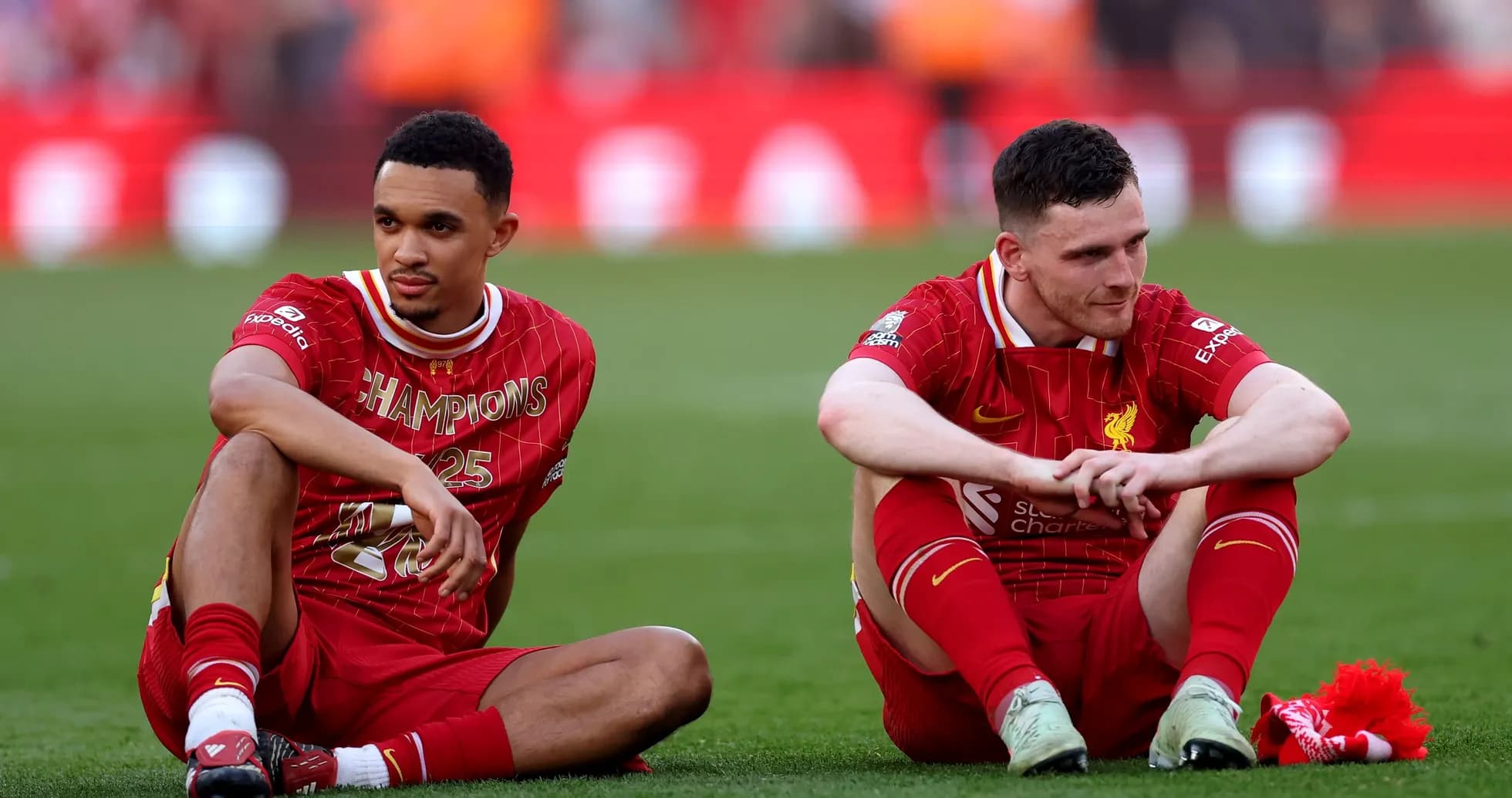
Andrew Robertson has lifted the lid on the defensive demands that came with Liverpool’s celebrated full-back pairing – and why he always felt Trent Alexander-Arnold took the heaviest hits.
Under Jurgen Klopp, the two carved out a reputation as the most destructive full-back duo in Europe. A Champions League in 2019, a Premier League title in 2020, and season after season near the top of the assist charts. They were Liverpool’s creative engines, flinging crosses and switches of play that defined an era at Anfield.
But behind the numbers, Robertson insists, the job description on each flank could not have been more different.
‘I started to feel sorry for him’
Speaking on The Overlap, the current Tottenham defender explained how Liverpool’s structure left Alexander-Arnold repeatedly exposed on the right, while he enjoyed a more robust shield on the left.
“The way I defended at Liverpool compared to Trent was very different,” Robertson said. “I had Sadio helping me out and he was a bit more aggressive so if I missed [a tackle], he’d usually be there.”
On the opposite side, the brief for Mohamed Salah was clear: stay high, stay dangerous.
“With Mo [Salah], we didn’t want him coming back towards our box,” Robertson explained. That attacking licence came at a cost. When Liverpool lost the ball, Alexander-Arnold often stood alone, waiting for midfield help that could not always arrive in time.
“A lot of times, Trent was waiting on someone like [Jordan Henderson] to come over, so, sometimes, I started to feel sorry for him.”
That tactical reality clashed brutally with the narrative. Every mistake, every clipped highlight of a winger going past him, fed into a simple label: Trent can’t defend.
English spotlight, different standards
Robertson believes that label stuck quicker and cut deeper because of Alexander-Arnold’s passport.
“It’s very different when you are English, compared to another nationality,” the Scotland international said. “I always said to Trent, ‘I will never get as much high praise as you, but I’ll never get as much criticism as you.’”
While both full-backs poured forward, their reputations diverged. Robertson, the relentless Scot, was framed as the dependable defender. Alexander-Arnold, the local lad from West Derby, became the risk-taker whose flaws were replayed and dissected.
For Robertson, that has always been a distortion of the full picture.
Locking down Europe’s elite
The criticism jarred most when stacked against Alexander-Arnold’s performances on the biggest stages. During Liverpool’s run to the 2018 Champions League final, he produced a series of commanding defensive displays, handling some of Europe’s most dangerous wide forwards.
“I’ve seen him lock out [Kylian] Mbappe at PSG. In the Champions League finals, he was unbelievable,” Robertson said. “Trent is a very, very good defender… [in his] best games, he was an unbelievable one-v-one defender.”
That is the version of Alexander-Arnold his former teammate remembers: not the meme, not the social-media clip, but the right-back who could shut down world-class opponents and still dictate a game with the ball.
Yet the stigma never really left.
“Now, at times, he maybe makes mistakes. But we all do,” Robertson added. “But it’s if [Trent] had this stigma around him, that he can’t defend. And he’s had that from a very early age. It’s as if he can’t shift it.”
A career at a crossroads
Alexander-Arnold’s journey has moved on from Anfield, but the debate trails him. His 2025 move to Real Madrid was supposed to be the next step in a glittering career. Instead, his La Liga spell has stuttered, his place in the starting XI no longer guaranteed, his long-term future in the Spanish capital uncertain.
At 27, he stands at a delicate point. The talent that once redefined the modern full-back is not in question. The form, and the role, are.
For now, his attention swings back to the international stage. Called up to Thomas Tuchel’s latest England squad, he walks into yet another camp where nothing is guaranteed. Under previous managers, he struggled to nail down a regular starting spot for the Three Lions. A new coach brings a new system, a new judgment, and perhaps one last chance to rewrite a story that has always felt skewed.
If Tuchel finds the right balance and Real Madrid rediscover the best version of him, the conversation around Trent Alexander-Arnold could finally change. The question is whether the game will allow him to be seen for what he is, rather than the stigma he has carried since his breakthrough.