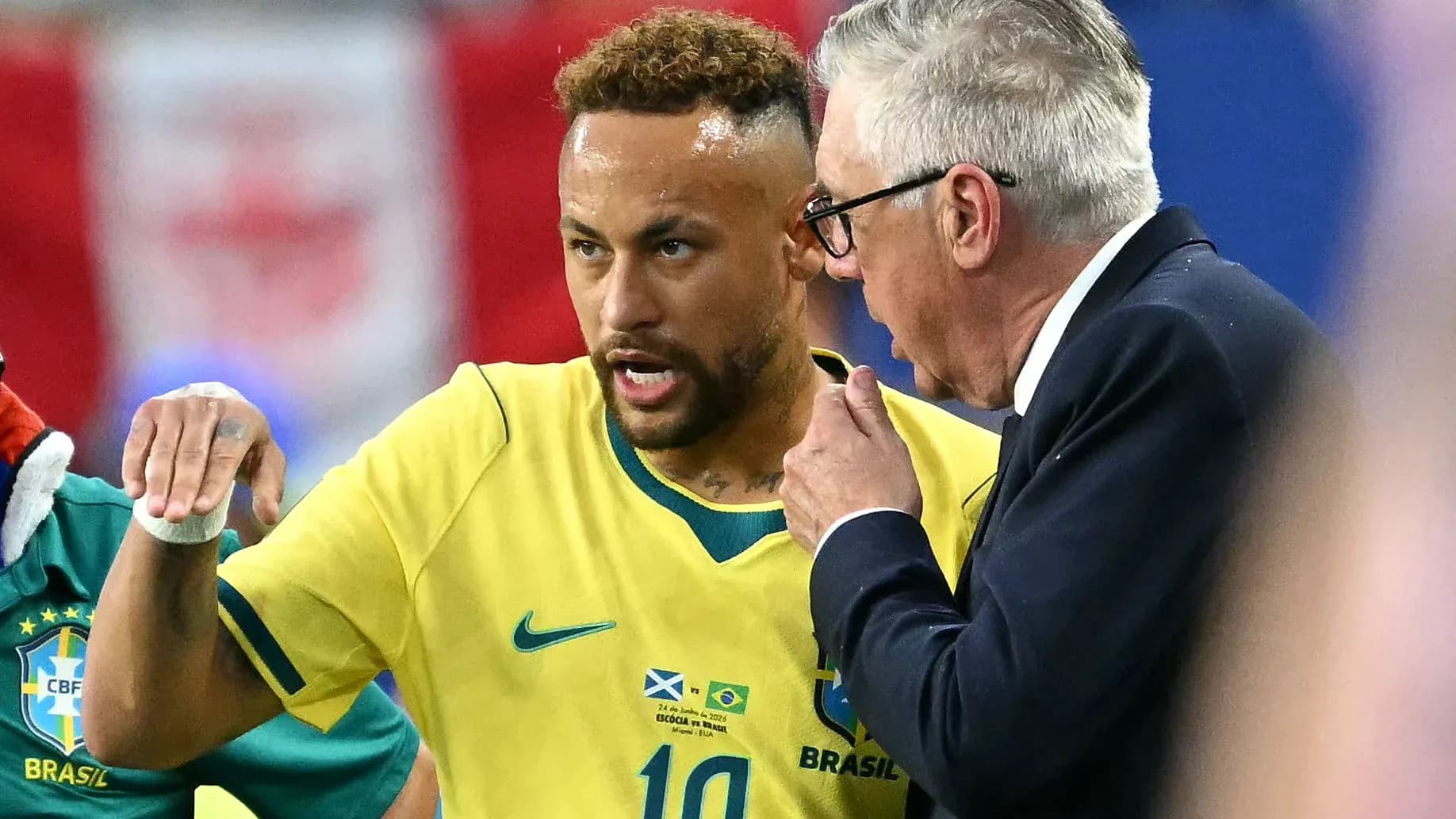
Ancelotti's Bold Vision for Brazil's Future
Carlo Ancelotti has never been afraid of big decisions or big statements. This time, both revolve around Neymar – and a Brazil side he believes must finally cut the cord with its past.
The Italian coach laid bare the dilemma that defined his use of the No.10: a superstar name strapped to a body that never truly caught up with the demands of the tournament. A grade 2 calf strain kept Neymar out of the opening group games against Morocco and Haiti, and in Ancelotti’s eyes, that absence shaped everything that followed.
“I think he didn’t contribute on a technical level as it was hoped he could, because he couldn’t,” Ancelotti told ESPN. The words were blunt, but not cold. He quickly drew a line between what Neymar could not do with the ball and what he did offer in the dressing room. “In terms of attitude, it was a very positive attitude. I have a lot of affection for him, I thanked him for his attitude, for his behavior, and I think it was the right decision to include him on the 26-man roster.”
The message was clear: the decision to take Neymar was about more than minutes on the pitch. Yet the coach did not hide his frustration at how those minutes were delayed.
The only thing that really stung him? Preparation.
“The only thing that bothered me is that Neymar could have prepared himself better during that lead-up period,” Ancelotti admitted. “He could have been ready for game one instead of game four. That was the only disappointing part.”
Those lines cut to the heart of a long-running tension around Neymar’s international career: the balance between his immense talent and the physical reliability required at the very top level. This time, in Ancelotti’s view, Brazil paid for that imbalance.
Now, with Neymar stepping away from the international scene, Ancelotti is not talking about tweaks. He is talking about a reset.
A Total Rebuild for 2030
The Brazilian bench is no longer anchored by the icons of the 2010s. Ancelotti is openly planning for a different kind of Brazil, one that will arrive at the 2030 World Cup shaped by a new generation rather than built around the old one.
“I think that players like Neymar, who already commented yesterday, and with all due respect to his decision. I believe that in history, one generation ends and another has to come, and it has to be better than the last one,” the former Real Madrid boss said.
That is not just a farewell speech. It is a manifesto. Ancelotti is effectively drawing a line under an era defined by Neymar and his contemporaries, insisting that the next wave must not merely replace them but surpass them.
And Neymar will not be the only high-profile casualty of this shift.
End of the Road for Brazil’s Old Guard?
When the conversation turned to Casemiro, Danilo, and Alex Sandro, Ancelotti did not reach for polite evasions. He answered like a man who has already started to redraw his depth charts.
“I think so. It is a period that is coming to an end. Obviously, we have to thank all of them, and I have a lot of affection for all of them. But I think the idea that a player over 30 is done means that we have to think about the future.... Some of these players will be there, obviously. Marquinhos, for example. Alisson, we’ll see.”
The nuance matters. This is not a blanket purge of anyone born before 1995. Marquinhos is clearly seen as part of the bridge between eras. Alisson’s future, Ancelotti suggests, will be judged on form and fitness rather than age alone.
Still, the tone is unmistakable. The core that carried Brazil through the last decade is being gently, but firmly, moved aside. Gratitude, yes. Sentimentality, no.
Ancelotti has put it in simple terms: one generation has ended. The only question now is whether the next one really can be better than the last.