Amani’s Rise: From Dougbafla to Bayern Munich Glory
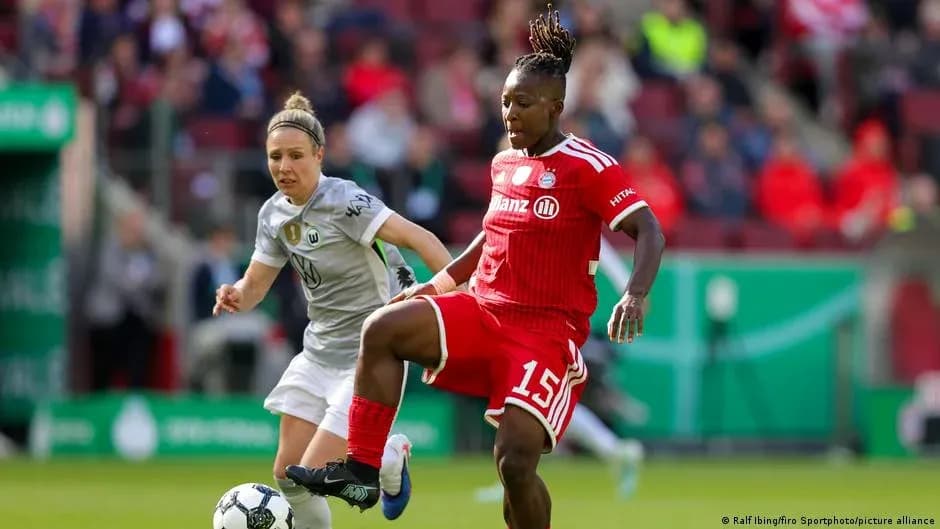
Seven months in Germany. Two trophies in the bag. Bernadette Amani has not just arrived at Bayern Munich — she has planted a flag.
The 28-year-old midfielder capped her first half-season in Bavaria with a Bundesliga title and a German Cup triumph, the kind of instant impact that turns a move into a statement. For her, this is not a stop on the way. This is the dream.
"It's a dream come true for me to be here, and I'm living my dream to the full," she told DW shortly before the Women's Africa Cup of Nations kicked off in Morocco.
Bayern, she knows, is a different universe.
"Munich is a very, very big club. Beyond just making me happy, it's a real achievement, a dream come true to be here, to play for such a prestigious club."
A Different Level in Munich
Amani arrived from CD Tenerife Femenino in Liga F, already a professional, already hardened by Spanish football. Yet the step to Bayern has redrawn her idea of what elite really looks like.
"I was already professional when I was in Spain, but let's just say it wasn't quite the same level of professionalism," she said.
In Spain or Ivory Coast, she was used to lean backroom staffs, five or six people at most. At Bayern, the cast list is longer, the margins finer.
"Here there are eight or 10 people. And that enables them (the players) to perform at that high level for a long time."
The structure around her, the depth of expertise, the standard of teammates — all of it drags a player upwards or exposes them. There is no middle ground.
"I've learned a great deal about aspects I wasn't already aware of; how to position myself, how to position my body, how to interact with the ball and how to think. Really understanding the game is something I'm gradually learning alongside (the players) and the coaching staff."
At Bayern, talent is a starting point, not a destination. And Amani knows it.
"Someone on the outside will say to you: 'You've put in the effort, you've made it to Bayern, a club that wins titles, that's professional and renowned all over the world,'" she said.
"But someone who's involved in football will tell you that's where the hard part begins. Staying there is even better. And it's hard not to let your guard down."
A Village Girl Who Wasn’t Supposed to Be a Footballer
None of this was mapped out when Amani first chased a ball around dusty pitches in Dougbafla, playing with the boys and playing against expectations.
Back then, football was not a career path; it was a distraction. Her parents made that clear. Education came first. So she left the village for Abidjan, the capital, to study — a move meant to pull her away from football, not fling her into its heart.
Instead, Abidjan opened her eyes.
"I discovered the women's football league. I went to a match and, as luck would have it, it was the top team against the second-placed team," she recalled.
On that day in 2019, the game in front of her looked nothing like the informal kickabouts of her childhood. The intensity struck her. The technique, too. Then she heard the stories.
"I saw the intensity, I saw the technique, and then I heard that so-and-so isn't here today because she's playing in Serbia, another isn't here today because she's playing in Turkey. And that was a real eye-opener for me; it made me realize that I could make a living from what I love."
One of the teams on the pitch, Onze Soeurs de Gagnoa, invited her for a trial. She went. She made it. The climb began.
Within a year, Amani had left Ivory Coast for Spain’s third tier. Five years later, she was in Liga F with Eibar. Then Tenerife. Each move a rung higher, each season a test of whether she belonged at the next level. Bayern, she says, is "the top." She treats it as a summit that demands constant proof, not a place to relax.
Captain of a Returning Force
For now, though, the red of Bayern gives way to the orange of Ivory Coast. Amani has swapped club glory for national responsibility, leading her country at WAFCON 2026 as captain of the Lady Elephants.
Ivory Coast are back at the Women’s Africa Cup of Nations after 12 years away, one of four late additions when the tournament expanded from 12 to 16 teams. The return brings pressure and a clear benchmark.
"The target that has been set for us is, of course, to do no worse than we did at the last Africa Cup of Nations we took part in — that is, to finish third," she said.
This is not the same Ivory Coast that last graced the tournament. More players now ply their trade in Europe’s top leagues, including Amani herself. Yet the squad is also raw.
Almost half of the group are about to taste WAFCON for the first time. Experience and inexperience sit side by side. Amani does not hide the challenge, but she does not shrink from it either.
"We're going to focus on our own game, and we know that we've got qualities that could give (our opponents) a run for their money," she said.
On Monday in Casablanca, those qualities burst into view. Ivory Coast swept past Burkina Faso 4-1 in their opening match, a commanding win that put them top of Group B and injected early belief into a returning force.
The real measure comes next.
On Friday, they face South Africa, ranked second on the continent. On paper, it is the group’s heavyweight clash. In reality, it arrives with a twist: South Africa were stunned 2-1 by Tanzania in their opener, a result that rattled the hierarchy and sharpened the stakes.
For Amani, it is the kind of test that mirrors her own journey — step up, or step aside.
From Dougbafla to Abidjan, from Spain’s lower leagues to Bayern’s title parades, she has made a habit of choosing the first option. Now, with the captain’s armband on her sleeve and a continent watching, the question is no longer whether she belongs at the top.
It is how far she can drag a nation with her.