Africa’s Final Without a Champion: Senegal’s Fury and CAF’s Crisis
Seventy-seven days after the final whistle, Africa still has no champion. Just a trail of accusations, legal battles, and a governing body under fire from every direction.
According to Spanish newspaper AS, the fracture began long before kick-off. Senegal arrived in Morocco expecting a showpiece final. They felt a trap instead.
Their delegation, the “Lions of Teranga”, was first housed in a luxury hotel in Tangier. Then came an abrupt move to the Al-Rihab complex, a venue not even on CAF’s official list of approved accommodation. For a team chasing a continental title, it felt like a demotion.
Senegal lodged an official protest. CAF responded with a compromise: the Amfitrit Hotel on the outskirts of Rabat. Technically an upgrade from Al-Rihab, but still not what the Senegalese considered worthy of a major final. The damage to trust had already started.
A Training Ground That Raised Alarms
The unease deepened when Senegal learned where they would train.
CAF allocated the Mohammed VI Sports Complex for their sessions – the same facility used by the Moroccan national team as their base. On paper, a world-class venue. In practice, a flashpoint.
Senegal saw it as a breach of competitive balance. Sharing a training site with the host nation’s team, in the build-up to a final against that very country, felt like a loaded decision. Officials within the Senegalese camp feared their sessions could be monitored, their tactical work compromised, their plans leaked.
Those suspicions fed into a wider narrative. They no longer believed they were walking into a neutral contest.
Tickets, Security, and a Public Warning
The off-field friction didn’t stop there.
When Senegal arrived in Rabat, they complained of chaotic organisation, security shortcomings and what they labelled an “unfair distribution” of match tickets. Their fans, they argued, were being squeezed out of the stadium on the biggest night.
Hours before the final, Senegal went public. They warned of “irregularities” around the event. It was a rare, open challenge to CAF’s handling of its own showpiece. By then, the atmosphere around the game had turned toxic.
Then came the night itself.
Chaos at Moulay Abdallah Stadium
The final at Moulay Abdallah Stadium did not simply unravel. It exploded.
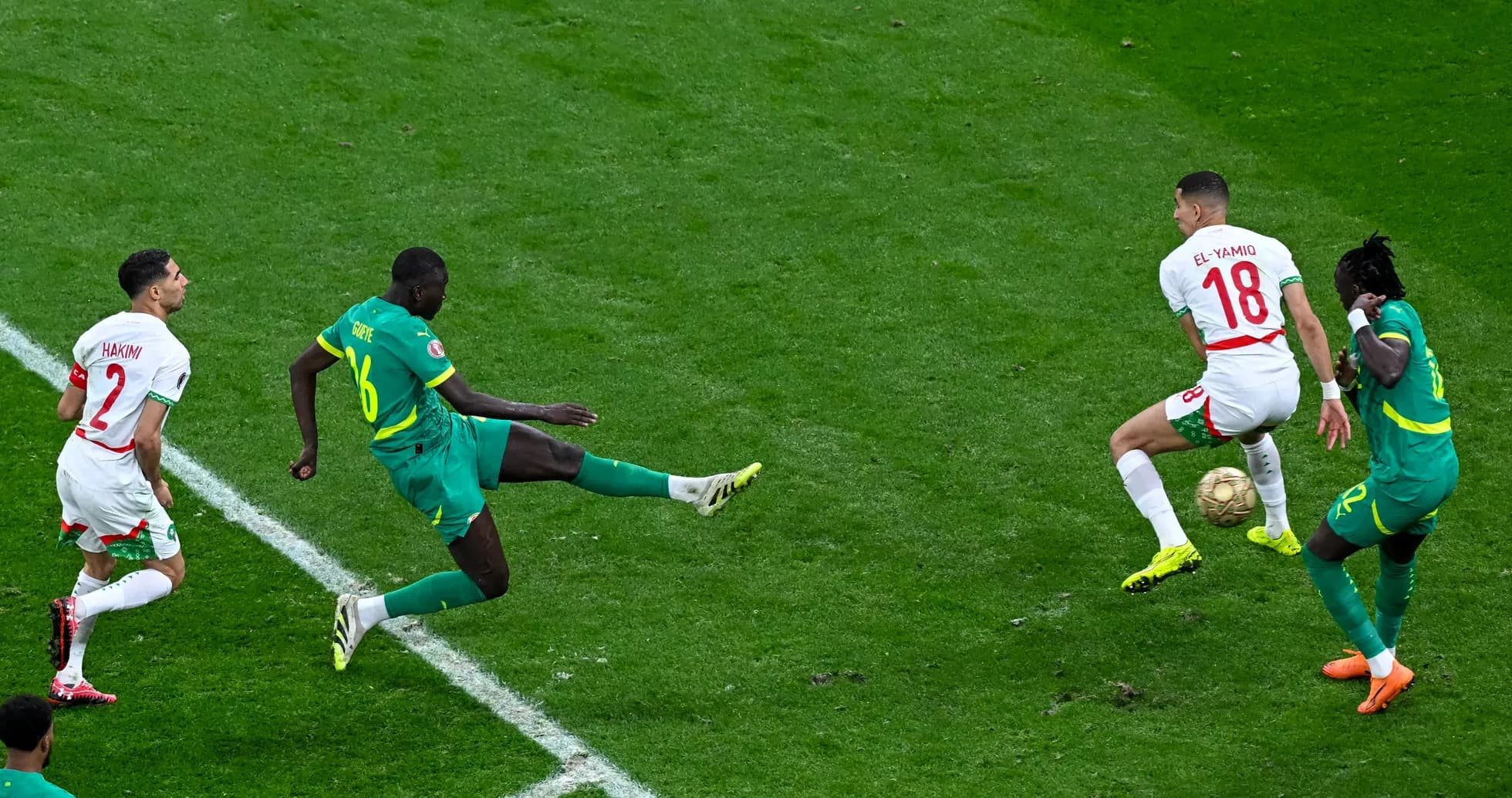
A controversial Senegalese goal was ruled out, triggering anger on the touchline and in the stands. Not long after, Morocco received a penalty. The decision ignited fierce protests from the Senegalese players and staff, who felt the officiating had crossed from incompetence into something more sinister.
The pressure boiled over. In a dramatic act of defiance, the entire Senegal squad walked off the pitch in protest, denouncing what they called “blatant refereeing injustice”. For a few surreal moments, the final stood on the brink of collapse.
When play eventually resumed, the spotlight shifted back to the penalty spot. Ibrahim Diaz attempted a Panenka-style effort, a bold, almost mocking gesture in such a charged setting. He missed. The gamble failed.
Senegal regrouped, tightened up, and dragged the match into extra time. There, with a clean sheet preserved, they found the winner. On the grass, in pure football terms, they had done enough. They left the field believing they were champions.
Morocco saw something very different.
A Walkout, a 3–0, and a Legal War
From the Moroccan perspective, Senegal’s mass walk-off was not a protest. It was a withdrawal. Under that interpretation, the result should be clear: a 3–0 victory awarded to Morocco.
CAF initially sided with that reading. The Confederation treated the walkout as an official abandonment, backing Morocco’s claim to a 3–0 win. For Senegal, who had returned to the pitch and then won in extra time, it was an astonishing reversal.
They took the fight to the Court of Arbitration for Sport (CAS). The legal battle began.
CAS eventually overturned CAF’s initial decision, blowing the case wide open again and leaving the title in limbo. No confirmed champion. No closure.
“Institutional Instructions” and a Refereeing Storm
While the lawyers argued, AS uncovered explosive details from inside CAF itself.
At an Executive Committee meeting in Dar es Salaam on 13 February, the head of the Referees’ Committee, Olivier Safary, made a remarkable admission. He stated that the referee in the final had received “institutional instructions” not to send off any Senegalese players during the period when the match was suspended.
The logic, according to that account, was simple: keep the game alive at all costs.
That revelation detonated inside CAF. If true, it suggested direct interference in refereeing decisions from within the organisation’s own structures. The referee, rather than applying the laws in isolation, had been guided to preserve the spectacle.
For a body already under scrutiny, it was a damaging look. For Senegal and Morocco, it added another layer of mistrust to a night already dripping with controversy.
A “Disastrous” Appeal and Conflict of Interest Claims
The courtroom battles brought their own drama.
At a press conference in Paris on 26 March, lawyers representing the Senegalese Football Federation did not hold back. They described the appeal hearing before CAS as “disastrous”, claiming the judge seemed to have made up his mind before arguments even began.
Senegal also attacked the integrity of CAF’s internal process. They highlighted the involvement of lawyer Moez Nasri in the Appeals Committee. Nasri is not just a legal figure; he also serves as president of the Tunisian Football Federation.
For Senegal, that dual role was indefensible. They called it a “clear conflict between his role as a judge and that of a party to the competition”. Even CAF President Patrice Motsepe, according to these accounts, expressed surprise at Nasri’s presence on the committee.
When the president of the confederation is taken aback by who sits in judgment, the questions practically ask themselves.
A Continent Waiting for a Champion
And so the stalemate endures.
Seventy-seven days on, the African continent has no official winner of its showpiece final. Senegal insists it won where it matters most – on the pitch, in extra time, with the score settled by football. Morocco stands by the rulebook and the initial administrative ruling, arguing that the law awards it the title after Senegal’s walkout.
CAF, caught between both, faces accusations of “mismanagement” and a “lack of transparency” from each side. The governing body has managed the rare feat of leaving both finalists furious.
The match is over. The arguments are not. The question now is stark: when the dust finally settles, will African football trust the verdict that emerges?