
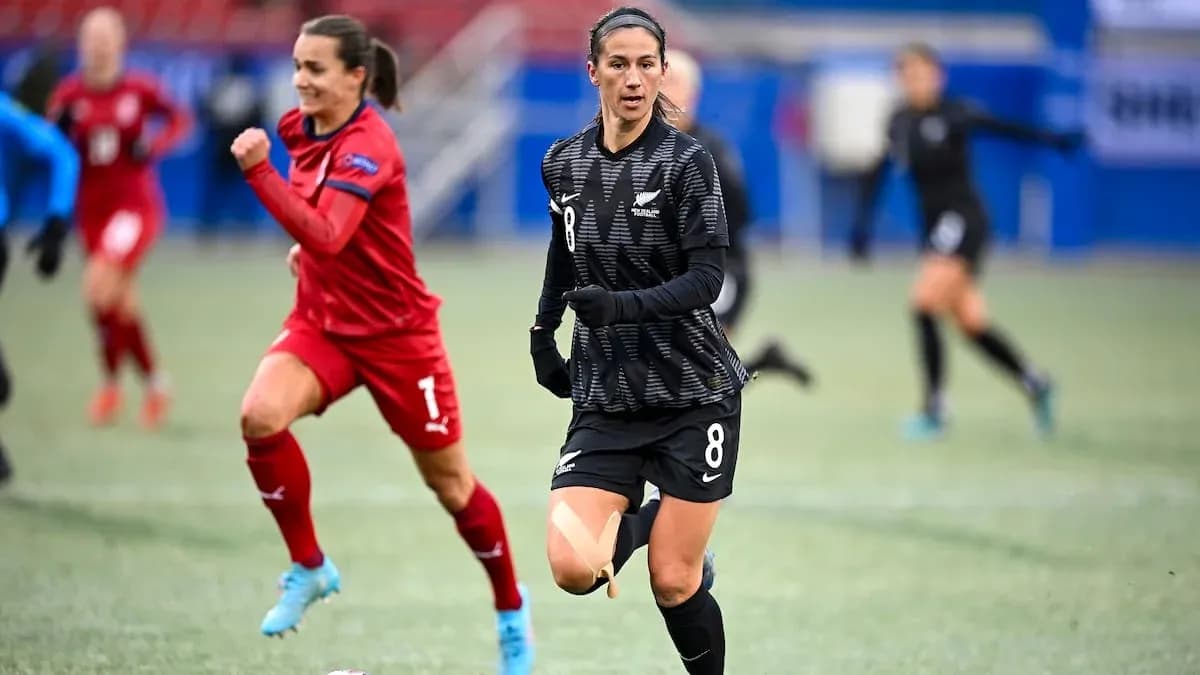
Abby Erceg: Choosing the Harder Path in Women's Football
Abby Erceg has never been one to take the easy road.
While a home World Cup lit up New Zealand last year, the country’s most decorated Football Fern watched from afar, having turned down what many players spend their entire careers chasing.
“It was a really tough decision,” Erceg said. “That’s the dream, isn’t it? You want to play a World Cup at home and it would have been towards the end of my international career as well, so kind of a perfect send-off. But it just didn’t sit right with me personally and professionally.”
She sat with it for a “long, long time”, weighing up the lure of a farewell on home soil against a nagging sense that she would be betraying herself if she went through with it.
“So I just had to put that first, rather than just doing something where my heart was never going to be in it,” she said. “I didn’t think that was fair to the group or to myself to do something like that.”
Some would call that brave. Erceg isn’t so sure.
“It was brave in the sense that you have to go through with it, yes,” she admitted. “A lot of people would think, it’s a World Cup, you have to represent your country. But people also forget that I was in one of the best club environments in the world at North Carolina.
“We were so successful and it was very difficult to leave that environment, and go into an environment that I didn’t feel ... was serving me as a player. I had to make that decision for my career, in that way.”
The Ferns’ campaign only sharpened the what‑ifs. They stunned Norway 1-0 in the opening game, igniting a nation, then failed to build on it, taking just a single point from their remaining matches against the Philippines (0-1) and Switzerland (0-0). With Erceg’s experience and authority at the back, it’s hard not to wonder how different those tight margins might have been.
This is hardly the first time she has stepped away on principle. Erceg previously retired in 2017 and again in 2018, frustrated by what she saw as New Zealand Football’s lack of support and resources for the women’s game. She returned in time for the 2019 Women’s World Cup, but by then her reputation was sealed: a captain prepared to challenge the system as fiercely as any opponent.
For all the turbulence, her legacy is immense. Three World Cups. Three Olympics. The first Football Fern to reach 100 caps, finishing on 146 appearances, 49 of them as captain. On the club stage, she anchored title‑winning sides in the National Women’s Soccer League, lifting championships in 2016 with Western New York Flash and in 2018 and 2019 with North Carolina Courage.
After 12 years in the United States, she took a sharp turn south, signing for Toluca in Mexico. It proved a revelation.
“It was phenomenal,” she said. “The culture, the food, the people, the football, the excitement around it. Such an incredible country.”
Now 36, Erceg stands at another crossroads. Offers are on the table, but the decision this time is not just about football.
“There are offers from everywhere,” she said. “In New Zealand, the A League, back in Mexico and clubs in America. But you get to that point in your career where family does become important.
“I’ve missed a lot of my family’s life. I’ve missed a lot of my nephews’ lives. So you do have to start taking those things into consideration.”
Before any long-term call, though, comes a short, sharp test: Chelsea. Eight-time English champions, one of the true powerhouses of the women’s club game, landing in New Zealand to face a scratch side that has had only weeks together.
“It’s going to be a challenge – and that’s a polite word,” Erceg said.
“It’s going to be a real education for a lot of people about where New Zealand football sits because we are playing one of the best female club teams in the world.
“We don’t have a lot of preparation so our work is going to be cut out for us. But at the same time, it’s good to have such a high calibre team in New Zealand and the exposure is great.”
For Erceg, it is another stage, another standard to measure against, another chance to show why she has always chosen the harder path. The question now is not whether she can still compete at that level.
It’s where – and for whom – she chooses to do it next.



