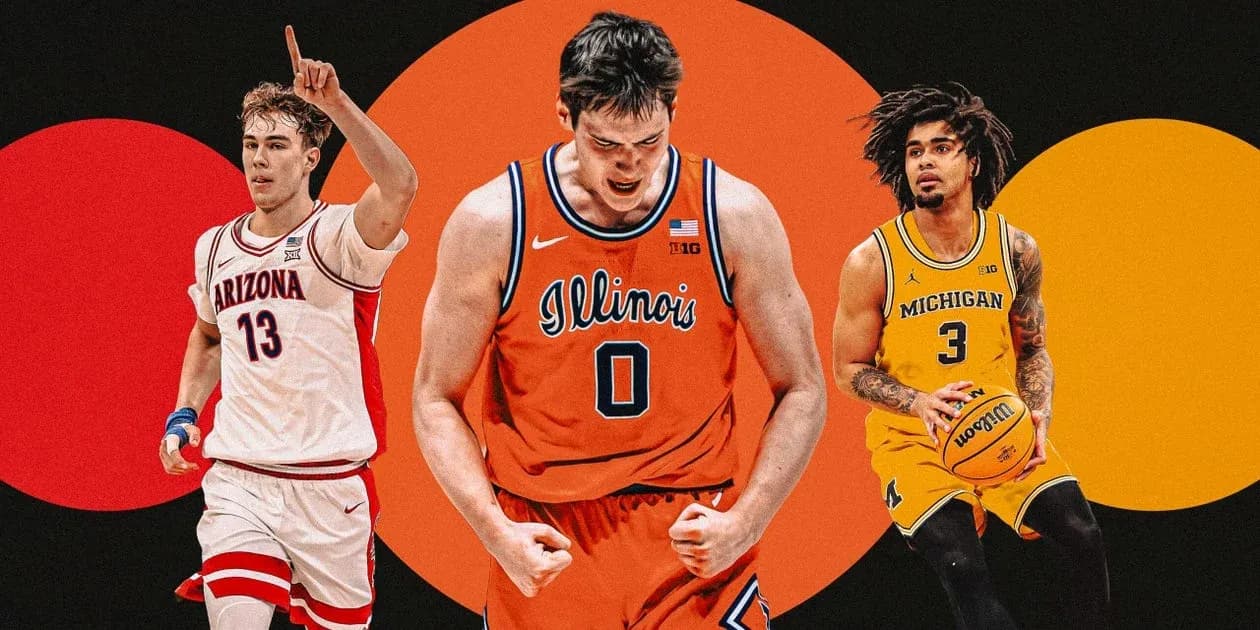
2026-27 College Basketball Landscape: Illinois Leads the Way
The transfer portal doesn’t officially swing open until Tuesday. Coaches are still in film rooms, NIL collectives are still shuffling numbers, agents are still calling. But the sport never really waits anymore.
So here it is anyway: a super-early, way-too-soon look at the 2026-27 landscape — with Illinois sitting on top of the pile and a lot of bluebloods scrambling to keep up.
1. Illinois: Big, Skilled, and a Point Guard Away
Brad Underwood doesn’t need a rebuild. He needs a quarterback.
Illinois’ path to a preseason No. 1 is that simple: find a lead guard in the portal and roll out a monster of a roster. The Illini’s frontcourt — David Mirkovic, Tomislav Ivisic, and a deep rotation of size and skill — is already built to bully almost anyone. Mirkovic, in particular, is on the verge of All-America territory. The ball will live in his hands, and he’s already one of the most inventive scorers and creators in the country.
The bench gets a serious boost with the return of Ty Rodgers, the 6-6 wing who has missed the last two seasons. He’s exactly the kind of multi-positional, switchable piece Underwood loves. Add in a freshman class that again looks like it might include an overachiever or two — whispers around Ethan Brown are promising, and four-star guard Quentin Coleman brings more scoring punch — and Illinois looks loaded.
One portal guard. That’s the job. Get that right, and the Illini walk into the season as the team to beat.
2. Michigan: Title Defense Depends on the Bigs
Michigan’s repeat chances hinge on two names: Aday Mara and Morez Johnson Jr.
Both bigs have NBA decisions to make. If at least one returns — and the early lean is toward Mara — Dusty May will have another title-caliber roster. If both leave, the Wolverines move from favorite to question mark, with the portal becoming a lifeline for frontcourt help.
The backcourt is in good hands. Elliot Cadeau and Trey McKenney give Michigan a dynamic, steady pairing, and they provide a high floor even if the frontcourt is in flux. Brandon McCoy Jr., once considered one of the elite talents in his class before sliding in the rankings, is the wild card. If May unlocks that original upside, Michigan’s ceiling spikes again.
The formula is clear: keep one of the stars up front, find another big in the portal, and let Cadeau and McKenney steer the ship.
3. Arizona: Defense First, Point Guard Wanted
If Ivan Kharchenkov and Motiejus Krivas both return, Arizona’s defense stays nasty.
Tommy Lloyd’s team would again have the length, rim protection, and physicality to suffocate opponents. The missing piece is obvious: a stud point guard and a deeper bench. Lloyd has long been one of the sharpest international recruiters in the game, so expect that search to stretch beyond the traditional portal.
Caleb Holt arrives as one of the best prospects in the class and a natural heir to Brayden Burries. Like Koa Peat before him, he has the advantage of already playing under Lloyd with USA Basketball. Sidi Gueye, barely used as a freshman, looms as the next big to follow the Gonzaga-style path: wait, develop, then pop.
Land the right point guard, and Arizona’s defense will have the offensive structure it needs to chase something serious.
4. Florida: Frontcourt Power, Portal Flex
Todd Golden is in an enviable spot. Florida doesn’t *need* the portal to be good. It just needs the portal to be great.
If Alex Condon and Rueben Chinyelu both return — and the NIL math suggests they can earn more in Gainesville than chasing NBA fringes — the Gators might have the best starting frontcourt in the country. Condon’s offensive polish and Chinyelu’s physicality give Florida a brutal one-two punch inside.
The backcourt still needs some work. Boogie Fland and Urban Klavzar headline the perimeter, and more guard depth is likely coming via transfers. Even without those additions, this roster looks like a preseason top-10 group. With them, Florida has the tools to play deep into March.
Golden starts this offseason from a position most coaches would kill for: already good, just shopping for upgrades.
5. Duke: Experience Overhead, Star TBD
For the first time in a while, Duke’s preseason story isn’t about a single can’t-miss superstar. It’s about a core that’s been through it.
Caleb Foster, Dame Sarr, Cayden Boozer and Patrick Ngongba II have all logged real minutes in big games. That experience gives Jon Scheyer something rare in Durham: continuity. Ngongba could still test the NBA waters, and if he leaves, Duke will almost certainly chase an elite replacement. Flory Bidunga’s name has been linked to the Blue Devils for a while.
The one thing missing is the obvious All-American headliner that Cooper Flagg and Cameron Boozer provided the last two seasons. Still, Scheyer has proven he can build balanced, complementary rosters in this era. With Deron Rippey Jr. stepping in and Bryson Howard and Maxime Meyer adding more size and skill, Duke again looks like a top-five lock.
They may not have the single biggest star this time. They might not need one.
6. UConn: Backcourt Promise, Frontcourt Question
Dan Hurley has a decision to make in the paint.
The numbers are stark: UConn was nearly 12 points per 100 possessions better with Tarris Reed on the floor than with Eric Reibe at center. With Reed gone, Hurley can either bet big on Reibe’s development or go hunting for another elite big man and push Reibe back into a reserve role.
History suggests he’ll chase another hammer. Hurley’s best teams have featured two quality centers, not one.
The backcourt, though, is in good shape. Solo Ball needs to rediscover the 3-point stroke that deserted him this season after a 41.4 percent year as a sophomore. If he does, and if Silas Demary makes a Tristen Newton-style leap from Year 1 to Year 2, the Huskies will again have one of the best guard groups in the country. Freshmen Colben Landrew and Junior County add more firepower on the wings.
Solve the center spot, and UConn’s ceiling climbs quickly.
7. Michigan State: Betting on Fears, Figuring Out the Five
Tom Izzo misfired on shooting last preseason. He won’t get caught making the same mistake twice.
With Jeremy Fears Jr. in the fold, Michigan State’s floor is high. His presence as a creator and leader gives Izzo a foundation. The concern this time is different: low-post scoring. Carson Cooper and Jaxon Kohler are gone, leaving a frontcourt that’s long on energy and short on back-to-the-basket threats.
Coen Carr is a terror in space but not a traditional post scorer. Cam Ward has some of that in his game but profiles more as a four than a true five. Izzo can turn to Jesse McCulloch or freshman Ethan Taylor at center, but the safer bet is this: he’ll start his best five players and live with the matchup quirks.
With Kur Teng and Jordan Scott adding shooting and versatility, Michigan State may not be perfect inside. It might not matter.
8. Iowa State: Otzelberger’s Next Step
T.J. Otzelberger could have walked into Chapel Hill. Instead, he doubled down on Ames.
That decision, backed by a new extension and more financial muscle, changes Iowa State’s recruiting profile. Otzelberger has already built a reputation as one of the best evaluators and developers in the sport. Now, with more backing, he can chase higher-end talent while still finding his usual undervalued gems.
On paper, he has five returning players who can start. The swing piece is Milan Momcilovic, who averaged 16.9 points and shot a blistering 48.7 percent from three. He’s good enough to test the NBA, but another year could push him into 2027 lottery conversations. If he’s back, Iowa State can slide Killyan Toure to the wing and look to the portal for a point guard to replace Tamin Lipsey and maybe another big.
The Cyclones already defend and compete like a top program. Now they might start recruiting like one too.
9. Arkansas: Calipari’s Defense-First Reboot
John Calipari’s first Arkansas team will look different from his late-era Kentucky groups. It might start with defense.
Jordan Smith Jr. is the tone-setter. On the grassroots circuit, he built a reputation as an elite defender who plays with a relentless motor and lifts the intensity of everyone around him. He’s not Darius Acuff Jr. as a scorer, but he can change the Razorbacks’ identity overnight.
Meleek Thomas and Billy Richmond give Calipari a backcourt loaded with talent and depth. The problem is up front. Arkansas needs size, rim protection and rebounding. Right now, those answers aren’t on the roster. The portal has to deliver.
If Calipari lands the right bigs, this can go from intriguing to dangerous in a hurry.
10. Nebraska: Hoiberg’s Shooters and Two Big Holes
Fred Hoiberg has his type, and he has it again: shooters everywhere.
Pryce Sandfort and Braden Frager return as elite perimeter threats, and Connor Essegian’s comeback from injury adds yet another marksman. Add freshmen Colin Rice and Jacob Lanier to the wing mix, and Nebraska should once again be one of the best shooting teams in the country.
What Hoiberg doesn’t have — yet — is a starting-caliber point guard or a reliable big. Both are on the shopping list. Veteran Cale Jacobsen can start if needed, but the plan is clear: go into the portal, find a lead guard to organize all that firepower, and secure a frontcourt anchor who can hold up against the Big Ten’s heavyweights.
With the right two pieces, this offense will hum.
11. Iowa: Life After Bennett Stirtz
Ben McCollum’s first season at Iowa proved something important: his system translates.
Now he faces his first major test in Iowa City — replacing Bennett Stirtz, the do-everything lead guard who powered the Hawkeyes’ run to the Elite Eight. McCollum’s offense puts a huge burden on that spot. He needs a new engine.
He also needs a post anchor. To consistently survive against Michigan, Illinois and the rest of the Big Ten’s bruisers, Iowa has to add size and physicality inside. The good news: the wings are in great shape. Tate Sage (6-7) and Cooper Koch (6-8) bring positional size and skill, and the roster continuity elsewhere is strong.
McCollum just showed the nation he’s one of the sharpest tacticians in college basketball. At this point, it’s reasonable to pencil Iowa into the “they’ll be good” category every year — as long as he finds that next Stirtz.
12. Gonzaga: Huff’s Health and a New Floor General
Everything in Spokane starts with one question: is Braden Huff fully back?
Huff missed the final 17 games with a knee injury, and his return to form is the linchpin of Gonzaga’s 2026-27 outlook. If he’s right, he becomes the go-to option with Graham Ike gone, giving Mark Few another skilled big to run offense through.
Jack Kayil, a 20-year-old guard currently averaging 11.6 points and 3.8 assists for Alba Berlin, looks like the next international success story. Pairing him with Mario Saint-Supery in the backcourt gives the Zags creativity, scoring and toughness. Freshmen Luca Foster and Sam Funches deepen the rotation.
Gonzaga’s ranking assumes Huff is healthy and productive. If that’s true, they’ll again be in the national conversation.
13. Purdue: The Omer Mayer Era
Matt Painter has a new point guard to build around, and his name is Omer Mayer.
Mayer’s freshman year never fully took off — just 14.3 minutes per game — but the per-40 numbers (15.3 points, 3.2 assists) hint at what’s coming. With Braden Smith gone, this is Mayer’s show. Painter has trusted guards before and watched them grow into stars. This feels like the next chapter in that story.
The one thing missing is the classic Purdue back-to-the-basket bruiser. Unless one of the freshmen — Sinan Huan, Jamyn Sondrup or Rivers Knight — emerges quickly, the Boilermakers will look different stylistically. The early portal addition of Caden Pierce, the 2024 Ivy League Player of the Year at Princeton, gives them a versatile forward who can score, rebound and facilitate.
This ranking is a bet on two things: Painter’s track record and Mayer’s leap.
14. Houston: Loaded Up Front, Searching Outside
Kelvin Sampson’s frontcourt is going to be a problem.
Chris Cenac and Joseph Tugler are both in line to return, and they’ll be joined by 7-foot-1 Arafan Diane, a rebounding machine who also brings the low-post scoring touch Houston lacked this season. That trio alone gives the Cougars one of the most imposing front lines in the country.
The backcourt, though, is wide open. Houston loses all three starting guards and has to rebuild on the perimeter. Mercy Miller is the next in line — a classic “wait your turn, then explode” Coogs guard — but he’ll need help. Sampson has to find at least one, probably two, portal guards who can defend, score and handle the ball.
If the guard hunt goes well, Houston’s physicality and defense will carry them right back into contention.
15. Kansas: Bill Self vs. the Portal Era
Kansas’ frontcourt has scattered to the portal. Flory Bidunga, Bryson Tiller and Paul Mbiya are all out — at least for now.
There’s a twist, though: Bidunga did this dance last year and came back. That option remains on the table. At the same time, the Jayhawks are heavily linked to Tyran Stokes, the top-ranked player in the 2026 class. So this isn’t a bare-cupboard situation as much as it is a roster in motion.
Taylen Kinney steps in at point guard, with Jamari McDowell and Samis Calderon returning on the perimeter. Davion Adkins, Trent Perry and Luke Barnett round out the incoming group. The assumption here is simple and time-tested: Bill Self will find three quality frontcourt pieces to plug the gaps.
We’re in a new era where even Kansas can see an entire starting front line hit the portal. But Self didn’t stick around to coach a thin roster. Expect reinforcements.
16. Saint Louis: Life After Robbie Avila
Saint Louis didn’t just show up in March. It made a statement.
A blowout win over Georgia and a rugged fight against Michigan announced that Josh Schertz’s system works at the highest level. Now he has to replace Robbie Avila, the unicorn center who made that offense hum.
The Billikens now have the budget and the profile to chase a bigger, more athletic center to help them survive the size they’ll see in March. Even without Avila, the offense still has serious juice. Trey Green and Ishan Sharma stretch the floor as elite shooters, while Quentin Jones and Kellen Thames are two of the most dangerous slashers in the country. Amari McCottry, a playmaking four, could even slide into a modified Avila role if Schertz lands a more traditional rim protector.
Saint Louis proved it can hang. Now it wants to push through.
17. TCU: Quiet Continuity in the Big 12
While the rest of the Big 12 churns, TCU brings back something invaluable: four starters from a team that won 11 league games.
Brock Harding runs the show as a sharp table-setter, and the David Punch–Xavier Edmonds frontcourt remains one of the most underrated duos in the country. Their chemistry, physicality and production give Jamie Dixon a reliable base.
The Horned Frogs also add a potential X-factor in Trent Lincoln, the top junior college recruit in the nation. At 6-3, he brings scoring and playmaking punch. Seven-footer Ryan Hunt adds depth up front.
In a conference obsessed with splashy moves, TCU is betting on continuity. That might be its biggest strength.
18. Texas: Vokietaitis and the Portal Push
Matas Vokietaitis turned March into his personal showcase.
He poured in 55 points across three tournament wins and finished third nationally in free-throw rate. If he can tighten up his accuracy at the line, he has all-league potential written all over him. Sean Miller will build plenty of offense around his aggressive, foul-drawing style.
The rest of the roster needs work, especially on the perimeter. Texas has money to spend and a clear priority: find a point guard. Austin Goosby and Bo Ogden, both top-40 wings, arrive ready to compete for starting spots, with Joe Sterling and Coleman Elkins adding more depth.
With Vokietaitis as the focal point and the portal as a weapon, Texas has a clear path back into the national picture.
19. Kentucky: Cap Space and a Big Bet on Moreno
Kentucky’s roster churn looks dramatic on paper — multiple portal exits, Otega Oweh graduating, Jayden Quaintance likely off to the NBA. In practice, it opens something else: flexibility.
Those departures free up a significant amount of NIL money with relatively little proven production lost. Mark Pope and his staff now have room to reshape the roster aggressively through the portal, especially at point guard. That market will be crowded, but Kentucky’s brand and budget still matter.
Malachi Moreno is the centerpiece of what remains. His freshman year was one of the few bright spots in a disappointing season, and a full breakout would change Kentucky’s trajectory. Collin Chandler and Kam Williams offer backcourt pieces to build around, while Trent Noah and Mason Williams deepen the rotation.
Get the right guards in the door, and this rebuild speeds up fast.
20. Virginia: Defense Locked In, Depth TBD
Virginia’s identity is already in place. The roster isn’t.
The international frontcourt of Thijs De Ridder and Johann Grunloh hit big this past season. De Ridder, in particular, has All-America potential as a sophomore. With those two patrolling the paint, Virginia should again own one of the nation’s best two-point defenses and protect the rim at an elite level.
Chance Mallory and Sam Lewis give new coach Ryan Odom a backcourt foundation, but the depth chart behind the projected starters is almost empty. Outside of those four, the returning players combined for just 50 total points last season. Odom hasn’t signed a 2026 recruit yet.
The defense is ready. The rotation is not.
21. Miami: Two Big Portal Swings Away
Miami’s path back to relevance is straightforward and difficult at the same time: land a point guard and a big.
Jai Lucas has already shown he can revive careers — Malik Reneau and Tre Donaldson just had their best seasons under his watch. That proof of concept matters on the trail. Now he needs a floor general and a frontcourt anchor to complete what is otherwise a strong eight-man rotation.
Caleb Gaskins, a top-15 prospect at 6-8, gives the Hurricanes a modern, versatile forward. Shelton Henderson has lottery-level upside if his jumper comes along. Dante Allen returns as a steady guard option, with Marcus Allen and Salih Altuntas providing depth.
The core is good. The missing pieces are hard to find. Lucas’ second offseason will define Miami’s ceiling.
22. St. John’s: Trusting Pitino and the Wings
Rick Pitino loses his interior rock in Zuby Ejiofor and a lot of size up front. He still has three reasons to believe: Dylan Darling, Ian Jackson and Joson Sanon.
That trio forms the spine of St. John’s next iteration — a group of guards and wings who can score, defend and, crucially, take a step forward after a full summer under Pitino’s demanding eye. History says that’s time well spent.
The frontcourt is the issue. With Ruben Prey and Lefteris Liotopoulos returning but little proven depth beyond them, Pitino will have to work the portal for size and experience. This ranking is essentially a bet on his track record. He usually finds answers.
23. Vanderbilt: The Tanner Effect
If Tyler Tanner returns, Vanderbilt walks into next season with something most programs don’t have: the best player on the floor almost every night.
Tanner averaged 19.5 points and 5.1 assists with a staggering 125.9 offensive rating. Those are All-America numbers. New coach Mark Byington will build everything around him and then head to the portal to find starting-caliber help at the two, four and five.
Mike James and Jayden Leverett give the Commodores some continuity, while freshmen Ethan Mgbako, Anthony Brown and Jackson Sheffield add size and skill across the lineup.
Vandy’s portal pitch is simple: come play with an elite guard and touch the ball a lot.
24. North Carolina: Malone’s First Test
Michael Malone steps into one of the most pressurized jobs in the sport with a roster that could go in a lot of directions.
If he holds onto the returning core and the current recruiting class, North Carolina will climb in future iterations of these rankings. For now, this is a hedge — a nod to the uncertainty that comes with a coaching change and an open portal.
The pieces, though, are intriguing. Dylan Mingo is a five-star talent. Maximo Adams is another top-25 recruit. Henri Veesaar has the tools to become one of the best centers in the country. Six rotation players from an NCAA Tournament team are in line to return, including Jaydon Young and Luka Bogavac.
Keep them together, add a starting-caliber guard or two, and Malone’s debut season could escalate quickly.
25. Tennessee: Shooting Found, Size Needed
Tennessee already solved one problem: perimeter shooting.
The Vols landed Tyler Lundblade from Belmont, where he averaged 15.6 points and hit 40.6 percent from three for the Missouri Valley champions. Players who dominate the MVC tend to translate just fine at the high-major level.
The bigger issue is, literally, bigger. Losing JP Estrella hurts. He had the tools to become one of the SEC’s best bigs. DeWayne Brown is an option at center, but he’s undersized for the role. Tennessee almost certainly needs another frontcourt piece from the portal and a starting point guard to tie it all together.
Ralph Scott, Manny Green and Marquis Clark give the Vols more depth and versatility, but the next few weeks in the portal will decide whether this is just a solid team or something more dangerous.
The portal will rewrite plenty of this in the coming weeks. But for now, Illinois sits atop a crowded field, bluebloods are scrambling to plug gaps, and everyone is chasing the same thing: one or two perfect additions that can tilt an entire season.