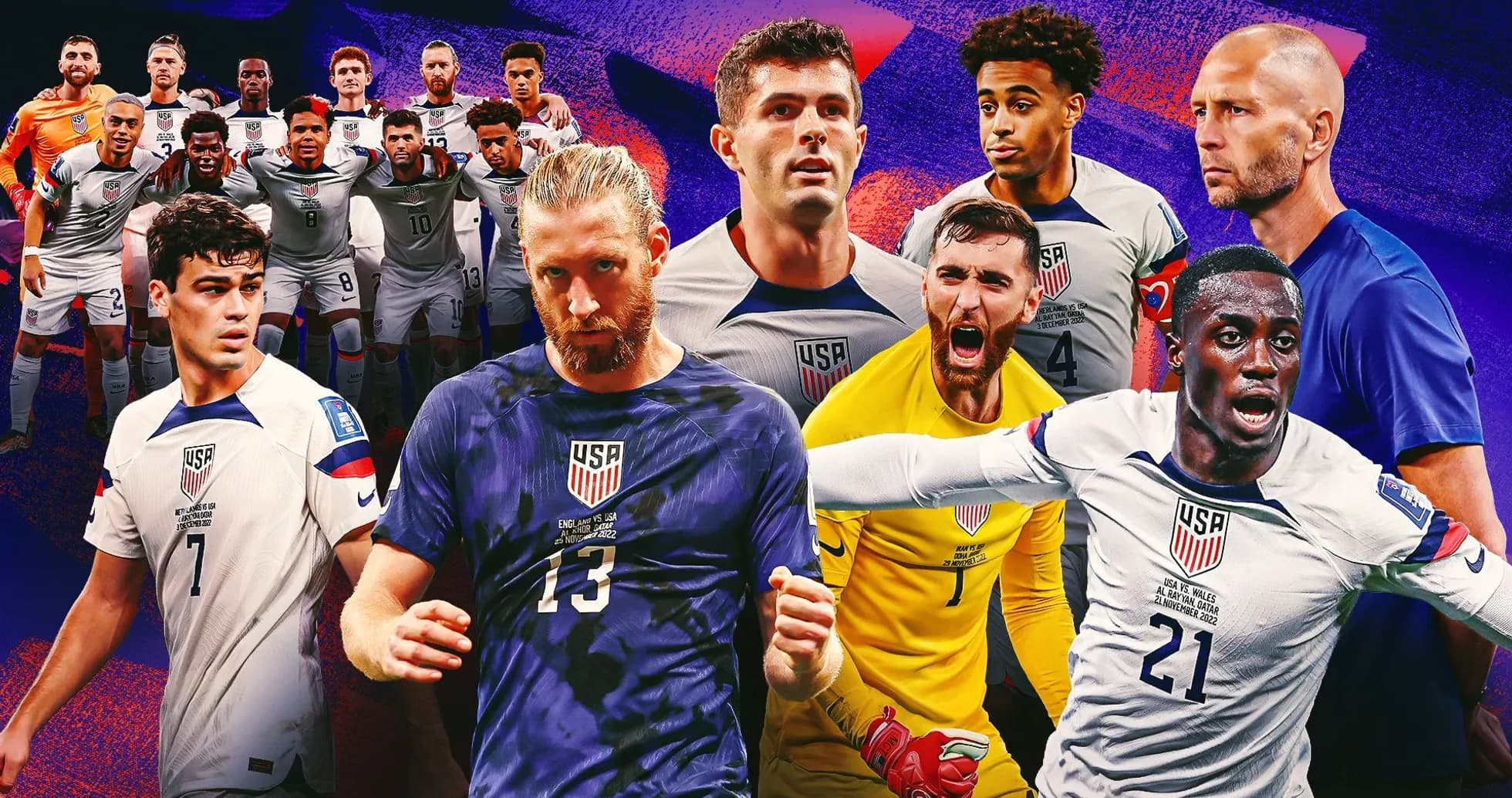
World Cup Memories: The Journey of U.S. Soccer Players in Qatar
On the eve of Wales, in a hotel room in Qatar, Gregg Berhalter didn’t talk tactics first. He talked history.
He pulled 26 players into a circle and gave them a number.
Not a squad number. A lineage.
“Each one of you has been assigned a number,” he told them. “It represents what number you are representing the U.S. in a World Cup.”
Walker Zimmerman’s was 152.
“I was the 152nd player to represent the U.S. in a World Cup,” he recalls. “When you think about it, you’re like, ‘152, that’s it?’ That’s all that has ever gotten to this.”
Back in his room, the jersey was waiting. Name, number, and that tiny, heavy piece of history stitched into the fabric. Start slicing it by position, by starters, by minutes played, and the club gets smaller still. Zimmerman knew he had stepped into something rare.
He wasn’t alone. This generation didn’t just arrive in Qatar together; they’d grown up together. Tyler Adams, Christian Pulisic, Weston McKennie. Tim Weah, Josh Sargent, Sergiño Dest. Youth camps, bus rides, underage tournaments. Years of promise, followed by the wreckage of 2018 and the responsibility to drag the U.S. back.
“Those are the best memories,” Adams says. “My memories with Weston are always going to be more valuable as a kid. It’s the memories of us getting to that stage, even more than where we are now.”
A World Cup in fast‑forward
Then the whistle blew on nostalgia.
Once the tournament started, everything moved at double speed. No long training camp, no gentle ramp-up. Players flew in from clubs and dropped straight into the white heat of a World Cup.
“It’s so quick,” Tim Ream says. “You’re in such a bubble. The games are late, you’re playing at 10 PM, staying up until three in the morning. Even on days we weren’t playing, they wanted us to stay up until 2 o’clock. Breakfast at 12, lunch at four, then training.”
Body clocks spun. Days bled into nights. Wales, England, Iran – three group matches in eight days, stitched together with regen sessions, tactical meetings and the strange silence of a city that only really woke up when the floodlights did.
Some players tried to slow the film down.
“I have a good mental coach that I work with, and we made that a big priority,” Sargent says. “Make sure that, while you’re there, take some deep breaths and be grateful and take it all in.”
Even then, it slipped through their fingers.
“Looking back now,” Haji Wright says, “the World Cup was like a fever dream. It went by so fast.”
For Joe Scally, who never got on the pitch, the sensation was different but no less intense. He sat, watched, and burned.
“Seeing the guys go out there, national anthem, full stadium, the whole world is watching, it’s something you want to be a part of so badly,” he says. “Of course, I was a part of it, but not on the field.”
Three goals, three very different stories
Only 25 American men had ever scored at a World Cup before Qatar. By the time the U.S. were done, three more had joined that small club. The goals looked simple on the highlights. The emotions around them were anything but.
Tim Weah went first.
Wales. Match one. The U.S. needed a jolt, needed something to mark their return after eight lost years. Pulisic burst through midfield and slipped the pass. Weah took it in stride and slid the finish home.
He had seen it a thousand times in his head.
“Leading up to that World Cup, I dreamt of scoring,” he says. “Years were passing by, and I literally always dreamt of that one moment at a World Cup, how it would feel, how I would celebrate. For it to become a reality, it was – man, it was amazing.”
Just playing in a World Cup was one dream. Scoring in it was another tier entirely.
Then came Pulisic.
England had ended 0–0. Iran loomed, with everything attached: geopolitics, tension, the knowledge that anything less than a win would send the U.S. home. The moment came late in the first half. Weston McKennie to Sergiño Dest, the cut-back, Pulisic crashing into the box like a man who understood the stakes.
He scored – and paid for it instantly.
As the ball crossed the line, he collided violently with goalkeeper Alireza Beiranvand, injuring his pelvis. No iconic sprint to the corner flag. No pre-planned celebration. No slow-motion shots of the star man roaring at the camera.
There was pain, a hospital trip, and a FaceTime back to the dressing room while his teammates saw the game out.
“It would have been, and it was, a huge moment,” Pulisic told GOAL in 2024. “Normally I would have been excited. I would have had a pretty cool celebration with the team. You could see the team wanted to run over and celebrate, but it was like, I just didn’t have that.”
He doesn’t dwell on it.
“I wouldn’t have changed it for the world,” he says. “I hope to have many big moments. I want to go in and I want to win these tournaments. At the end of the day, people will talk about that and that’s what they’ll remember.”
Haji Wright’s goal felt stranger still.
Round of 16. Netherlands. The U.S. were being picked apart by a more seasoned side when Wright stuck out a boot and watched the ball loop, almost lazily, over Andries Noppert and into the far corner. It was awkward, almost accidental, but it dragged the U.S. back into the game.
Or seemed to.
“After it went in, I kind of felt like the momentum might change a little bit and felt we might get another opportunity,” he says. “Obviously, that’s not how it went.”
The Dutch scored again. The U.S. went out 3–1. The dream stopped abruptly, mid-sentence.
“Being a World Cup goalscorer is amazing,” Wright says. “Being knocked out of that same game, though? What happened after the goal? The emotions that I felt? That’s what I remember.”
Only with time have those three been able to see their goals from the outside. Social media helps. Clips resurface. Reactions from bars and living rooms across the U.S. keep popping up in their feeds.
“We were just seeing the reactions online,” Weah says. “Seeing the fans back home when I scored or when Christian scored, it was amazing, man, just to see the impact that we have and the representation that we have in our country.”
The bubble inside the bubble
The goals are what the world remembers. The players often remember something else.
For DeAndre Yedlin, the only holdover from 2014, Qatar was about perspective. In Brazil, he was the kid. In Qatar, he was the veteran trying to help a young group survive the spotlight.
After every game, he led a group back out onto the pitch, long after the cameras had turned away.
“It feels like adversity gets multiplied by 10 because there’s always a camera on you, always a microscope on you,” he told GOAL in 2024. “I think it’s important to find that space and peace.”
He knew what the World Cup really was: entertainment, yes, but also hope, inspiration, something bigger and smaller than the players all at once.
“We’re so minuscule in the grand scheme of things,” he said, “but we also play a huge part.”
His teammates searched for their own quiet corners. Some stayed off their phones. Some tried to memorize every detail. Some, like Ream, only remember flashes.
“I can see glimpses of it,” Ream says. “I’m so insanely focused. It’s like tunnel vision. There’s a whole lot that you forget.”
They will never forget the setting.
The call to prayer rolling across Doha. Souqs and old markets shadowed by brand-new stadiums. A city that seemed to breathe in time with the match schedule.
“I enjoyed every bit of it,” Matt Turner says. “It was so cool to be in a culture I’ve never experienced before. The call to prayer was going on and, to me, it was peaceful and it was thoughtful. It was special because we were in this foreign land all together, and we had just this rock solid bubble.”
Doha itself felt like a bubble. The team’s hotel, on The Pearl at the Marsa Malaz Kempinski, became something even smaller: a home.
Yunus Musah felt it so strongly that he went back the following summer.
“Everything was like a throwback,” he said in 2025. “The smell! I could smell it again. The room, the view. I would just walk around, and it felt like I was experiencing all of those moments from the World Cup all over again.”
At the heart of it all sat the Players’ Lounge.
Tyler Adams calls it a sanctuary. Games on TV. Movie nights. Ping-pong, pool, video games. Long stretches of nothing, filled by the same faces, the same jokes, the same arguments about who was actually any good at FIFA.
“Gregg made it a priority that team camaraderie and the time we spent together was valued and sacred,” Adams says. “It just felt that, during the World Cup, I got even closer to some guys that I didn’t even know I could get closer with.”
Competition never really stopped. When they weren’t chasing points on the field, they were chasing bragging rights off it.
“Sean Johnson and DeAndre Yedlin had their crazy style of pool that they were playing,” Zimmerman laughs. “It was basically snooker. They barely hit the ball and just tried to make you lose by scratching.”
Cristian Roldan did everything he could to avoid being alone.
“I remember being around the boys in the Players’ Lounge and making sure I didn’t spend any time in my room and didn’t take any moment for granted,” he says.
The family section
There was another lounge, another bubble, that mattered just as much: the family section.
Zimmerman can still see it. First game, Wales, anthem playing, the noise rising and then thinning into something sharper.
“Everyone’s story is tied up with what that group of supporters has done to get us into this spot,” he says. “All of the sacrifices that those people made, those families, to get you to where you are on the field.”
Parents, siblings, partners, children. Friends who had driven them to training as kids. Coaches who had given them a chance when they were 14 and raw. All of them jammed into that section, living the moment in their own way.
Ream remembers the rare pockets of time when families could come to the hotel.
“Those were the only moments where you felt you could actually sit back and breathe,” he says. “My wife and kids and I, we’re all here in this place together.”
The families bonded with each other, too. Years of knowing names and faces turned into shared dinners, shared nerves, shared pride.
“It was just this experience that drew us all closer together,” Weah says. “Having that period of time to connect and meet everyone’s family, share our lives together, that was amazing.”
Life has shifted since. Some players are fathers now. Others have watched their kids grow old enough to understand what a World Cup is. Circles have widened. Priorities have sharpened.
Roldan feels it every day.
“I’ve had this late surge because I’ve had my daughter around,” he says. “Part of my motivation to extend my career and continue to play at a high level is that I want her to watch me play. I want her to watch daddy play.”
Sebastian Berhalter watched the whole thing from a different seat. Not as a player, but as a son.
“Going to that World Cup was so special,” he says. “Seeing your dad coach against some of the best teams in the world was something I’ll never forget.”
The fracture and the fallout
Not every memory from Qatar is wrapped in warmth.
For Gio Reyna, the World Cup he had dreamed of became something far more complicated. Injuries had already disrupted his build-up. When it became clear his role would be limited, frustration boiled over.
What followed has been dissected endlessly: Reyna’s minutes, questions about his response in training, and, after the tournament, the Reyna family informing U.S. Soccer about a decades-old domestic violence incident involving Gregg Berhalter. A private rift became a public scandal.
It went far beyond formations and substitutions. Careers and reputations were dragged into the light.
Time has moved on. Berhalter returned in 2023, then departed after Copa América 2024. Mauricio Pochettino is now in charge. Reyna remains part of the player pool and, with a home World Cup looming, he has started to frame 2022 as a harsh but valuable lesson.
“I think just individually and collectively, we were all very, very young and maybe a little bit inexperienced at the time,” he says. The Netherlands, he notes, were “a little bit more experienced, a little bit better, a little bit more savvy with the game.”
He talks now about the collective, about doing “whatever you can to help the team,” about the weight of representing an entire country – especially when the tournament is on home soil.
Reyna left Qatar with scars. Others left with a different kind of emptiness.
The ones who never got there
Some World Cup stories are written in ink. Others are written in the gaps.
Miles Robinson’s place on the plane looked certain. He had been a rock in qualifying, a near-lock to start in Qatar. Then his Achilles went. Season over. World Cup gone.
By November, he had a choice: turn away from it all or lean in.
“Man, I was outside watching that sh*t,” he told GOAL with a smile. “We were partying, watching, cheering on my guys. I really wanted to experience that real-life energy because that’s who I am.”
Chris Richards never had the luxury of months to process. A hamstring injury for Crystal Palace came just before the squad announcement. The timing was cruel. Too late to recover, too early to accept.
“I’m in London watching the boys kill it at the World Cup,” he remembers. “I was so, so happy for them, but for myself, it was lonely. I didn’t want anything to do with soccer.”
Mark McKenzie’s pain came from a different place. He was fit. He was playing. He still didn’t make the cut.
“Missing out on the 22 World Cup? It ripped me apart, bro,” he says. “When you get that call that you’re not going, that you weren’t selected, it’s a punch to the stomach.”
It forced him to look inward.
“Maybe I put too much onus on this,” he says now. “So much that I lost who I was, lost focus on the small areas of my game or my life that I need to improve.”
Those three, and others like them, carry their own version of unfinished business into 2026.
From prelude to main event
So much has changed since that winter.
Berhalter is gone. Pochettino will lead the U.S. into a World Cup on home soil. The core of that young 2022 side is older, richer in experience, heavier with expectation.
Tyler Adams felt the shift as soon as he went home.
“From a notoriety standpoint, people all of a sudden knew who I was walking back home in the streets of New York City,” he says. “It’s a city that I never imagined I’d get recognized in, and people are recognizing you.”
He was juggling a new kind of fame with something even more life-altering: his first child on the way.
Now the entire squad will have to juggle something similar, on a bigger scale. In 2022, the U.S. were one of 32 guests. In 2026, they are hosts. The spotlight will be harsher. The noise will be louder. The margin for error will be thinner.
“It’s an amazing feeling, but also a responsibility at the same time,” Weston McKennie says. He talks about pathways, about kids who will see themselves in this team. “The ultimate thing is to believe in yourself and bet on yourself always.”
Soon, 26 players will hear their names and feel that weight settle on their shoulders. Some will have Qatar in their rear-view mirror. Others will be walking into the unknown.
Some will start. Some will sit. Some will score. Some will never touch the ball.
All of them will be numbered, like Zimmerman was. All of them will be part of a story that stretches back decades and forward into whatever American soccer becomes after 2026.
For the class of 2022, that winter in Qatar is sealed now. A fever dream, a sanctuary, a fracture, a family reunion. A set of memories that will never quite sit still.
“I can understand how people call it emotionally draining,” Wright says. “After it was over, it felt like soccer had changed me, in a way, and now you find yourself chasing that same feeling. It’s hard to get that feeling again outside of a World Cup.”
Turner feels it too.
“I had some amazing experiences,” he says. “That’s why I need to get back there, because I really want that feeling again.”