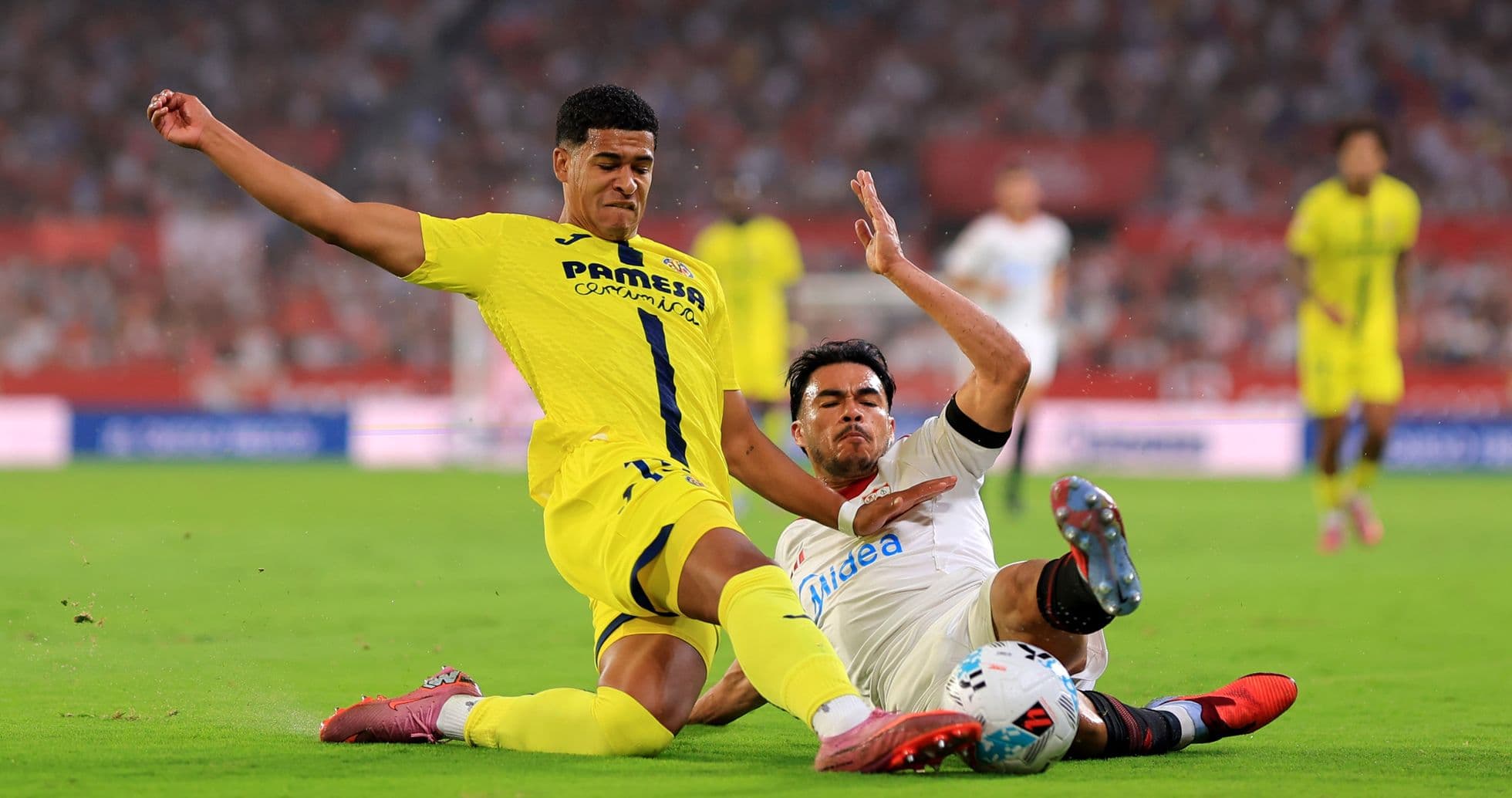
Villarreal vs Sevilla: Tactical Analysis of a 3-2 Thriller
Under the late-afternoon lights of Estadio de la Cerámica, this was supposed to be another statement of power from one of La Liga’s most imposing home sides. Villarreal, third in the table on 69 points with a home record built on 14 wins from 18 and an imposing 43 goals scored at home, walked out in their familiar 4-4-2 expecting to dictate. Instead, Sevilla – 12th with 43 points and a negative overall goal difference of -12 (46 scored, 58 conceded) – arrived in a black-clad 5-3-2 and turned the script on its head, edging a 3-2 thriller that exposed both the Yellow Submarine’s structural flaws and the visitors’ latent punch.
I. The Big Picture: Structures and Season DNA
Following this result in Round 36 of La Liga’s regular season, the numbers behind the narrative are stark. Villarreal’s overall goal difference of +24 (67 for, 43 against) has been built on relentless attacking at home: they average 2.4 goals for and only 1.0 against at La Cerámica. The 4-4-2 Marcelino trusted again here is the backbone of their campaign, used in 35 of 36 league games. It is a system designed to stretch the pitch horizontally, with wingers and attacking full-backs feeding a dual-threat front line.
Sevilla, by contrast, have been a tactical chameleon in 2025–26. They have used nine different formations across the league season, with 5-3-2 only their joint-third most common shape (6 times). Their away numbers tell a different story from Villarreal’s dominance: on their travels they have won just 5 of 18, scoring 22 and conceding 34, an away defensive average of 1.9 goals against per game. Yet here, Luis Garcia Plaza’s decision to go with a back five and twin strikers was a calculated gamble: absorb, then spring forward into the spaces Villarreal’s expansive shape would inevitably leave.
The first half, which finished 2-2, reflected those identities colliding at full speed. Villarreal’s home attacking rhythm was there – quick circulation through Dani Parejo and P. Gueye, width from N. Pepe and Alberto Moleiro, and the dual movement of Gerard Moreno and G. Mikautadze. But Sevilla’s verticality in transition, built around R. Vargas between the lines and the running of A. Adams and N. Maupay, repeatedly found cracks in a back line missing key depth.
II. Tactical Voids: Absences and Discipline
The absences list framed some of the structural choices. Villarreal were without P. Cabanes and J. Foyth, both listed as Missing Fixture. Foyth’s Achilles tendon injury in particular removes a versatile defender who can slide centrally or wide and defend one-v-one in big spaces – precisely the kind of profile that would have helped against Sevilla’s counter-attacks. Instead, Marcelino started a back four of A. Freeman, P. Navarro, Renato Veiga and A. Pedraza, with Veiga – one of La Liga’s leading red-carded players this season – again tasked with anchoring the left side.
Sevilla, for their part, travelled without M. Bueno, Marcao and Isaac Romero, all Missing Fixture. The loss of Marcao reduced their left-sided defensive depth, making G. Suazo’s role in the back five even more central. Isaac’s absence, with his four league goals and a history that includes a red card and a missed penalty this season, forced Plaza to lean more heavily on Adams and Maupay as his forward pairing.
From a disciplinary standpoint, the season-long trends were always likely to surface. Villarreal’s yellow-card distribution shows a pronounced late-game spike: 25.64% of their yellows come between 76-90 minutes, with an additional 8.97% from 91-105. Sevilla are similarly combustible late, with 18.63% of their yellows between 76-90 and a league-high 20.59% from 91-105. This was a fixture almost designed to tilt into chaos as legs tired and spaces opened; the second half, which produced Sevilla’s decisive third goal, was played on that emotional edge.
III. Key Matchups: Hunter vs Shield, Engine Room
The “Hunter vs Shield” duel centred on G. Mikautadze against Sevilla’s away defence. Mikautadze has been Villarreal’s cutting edge this season: 12 league goals and 6 assists in 31 appearances, with 51 shots (29 on target) and 26 key passes. His movement off Gerard Moreno, dropping into the half-spaces and then bursting into the box, is the focal point of a home attack that averages 2.4 goals per game.
Up against him was not a single defender, but a structure: a back five led by C. Azpilicueta and K. Salas, flanked by Carmona and Suazo, with Oso completing the line. On their travels, Sevilla concede 1.9 goals per game, but the back-five design here narrowed the central channels Mikautadze usually exploits. Instead of repeatedly breaking the line, he was often forced to receive with his back to goal, combining rather than finishing, and Sevilla’s compactness inside their own box proved just enough.
In midfield, the “Engine Room” was a fascinating duel: Parejo and P. Gueye against L. Agoume and D. Sow. Parejo’s role as Villarreal’s metronome is unquestioned; his partnership with Moleiro, whose 10 league goals and 5 assists and 36 key passes make him one of La Liga’s most influential young creators, gives Villarreal a natural dominance of possession. On the other side, Agoume has quietly become Sevilla’s enforcer-playmaker hybrid: 1250 passes at 80% accuracy, 66 tackles, 47 interceptions, and 10 yellow cards tell the story of a player who both breaks and makes play.
Here, Sevilla’s trio – Agoume sitting, Sow and Vargas stepping higher – worked as a sliding shield. Vargas, who has 6 assists and 25 key passes this season, was the outlet, repeatedly driving Sevilla up the pitch and linking with Adams. That Adams himself has 10 goals and 3 assists, with 46 shots and 3 penalties scored, meant every Sevilla counter carried genuine threat.
IV. Statistical Prognosis: What the Numbers Say About the 3-2
Following this result, the underlying season profiles still suggest Villarreal would win this fixture more often than not. Their overall scoring rate of 1.9 goals per game, combined with Sevilla’s overall concession rate of 1.6 and away figure of 1.9, points to a typical xG landscape where Villarreal generate the higher volume and quality of chances at home. Their 8 clean sheets overall and only 18 goals conceded at home underscore a defensive unit that is usually more secure than the five-goal spectacle here suggested.
Yet Sevilla’s volatility always offered an alternative script. They have failed to score away only 4 times in 18, and their 22 away goals – 1.2 per game – coupled with the individual finishing of Adams and the creativity of Vargas mean their attacking xG on the road is rarely negligible. Add in the emotional, card-heavy late phases for both sides, and a high-variance outcome like a 3-2 away win becomes less an anomaly and more an expression of the matchup’s chaotic potential.
In tactical terms, this was the night where Villarreal’s aggressive 4-4-2, so often their superpower at La Cerámica, left just enough space for Sevilla’s 5-3-2 to cut through. The numbers still paint Villarreal as the more stable, higher-ceiling side heading into the final weeks of the campaign, but Sevilla’s win here is a reminder: in a league of fine margins, the right structure, the right transitions, and the right hunters – Adams, Vargas, Maupay – can overturn even the most imposing home fortress.