Hellas Verona vs AC Milan: A Tactical Analysis of Serie A Clash
The Stadio Marcantonio Bentegodi felt like a stage for a mismatch, and the final 0–1 scoreline only partially captured the gulf between a side fighting for survival and another chasing the title. Following this result in Serie A’s Regular Season - 33, Hellas Verona remain marooned in 19th with 18 points, while AC Milan consolidate 2nd on 66 points, their season-long patterns reaffirmed rather than challenged.
I. The Big Picture – Structures and Season DNA
Verona’s 3-4-2-1 under Paolo Sammarco was a pragmatic response to their reality. Heading into this game, they had won only 3 of 33 league matches in total, with a goal difference of -33 (23 scored, 56 conceded). At home they had just 1 win from 16, scoring 12 and conceding 25. The shape on the day – L. Montipo behind a back three of N. Valentini, A. Edmundsson and V. Nelsson – was designed first and foremost to survive.
Their season statistics tell the same story. In total this campaign they average only 0.7 goals for per match (0.8 at home), while conceding 1.7 in total (1.6 at home). The minute distribution is damning: Verona concede a massive 29.63% of their goals between 76-90', a late-game collapse pattern that has haunted them all year.
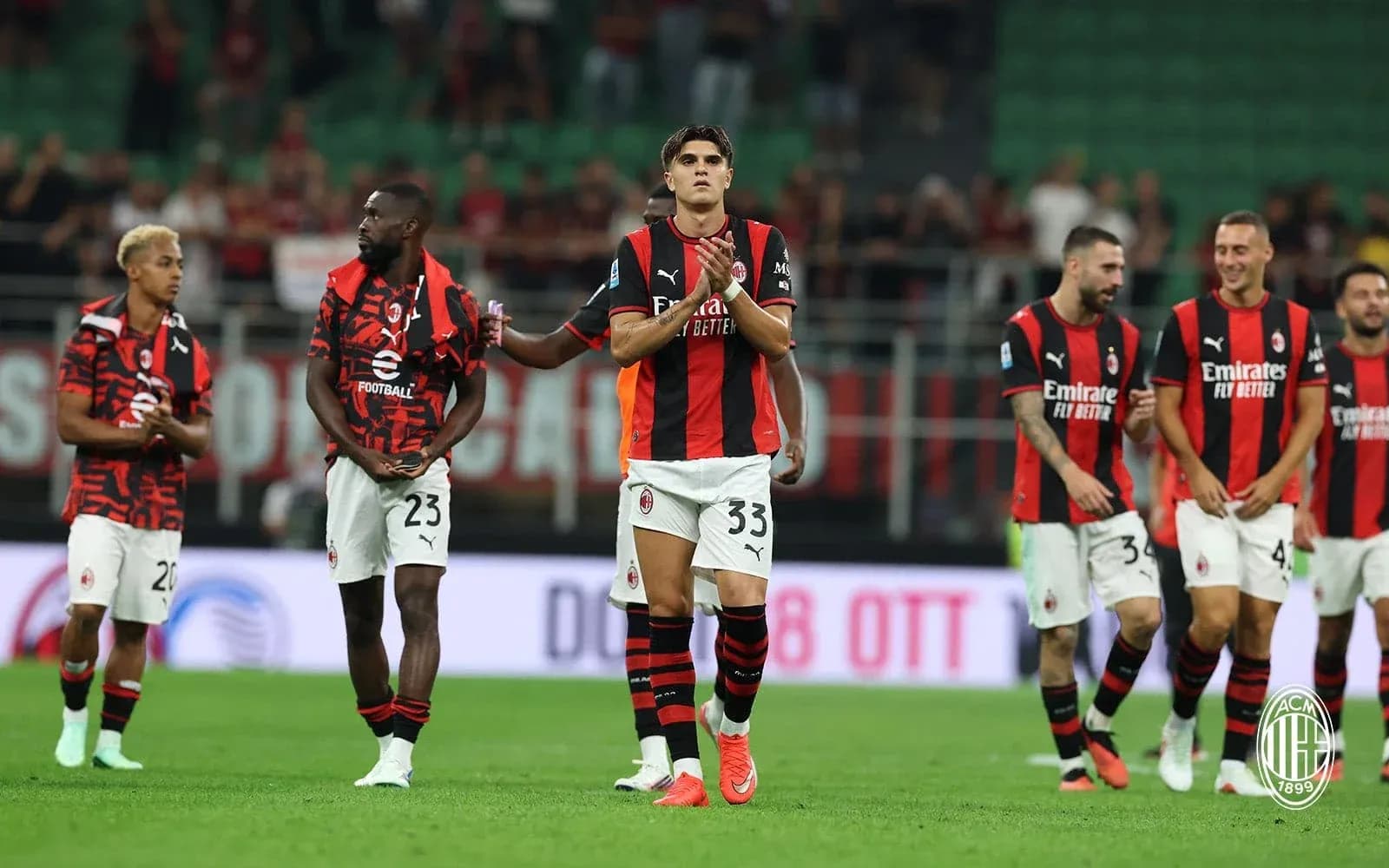
Milan, by contrast, arrived as a fully formed contender. Massimiliano Allegri’s 3-5-2 has been his default – used 29 times in total – and at Bentegodi he trusted it again: M. Maignan in goal, a back three of S. Pavlovic, M. Gabbia and F. Tomori, a five-man midfield with A. Rabiot and Luka Modric orchestrating, and a front two of Rafael Leão and C. Pulisic. Heading into this game, Milan had 19 wins from 33, with 48 goals for and 27 against in total, a goal difference of +21. On their travels they had been particularly ruthless: 10 away wins from 17, scoring 26 and conceding only 11.
Their season attacking profile is balanced and relentless. In total they average 1.5 goals per match, both home and away, with their most productive windows between 31-45' and 46-60' (each 24.49% of their goals), and a strong late push between 76-90' (22.45%). Defensively, they concede only 0.8 goals per game in total, dropping to 0.6 away – elite numbers for a side that often plays on the front foot.
II. Tactical Voids – Absences and Discipline
Verona came into the fixture shorn of several options: K. Bowie (injury), D. Mosquera and S. Serdar (both knee injuries), and A. Sarr (inactive) were all listed as Missing Fixture. For a squad already thin on quality, these absences narrowed Sammarco’s tactical palette. With G. Orban required up front and R. Belghali and A. Bernede working in the half-spaces, there was little scope to change the attacking structure without significantly weakening another line.
The disciplinary profile of Verona’s midfield also shaped the approach. R. Gagliardini and J. Akpa Akpro both sit high on the league’s yellow-card charts with 8 yellows each in total this campaign. Their roles as destroyers were essential against Milan’s technical midfield, but their propensity for fouls (Gagliardini has committed 37, Akpa Akpro 34) meant Verona could not press recklessly. The result was often a mid-block rather than an aggressive press, aiming to protect the back three and avoid early bookings that would destabilise the structure.
Milan’s own disciplinary risk sits more on the flanks and in rotation. P. Estupiñán, a red-carded player this season, started on the bench, allowing Allegri to keep his starting back line relatively stable. Milan’s yellow card distribution – with 24.00% of their yellows arriving in the 76-90' window – underlines how often they are still contesting games intensely late on. Here, the narrow scoreline demanded that same edge, but their control of territory and possession reduced the need for desperate interventions.
III. Key Matchups – Hunter vs Shield, Engine Room
The headline duel was always going to be “Hunter vs Shield”: Rafael Leão against Verona’s fragile defensive record. Leão entered the fixture with 9 league goals and 3 assists in total, from 25 appearances. His 40 shots and 23 on target, plus 51 dribble attempts (22 successful), paint the picture of a high-volume, high-impact forward. Against a Verona side that has conceded 56 goals in total, and in particular 16 goals (29.63%) in the final quarter-hour of games, Leão’s threat between the lines and in transition was a structural problem for Sammarco.
Gift Orban was Verona’s counterpunch. With 7 goals and 2 assists in total this season, he is their sharpest attacking edge, but he operates in a team that fails to score in 17 of 33 matches in total. Up against a Milan back line that concedes only 11 goals away and keeps 8 clean sheets on their travels, Orban’s task was Herculean. His tendency to play on the shoulder and attack space behind meant Verona’s rare attacking moments had to be perfectly timed and supported by runners from deep.
In the “Engine Room”, the battle between A. Rabiot and Verona’s double pivot of Gagliardini and Akpa Akpro defined the game’s rhythm. Rabiot, one of Serie A’s leading assist providers with 4 assists and 6 goals in total, is more than a passer: 1115 total passes at 85% accuracy, 21 key passes, 46 tackles, 5 blocked shots and 14 interceptions show a complete midfielder. His duels (262 total, 144 won) underline his capacity to dominate physically as well as technically.
Against that, Gagliardini and Akpa Akpro offered grit and coverage. Gagliardini’s 61 tackles, 10 blocked shots and 50 interceptions in total this campaign make him Verona’s primary shield in front of the back three. Akpa Akpro adds 39 tackles and 6 blocked shots. But the mismatch in technical quality was stark: Rabiot and Modric could circulate under pressure, while Verona’s midfield often treated the ball as something to be cleared rather than used.
C. Pulisic added a different dimension to Milan’s front line. With 8 goals and 3 assists in total, 36 key passes and 56 dribble attempts (26 successful), he is both finisher and creator. His single missed penalty this season is a rare blemish in an otherwise clinical profile, but his movement between the lines helped drag Verona’s wide midfielders – D. Oyegoke and D. Bradaric – into uncomfortable central spaces, opening corridors for Leão and Rabiot to exploit.
IV. Statistical Prognosis – xG, Control and the Narrow Margin
Even without explicit xG values, the season data provides a clear probabilistic frame. Heading into this game, Verona’s total attacking output – 23 goals from 33 matches, 0.7 per game – against Milan’s total defensive record of 27 conceded (0.8 per match) and 14 clean sheets in total suggests a low-likelihood event for a home goal. Conversely, Milan’s 48 goals in total at 1.5 per game, facing a defence that concedes 1.7 per match and collapses late, pointed toward a multi-goal away performance.
That the match finished only 0–1 speaks more to game-state management than to equality. Milan’s away average of 1.5 goals, combined with Verona’s late-game weakness, would normally forecast a second-half surge. But once ahead – and with Verona’s attacking resources limited and their bench lacking game-changing profiles beyond Isaac, I. Vermesan or J. Ajayi – Allegri could lean on control, possession and a compact 5-3-2 out of possession to suffocate the contest.
Following this result, the trajectories remain consistent. Verona’s form line – a season-long sequence littered with “L” and only brief flickers of “W” – continues its downward slope, their relegation fears hardening into expectation. Milan, with a robust goal difference of +21 (48 scored, 27 conceded) and a proven ability to win tight away games, look every inch the side built for the Champions League places.
Tactically, this was a game that played to type: Verona defended deep, relied on Orban’s isolated bursts, and hoped their fragile late-game psyche would hold. Milan, powered by Leão’s vertical menace, Pulisic’s creativity and Rabiot’s all-court control, imposed their structure and let the numbers do the rest. The scoreline was slender; the underlying story was anything but.