VAR Blunder in Manchester Derby: The Cost of Speed
“Quick, quick, quick, quick! Go, go, go, go, go!”
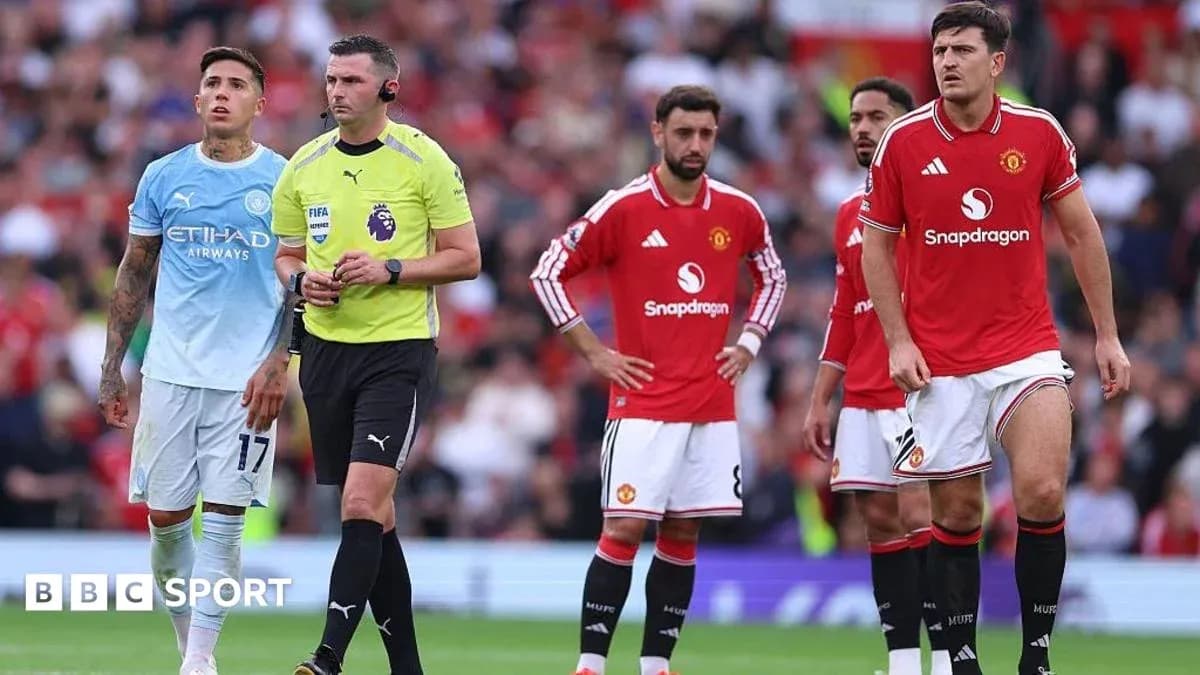
Those weren’t the words of a frantic commentator. They came from video assistant referee Matt Donohue, hurtling through a review that would hand Erling Haaland the winning goal in the Manchester derby – and leave the Premier League with one of its most calamitous VAR errors.
Donohue was clearly chasing efficiency. Instead, he helped create a mess.
Enzo Fernandez stood three yards offside before attacking the cross. Somehow, neither Donohue nor assistant VAR Blake Antrobus picked it up. The goal stood. Manchester City 1-0 Manchester United. The biggest game of the weekend, decided while the officials in Stockley Park rushed past the most basic detail.
Speed over sense
Refereeing has always been a goldfish bowl. VAR has turned up the light and shrunk the bowl.
This season, the Premier League even hard-wired “more efficient application of VAR to reduce delays” into its football principles. Fewer stoppages. Quicker checks. Less waiting around.
But when the pressure to be fast collides with the need to be right, what wins?
In Donohue’s case, the urgency bled through the audio.
“Let’s go, let’s go, let’s go, let’s go!”
Not calm. Not methodical. A panicked back-and-forth with the replay operator, the exact opposite of what a video official is supposed to sound like.
Officials hear it constantly – from fans, pundits, managers, broadcasters – VAR must be quicker. Long delays are branded unacceptable. The Premier League’s stakeholders’ survey, which canvassed managers, coaches and supporters, echoed the same theme: speed up the decisions.
That pressure sits in the room. It doesn’t excuse what followed.
City boss Enzo Maresca, speaking on Wednesday, could afford a touch of sympathy. His team had just benefited from the blunder.
“To make a decision in 10, 20 seconds is not easy for them,” Maresca said. “Sometimes they make mistakes. I make mistakes, players make mistakes. It’s part of our job.”
Howard Webb, head of referees, has tried to respond to the demand for faster reviews. On paper, it’s working. VAR delays – including the time taken for the referee’s stadium announcement – have dropped from an average of 46 seconds per game to 36 seconds compared with last season.
Yet the other major VAR error this campaign – failing to award Arsenal a penalty at Aston Villa – also came from an incident waved away too quickly.
The pattern is not subtle.
The process that broke
The derby fiasco wasn’t just about speed. It was about the process being abandoned.
Donohue’s key mistake came before he ever rushed through the attacking phase. As Josko Gvardiol shaped to cross, Donohue told the replay operator to stop the video on the first replay at the moment of contact. From there, he jumped straight into the semi-automated offside technology.
That short cut should never have happened.
The VAR team should have watched the entire sequence: Gvardiol’s cross, the movement in the box, Fernandez’s position, Haaland’s finish. Only then do you understand the full picture, the players’ locations, and who is interfering with play.
They didn’t. The chaos inside the penalty area wasn’t really assessed until Donohue moved on to the attacking phase. By that point, his and Antrobus’ focus had narrowed to a single question: did Fernandez touch the ball? A touch would have started a new phase and left Haaland offside.
The glaring fact that Fernandez had been offside at the initial cross was never truly confronted.
Donohue has absorbed most of the criticism, but Antrobus’ role – or lack of one – was just as important. The AVAR is there as a safety net, to spot what the main VAR might miss, to challenge, to question.
In this case, his entire contribution to the review boiled down to “no, yeah” about the possible Fernandez touch. One second later, Donohue said: “final decision is goal, check complete.”
The checks and balances never materialised.
The shadow of a four-minute delay
Antrobus’ recent history adds another layer. The only lengthy VAR delay this season came in Brentford v Sunderland, when a Dan Ballard goal was chalked off for a subjective offside against Kevin Danso. That review took more than four minutes and drew heavy criticism in sections of the media.
Antrobus was AVAR that day as well.
Did the backlash over that marathon check linger in his mind on Sunday? Did it nudge him away from asking for more replays, more time, more scrutiny?
No one can say for sure. The irony is stark, though: in that Brentford game, Antrobus played a crucial role in helping VAR Tim Wood reach the correct offside call against Danso.
There was also a support VAR on duty, stationed in the operations room next to the match hub at Stockley Park. That official can step in on protocol issues, essentially acting as a final guardrail.
They watched it unfold. No intervention came.
Even after the ball hit the net, the situation was still salvageable. Under current protocols, the review could have been corrected in the window between the goal and the restart. It never was.
Specialists under the microscope
Pro Ref has poured time, money and training into VAR. The aim has been clear: make it slick and accurate. When an error of this size explodes in a global fixture, that investment feels paper-thin.
Calls for dedicated VAR specialists have grown louder. Yet Donohue is exactly that, at least by the Premier League’s own definition.
Three seasons ago, Pro Ref invited officials to put themselves forward as video specialists. Candidates went through aptitude tests, with roughly 15 reaching the final training phase. Ten of those have since taken charge of VAR in Premier League matches.
Donohue is one of them. Sunday was his 65th match as the video official.
His progression has been steady enough that he now sits on the international list, appointed to UEFA club competition qualifiers over the summer. He has made mistakes, like almost every VAR. The job is unforgiving. The margin for error is tiny. The spotlight is relentless.
Only two VARs have a clean record over the past two seasons: Nick Hopton and Neil Davies, both products of the same accelerated programme.
Persuading active referees to give up the whistle and spend their careers in the VAR room is a hard sell. It also offers no guarantees. Lee Mason and Mike Dean, the Premier League’s only full-time VARs appointed after retiring from on-field duties, were both dismissed by Webb within months of his arrival after a string of high-profile errors.
Spain offers another warning. La Liga and its second division use a full team of officials who only work as VARs and never referee on the pitch. Yet the headlines are just as volatile as in England. At the start of last season, the VAR team there completely missed that a goalscorer was offside when the ball was played. Different country, same outrage.
Football’s obsession with the clock
Pro Ref will now have to explain why, in one of the season’s showcase fixtures, a VAR felt compelled to sprint through a review that demanded the opposite.
Nobody complained about the time taken when West Ham’s stoppage-time equaliser at Arsenal was ruled out last season. That check lasted more than four minutes. It ended with the right decision.
The derby, by contrast, lasted seconds and collapsed into farce.
This is where the sport finds itself. The drive to make VAR slicker, faster, less intrusive is beginning to chip away at the very reason it was introduced: to correct the big, obvious errors.
The obsession with speed isn’t just a VAR problem. It’s a football problem. And unless the game decides what matters more – the clock or the call – this won’t be the last time a “quick, quick, quick” review leaves everyone staring at a still frame, wondering how on earth they missed the obvious.