Trent Alexander-Arnold: Can He Really Be a Midfielder?
The Trent question refuses to die. Can Trent Alexander-Arnold really be a midfielder?
Gareth Southgate tried it at Euro 2024, then tore up the plan after two group games. Jurgen Klopp built an entire Liverpool system around him drifting into central areas, but always from that familiar right-back starting point.
Now it is Jose Mourinho’s turn to experiment.
Mourinho’s midfield gamble
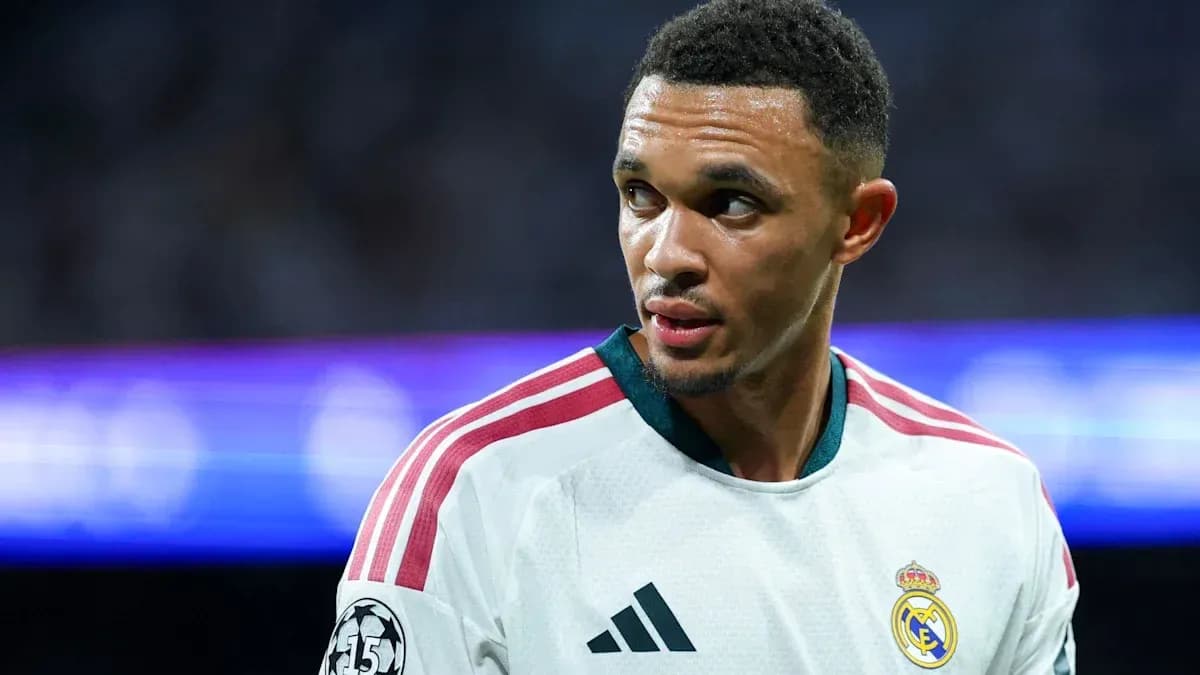
On Tuesday night, in a tight, nervous Champions League win over Inter Milan, Alexander-Arnold started in the middle for Real Madrid. Not at right-back, not as an inverted full-back. In midfield.
The context matters. Mourinho’s hand was forced. Eduardo Camavinga, Arda Guler and Bernardo Silva were all suspended, stripping Real of three natural options in the centre of the pitch. The solution? Push the 27-year-old inside alongside Federico Valverde and see what happens.
What followed was a performance that summed up the entire debate around him.
He created two chances. He attempted more crosses than any other Real player. His passing accuracy, though, dipped to 83.3%, and he did not win a single tackle. Neat on the ball, inventive in advanced areas, but exposed when the game became a scrap.
When Inter pulled one back on 77 minutes, Mourinho turned to his bench. Alexander-Arnold’s number went up. As he walked off, whistles rang around the Bernabeu. The noise felt more like a verdict on Real’s anxious display than on one player, but the timing did him no favours.
‘He is not a midfielder’
Mourinho’s assessment was blunt, even after praising the shift Alexander-Arnold had put in.
“He has played midfield with England and Liverpool... but he is not a midfielder,” the Real manager said after the 2-1 win.
“He has played very well. He has interpreted what he needed to really well, tactically. Both him and Valverde have worked very well at this level.”
So yes, Mourinho was “very grateful” for what Alexander-Arnold offered in an emergency role. No, that does not mean a permanent reinvention is on the way.
The Portuguese coach still sees him as something different: a full-back who can step inside, not a pure central midfielder. Someone who can slide into pockets, dictate from unusual angles, and feed attacks with that familiar whip of a right foot.
Still fighting for a position
The bigger picture is just as intriguing. Alexander-Arnold has not yet nailed down the right-back spot since arriving at the Bernabeu last summer. He spent last season battling Dani Carvajal. This season, the fight is with Denzel Dumfries.
For the first time in a competitive game, both started together against Inter. Alexander-Arnold moved into midfield, Dumfries operated on the right. It was a tactical compromise that underlined a simple truth: Mourinho still does not have a definitive first-choice right-back.
Real’s staff, though, have been impressed. They like his professionalism, his character, and the flexibility he brings. They see value in a defender who can pass like a playmaker, cross like a winger, and deliver set-pieces at an elite level.
That blend is why coaches keep trying to drag him closer to the centre of the pitch. His passing range, through balls and dead-ball quality remain among the sharpest weapons in his armoury. The question is where you place that weapon without weakening the rest of the structure.
England’s unfinished experiment
Southgate wrestled with the same dilemma. In June 2023, he handed Alexander-Arnold the England number 10 shirt for a Euro 2024 qualifier in Malta. England won 4-0, and Alexander-Arnold scored from midfield. It felt, briefly, like the start of something.
“I haven't played it too much, but it feels comfortable,” he told Channel 4 afterwards. “It feels natural, I will say that. It's somewhere I can see myself playing.”
Southgate kept flirting with the idea across the next 12 months. Then came the reality check. At Euro 2024, Alexander-Arnold started in midfield but struggled to convince. After a flat 1-1 draw with Denmark, he was substituted before the hour and the experiment was quietly shelved.
Mourinho saw similar teething problems on Tuesday.
“He has lost some balls because it is not the same to play in this position compared to at right-back,” he said. “The intensity of physical work is quite difficult. He has a different engine. He has given 100%. He left the pitch with nothing left to give.”
That last line matters. Nobody doubts the effort. The doubt lies in whether his qualities, and his “engine” as Mourinho put it, truly fit the relentless demands of a modern central midfielder at the very highest level.
A role that won’t sit still
So where does that leave him? Still in limbo, but a valuable limbo.
For Real Madrid, Alexander-Arnold remains a tactical wildcard. A full-back who thinks like a playmaker. A midfielder who grew up on the flank. A set-piece specialist who can change a game with one delivery.
For his managers, past and present, the temptation to move him infield never seems to fade. The question is whether someone will finally commit to that vision, or whether he will forever be the right-back who almost became a midfielder.
At some point this season, under the lights of another big European night, Mourinho will have to decide which version of Trent Alexander-Arnold he truly trusts.