Can Trent Alexander-Arnold Thrive as a Midfielder?
The question refuses to die. Can Trent Alexander-Arnold really live in midfield, not just visit?
Gareth Southgate tried to make it happen at Euro 2024, then walked away from the idea after two group games. Jurgen Klopp built an entire Liverpool structure around his ability to drift inside and dictate play, but always from the starting base of right-back. Now it is Jose Mourinho’s turn to experiment.
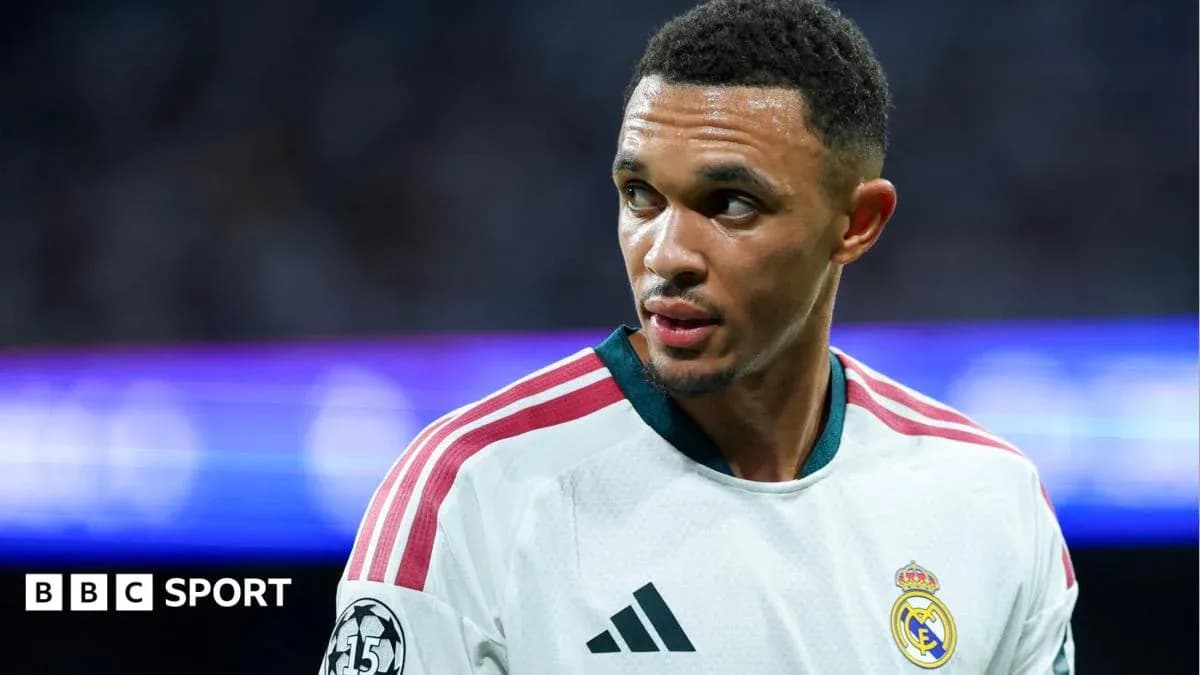
On Tuesday night, under Champions League lights against Inter Milan, Alexander-Arnold lined up as a midfielder for Real Madrid. Not as an inverted full-back. Not as a hybrid. As a bona fide central option.
The performance? Complicated.
Mourinho’s reluctant midfielder
Real Madrid edged a tense 2-1 win, and Alexander-Arnold was right in the middle of it – literally and figuratively. Yet Mourinho moved quickly to shut down any notion that this was the start of a permanent reinvention.
“He has played midfield with England and Liverpool... but he is not a midfielder,” Mourinho said afterwards. The message was blunt. Appreciative, but blunt.
The decision to use him there was born out of necessity. Suspensions for Eduardo Camavinga, Arda Guler and Bernardo Silva stripped Mourinho’s squad of central options and forced a reshuffle. Alexander-Arnold stepped in alongside Federico Valverde, asked to knit play and push Real forward.
He did some of it well. He also looked like a player still learning the role.
Mixed night in the middle
On the ball, his quality showed. Alexander-Arnold created two chances and hit more crosses than any other Real player. His passing still cut lines, his delivery still carried threat. But the numbers told a story of adjustment as well as influence.
An 83.3% pass completion rate, lower than he would expect. No tackles won. Moments where the game seemed to move a fraction quicker than his positioning.
When Inter pulled one back on 77 minutes, Mourinho turned to his bench. Alexander-Arnold’s number went up. As he walked off, whistles rolled around the Bernabeu. It felt less like a verdict on him and more a release of tension at a jittery team performance, but the soundtrack was harsh all the same.
It was the first time in a competitive match that Alexander-Arnold and fellow right-back Denzel Dumfries had started together. Mourinho had already tested the pairing in pre-season against Fiorentina, with Alexander-Arnold at right-back and Dumfries pushed higher on the same flank. This time, their roles split across the pitch, one wide, one central, as Mourinho searched for balance.
Right-back battle still unresolved
What Tuesday really underlined is that Mourinho still hasn’t settled on a first-choice right-back. Last season, Alexander-Arnold had to scrap with Dani Carvajal for minutes. This year, it is Dumfries in his path.
Yet inside the club, there is respect for what the England international offers. Mourinho, by all accounts, has been impressed by his professionalism, his attitude and his ability to shift roles without complaint. He sees a different kind of full-back: one who can step into central pockets, join the build-up and hurt teams from areas usually reserved for playmakers.
The strengths remain obvious. Passing range. Crossing. Through balls. Set-piece delivery. These are elite tools, whether he starts wide or central.
The question is where those tools do the most damage.
The long-running midfield experiment
Southgate’s attempt to answer that question on the international stage ended abruptly. During Euro 2024, he tried Alexander-Arnold as a central midfielder, only to drop the idea – and the player – after an underwhelming 1-1 draw with Denmark in which Alexander-Arnold was substituted before the hour.
Yet there have been glimpses of what might be possible. In June 2023, he wore England’s number 10 shirt in Malta, scored from midfield and helped the Three Lions to a 4-0 win. Speaking to Channel 4 afterwards, he admitted the role felt natural, even if unfamiliar, and said it was a position he could see in his future.
Southgate kept flirting with the idea over the next year, never quite committing. On Tuesday, Mourinho dipped a toe in the same water – and came out sounding just as cautious.
“He has lost some balls because it is not the same to play in this position compared to at right-back,” the Real coach said. “The intensity of physical work is quite difficult. He has a different engine. He has given 100%. He left the pitch with nothing left to give.”
That last line matters. Whatever doubts exist about his best position, there is no question over his effort.
So the debate rumbles on. Right-back, hybrid, or fully-fledged midfielder? For now, Mourinho’s answer is clear: Alexander-Arnold is a full-back who can survive in midfield when Real Madrid need him to. The real intrigue is whether, one day, a manager will decide that “can” is no longer enough – and build a team around him there.