Tottenham’s New Era Begins With 3-0 Loss Against Brentford
Tottenham’s season did not just start badly. It started with a jolt.
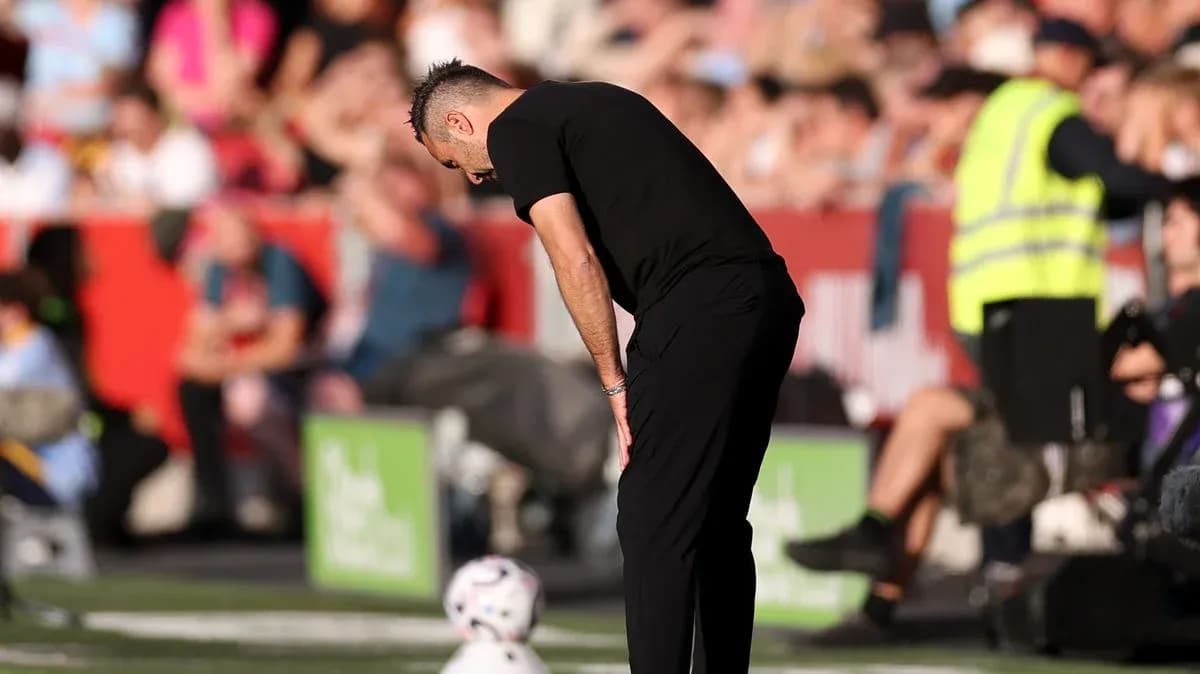
A 3-0 defeat at Brentford on opening day ripped away any illusion that Roberto De Zerbi’s revamped Spurs would glide straight into gear. New faces, new ideas, same old Premier League brutality.
At the Gtech Community Stadium, the hosts were sharper, stronger and far more cohesive. Spurs looked exactly what their head coach later called them: “not a team yet”.
Brentford ruthlessly expose a fragile Spurs
The warning signs arrived early.
On 12 minutes, new signing Mamadou Sangare drifted into the Spurs box with alarming ease. He had time. Too much of it. His cut-back found Keane Lewis-Potter, in even more space, who calmly side-footed past Antonin Kinsky. One simple move, one simple finish, and Tottenham were already chasing.
The second goal was uglier. Richarlison’s hold-up play broke down, Lucas Bergvall then lost the ball, and suddenly Brentford were in. Mathias Jensen’s effort was pushed out by Kinsky, but only into the path of Vitaly Janelt, who tapped in. Self-inflicted damage, the kind that drains belief.
Spurs trudged into half-time two down and fortunate it was not worse. It did not stay that way for long.
Within four minutes of the restart, the opening day turned into a full-blown nightmare. Sangare’s shot squeezed through a crowd, Kinsky parried again, and Michael Kayode reacted quickest, lifting the loose ball into the roof of the net. 3-0. Game gone.
Brentford even offered a mercy. Rodrigo Bentancur brought down Kevin Schade in the box and Igor Thiago stepped up from the spot, only to thump his penalty against the left post. The rebound spun away to safety. It was the rare moment that went Tottenham’s way.
Almost everything else belonged to the home side.
“We are not a team yet”
In the bowels of the Gtech, De Zerbi did not bother hiding from the reality.
“For many reasons. I think we are not a team yet,” he said. “Before becoming a team, we can't say what we can do.”
He pointed to fitness, preparation and upheaval, but refused to dress them up as excuses. Players returned late from international duty. The club’s Australia trip disrupted proper work. A new project, a new process, and all the teething problems that come with it.
“For sure, we are not in the right point in physical condition,” he admitted. “But they are not excuses. They are the normal situation when you are building a new project.”
He knew this might happen. The Hoffenheim friendly had already set off alarms in his mind.
“I said we are not in the right point, we are late for the start of the Premier League. But it's a step, we have to improve quickly.”
What stung him most was not just the scoreline, but the manner of the defeat.
“We lost too many duels, we made too many mistakes in the timing when we wanted to push the pressure higher. We arrived second for the second ball, we didn't win one second ball, one duel, one tackle, and it's tough.”
Kids on the frontline of a rebuild
De Zerbi repeatedly circled back to the youth in his side. This was not a throwaway line. It was central to his explanation.
“If you analyse last season, the defensive line, Porro, Danso, Micky Van de Ven and Udogie,” he said. “And today, Archie Gray, JP Van Hecke, Senesi and Robertson, four new players.”
In midfield, too, the contrast was stark. Last season, Rodrigo Bentancur and Palhinha. This time, Bergvall started ahead of Bentancur, who came back late in pre-season.
“I think at the beginning of the season, at the beginning of the new project, it was good, it was right to play with Lucas Bergvall,” De Zerbi said. He knew the risk. “Before the game, Lucas Bergvall, in this type of game, maybe he could suffer more than Rodrigo Bentancur, nine years older, and Lucas, 20. I knew before the game.”
Bergvall’s error led to the second goal, yet De Zerbi refused to hang him out to dry.
“I think he didn't play bad today, even if I substituted in the half-time,” he insisted. “Lucas Bergvall in the next two years, he will not lose that ball in that moment of the game. But there are steps to become better.”
The same applied to Archie Gray, another young piece in the new structure.
“Archie Gray can play as a full-back, as a midfielder. But I think he's much better than his performance today. But not just Archie Gray, also JP Van Hecke, Sandro Tonali, Richarlison, everyone. We didn't play a good game. But we can't change our idea on Archie Gray for today, or for Richarlison or Mathys Tel.”
The message was clear: the club is committing to a long-term plan, even if it hurts in the short term.
“We go, and we try to build something good for the club. We need also Archie Gray, we need also Lucas Bergvall, or we work for today. And tomorrow, I don't know.”
Soul, style and a missing identity
De Zerbi has spoken often about the intangible side of building a side. He went back to that theme again.
“To become a team, in my home, there are two big conditions. The soul and the style of play,” he said. “And today, we didn't show the soul, and we didn't show the quality of the play. With the ball and without the ball.”
That cut to the heart of the performance. Spurs looked disjointed in possession and far too soft without it. No clear press, no control, no edge.
“When we find these two conditions, I think we can become dangerous for everyone, every team. Until we don't arrive, we don't reach these conditions, we have to suffer,” he said. “And today, I think it's important for us, this defeat, because maybe we woke up stronger than we thought, maybe.”
The shock was shared.
“I was surprised, I was suffering for this defeat,” he admitted. “Even (though) we are suffering for the defeat, we are shocking for this defeat, especially for the way we lost the game. Because they deserve to win and we played very, very bad.”
Set-pieces, duels and the Romero-Palhinha void
One of last season’s foundations was Tottenham’s strength at set-pieces. That platform has been weakened.
With Cristian Romero and Palhinha gone, Spurs have lost two of their biggest weapons in both boxes. De Zerbi acknowledged the issue, but pointed to a different problem.
“Brentford in set-pieces are maybe the best team in the Premier League. So it's normal to suffer,” he said. “I think we suffer more the duels, more the second ball than the set-pieces.”
It was not just about structure. It was about fight.
“Anyway, we could fight stronger than we did today,” he said earlier. On this evidence, Spurs will have to.
Time, and how quickly it can pass
Supporters will not want to hear about patience after a 3-0 opening-day defeat. De Zerbi knows that. He also knows he cannot fast-forward chemistry.
“We need time, but I think we are much better than we showed today,” he said. “So from Wednesday we can show our qualities, and we can show who we are.”
He expects a reaction in midweek and against Newcastle next weekend. He also warned that one good result will not magically fix the deeper issues.
“Even if we win Wednesday or next Saturday, we need time to become a team. Because to become a team we need time. We need time, we have to analyse the situation, we have to understand the situation. The improvement we have to do, every one of us, because we lose and we win together.”
He insists his belief is intact.
“I couldn't lose confidence in my players. I believe in my players, I believe in my club, I believe in myself. I think we are working well.”
The Premier League, though, does not wait. Spurs have thrown themselves into a new project with young players, fresh combinations and a demanding coach who wants soul and style, not just results.
The first step was brutal. The question now is simple: how quickly can Tottenham turn “not a team yet” into something opponents actually fear?