Torino's Tactical Mastery in 2–1 Comeback Against Sassuolo
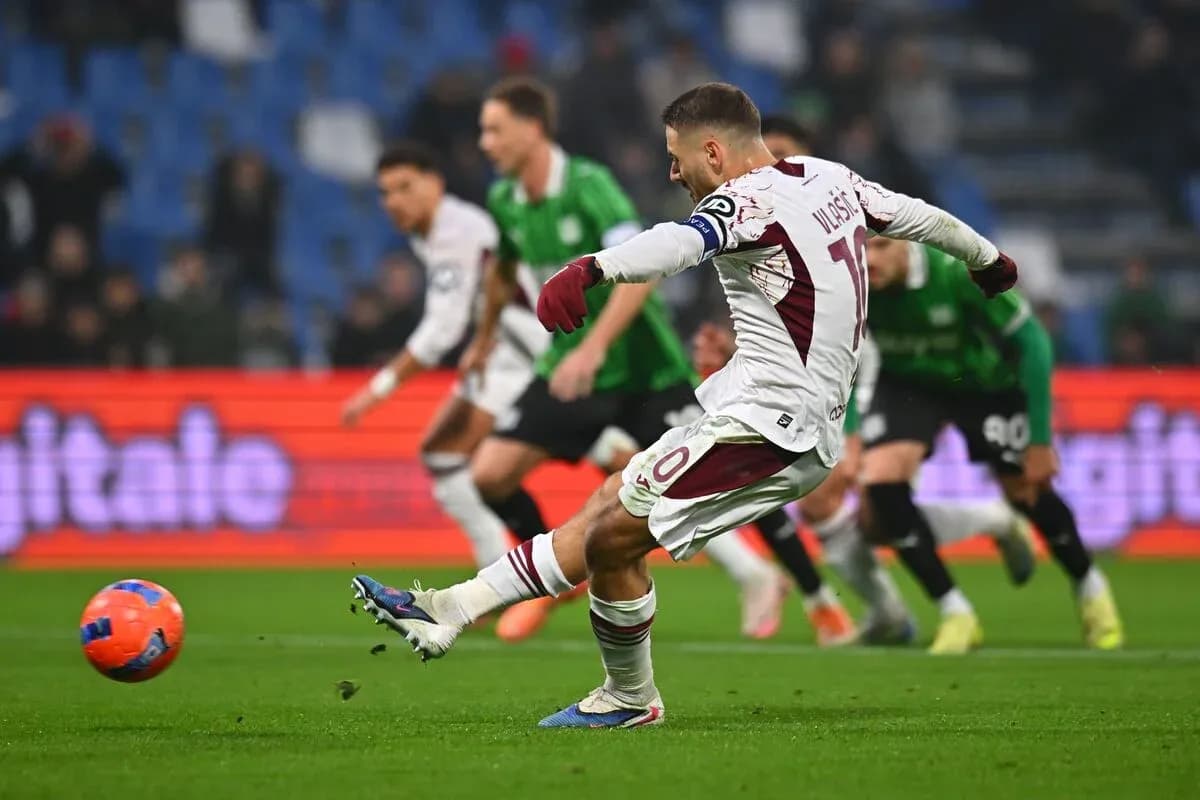
Torino’s 2–1 comeback over Sassuolo at Stadio Olimpico Grande Torino unfolded as a classic Serie A control-versus-directness duel, with Leonardo Colucci’s 3-4-2-1 gradually overwhelming Fabio Grosso’s 4-3-3 despite Sassuolo’s early initiative and marginal edge in possession (52% to 48%). The hosts translated their territorial pressure and superior chance quality (xG 2.82 to 2.1) into a second-half turnaround, driven by aggressive wing-back use, a high central block, and decisive bench interventions.
The disciplinary balance reflects a physically intense but controlled contest: Torino collected four yellow cards, Sassuolo two, all explicitly for “Foul”. In total: Torino: 4, Sassuolo: 2, Total: 6.
Disciplinary Log
- 38' Luca Lipani (Sassuolo) — Foul
- 51' Luca Marianucci (Torino) — Foul
- 63' Matteo Prati (Torino) — Foul
- 86' Kristian Thorstvedt (Sassuolo) — Foul
- 89' Niels Nkounkou (Torino) — Foul
- 90+3' Gvidas Gineitis (Torino) — Foul
Scoring sequence followed the same second-half surge. Sassuolo struck first at 51', immediately after Marianucci’s booking had momentarily disrupted Torino’s back line. Kristian Thorstvedt finished for the visitors, assisted by L. Lipani, exploiting the central channel between Torino’s wide centre-backs. The goal crowned a period where Sassuolo’s 4-3-3 had been finding pockets between Torino’s midfield duo.
Colucci’s response was immediate and structural. At 59', A. Njie (OUT) made way for D. Zapata (IN), and V. Lazaro (OUT) for M. Pedersen (IN). These two substitutions tilted the game. Zapata became a focal point for direct play, while Pedersen offered more verticality and crossing threat than Lazaro.
The equaliser came at 66', emblematic of Torino’s wing-back and half-space interplay. G. Simeone scored, assisted by E. Ebosse, after Torino worked the ball into advanced wide zones and attacked the box with numbers. One minute later, Colucci refined his midfield balance: M. Prati (OUT) for E. Ilkhan (IN) at 67', adding fresh legs and slightly more dynamism in the double pivot.
Torino’s winner at 70' was a pure substitution vector payoff. M. Pedersen, who had replaced Lazaro, scored with D. Zapata providing the assist. The pattern again underlined Torino’s shift toward direct, high-value entries into the box, using Zapata’s presence to destabilise Sassuolo’s centre-backs and open the far side for Pedersen’s late run.
Grosso’s reaction came later and was more reactive than proactive. At 63', he had already refreshed his front line and midfield balance: C. Volpato (OUT) for D. Berardi (IN) and L. Lipani (OUT) for I. Kone (IN), sacrificing some vertical running from Lipani for more on-ball creativity and ball-carrying from Kone. However, by the time further changes arrived, Torino had seized control of momentum. At 75', J. Doig (OUT) was replaced by U. Garcia (IN), and at 76' A. Pinamonti (OUT) by M. Nzola (IN), with 84' bringing N. Matic (OUT) for D. Bakola (IN). These moves marginally refreshed Sassuolo’s shape but did not fundamentally alter the dynamic: Torino were now defending higher, compressing space, and countering directly through Zapata and Simeone.
From a structural standpoint, Torino’s 3-4-2-1 offered superior occupation of the half-spaces once they raised the tempo. The back three of E. Ebosse, S. Coco, and L. Marianucci allowed the wing-backs V. Lazaro (later M. Pedersen) and R. Obrador (later N. Nkounkou) to push very high, effectively pinning Sassuolo’s full-backs J. Doig and W. Coulibaly. In midfield, M. Prati and Gvidas Gineitis initially struggled to control the zone against N. Matic, L. Lipani, and K. Thorstvedt, but Torino’s attacking trio of N. Vlasic, A. Njie, and G. Simeone increasingly dropped into pockets to overload Sassuolo’s central three.
After the break, this structure turned into a high central block: Torino’s front three and double pivot pressed Sassuolo’s first phase, forcing longer passes that their back three could handle. This is reflected in the shooting profile: Torino generated 18 total shots (13 inside the box) to Sassuolo’s 14 (11 inside), but crucially turned that into a higher xG (2.82 vs 2.1). Their 7 corner kicks to Sassuolo’s 5 underline the territorial shift toward the home side’s favour.
Sassuolo’s 4-3-3, with Thorstvedt as the advanced midfielder, initially enjoyed more of the ball (52% possession, 480 passes at 87% accuracy) and looked comfortable building through Matic and Lipani. However, once Torino increased their pressing intensity, Sassuolo’s midfield began receiving under more pressure, and their attempts to play through central areas were increasingly broken up by Gineitis and Prati/Ilkhan. The bookings for Lipani (38') and later Thorstvedt (86') for “Foul” also highlight the strain on Sassuolo’s midfield in transition, often forced into late challenges to halt counters.
In goal, A. Paleari’s workload was heavier: 5 saves to A. Muric’s 2, consistent with Sassuolo’s 7 shots on target versus Torino’s 4. Both keepers, however, posted the same negative goals-prevented figure (-0.25), indicating that finishing slightly outstripped their shot-stopping. Torino’s higher xG yet narrow 2–1 margin suggests some under-conversion, but their ability to create repeatable, high-quality chances through wing-back overloads and target-man play was the decisive tactical edge.
Defensively, Torino’s higher foul count (13 to Sassuolo’s 9) and four yellows indicate a more aggressive, sometimes last-ditch approach to protecting their lead in the final phase. The late bookings for Niels Nkounkou (89') and Gvidas Gineitis (90+3') for “Foul” underline how the closing minutes were about game management and disrupting Sassuolo’s rhythm.
Overall, the statistical verdict supports the narrative of a deserved Torino win: slightly less of the ball but more incisive, with superior xG, more shots, and better exploitation of substitutions. Sassuolo’s structure produced phases of control and a well-constructed opening goal, but their inability to adapt once Torino turned the match into a more direct, transition-heavy contest ultimately cost them the points.