Tony Popovic Refuses Four-Year Deal to Lead Socceroos
Tony Popovic has turned down the chance to lead the Socceroos all the way to the 2030 World Cup, choosing instead to live on the edge.
Offered a fresh four-year deal by Football Australia in the wake of the country’s bitter World Cup exit, the national coach has only committed until the end of January’s Asian Cup in Saudi Arabia – and says he will happily walk away once that contract ends, convinced his legacy is already in motion.
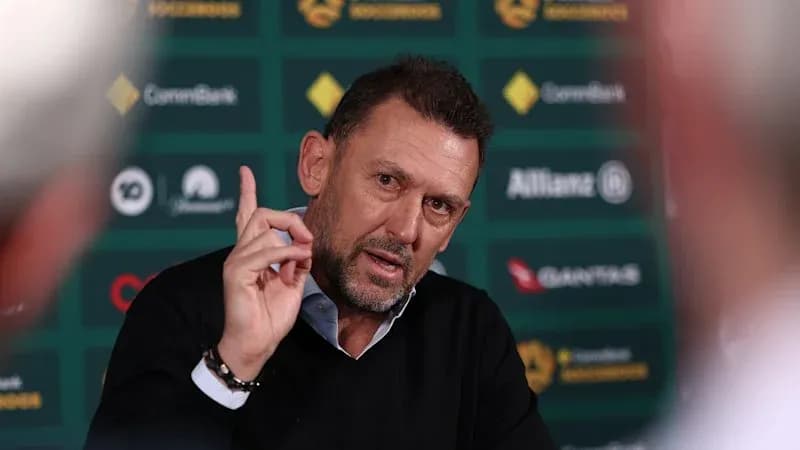
“I love coaching the Socceroos,” Popovic said on Tuesday, fronting the media for the first time since Australia’s controversial elimination in the United States. “It was my choice to go until the Asian Cup. Although I was offered a four-year deal, I decided to go to the Asian Cup. That’s something I think is good, and it also gives the FA an opportunity; if they want to go in a different direction, they can.”
He was calm. Almost disarmingly so.
“I’m very comfortable with the decision that’s been made. I’m very comfortable with how I’ve always worked for the future … if I leave a week later, I’ll still be comfortable with that.”
A four-year offer refused
Popovic’s short extension was quietly locked in on the eve of the World Cup. Only now is it clear how far FA were willing to go, ready to hand him another full cycle before a ball was kicked in the United States.
He insists job security never entered his thinking. If it had, he admitted, his World Cup squad would have looked very different.
Instead of leaning on experience, Popovic rolled the dice on youth. Australia fielded four of the eight youngest starting XIs at the tournament, a deliberate gamble aimed at fast-tracking a core capable of pushing deeper at the 2030 and 2034 World Cups – tournaments he openly accepts he may not be there to coach.
The shift was brutal. Fourteen players who featured in the decisive June 2025 qualifiers against Japan and Saudi Arabia were nowhere to be seen at the World Cup. In their place came the next wave: Lucas Herrington, Nestory Irankunda, Paul Okon-Engstler, Mohamed Toure and others, blooded at the game’s highest level years before their peak.
“That needs to happen,” Popovic said. “We need to create a pool of players that in four years, if we are fortunate enough to be at a World Cup … then you want to be in a better position with the starting players and the players that can come on and make a difference.”
That philosophy will not soften just because his contract clock is ticking. He has already signalled “a few fresh faces” for this month’s friendlies against Brazil in Queensland, and another youthful squad for the Asian Cup, where his minimum benchmark is a semi-final berth.
Living with the World Cup fallout
The anger after the round of 32 loss to Egypt has been raw. Pundits and fans have lined up to question his selections, his tactics, his substitutions. Popovic has heard it all.
He said he understands the emotion, but he is not backing away from his calls.
His only real regret? The second group game against the USA.
Australia had stunned Turkey 2-0 in their opener. Euphoria swept through the camp, and around the country. Then came the showdown with the co-hosts – and a selection call that lit up talkback lines.
Popovic benched match-winners Nestory Irankunda and Connor Metcalfe, bringing in Mathew Leckie and Nishan Veliupillay. The Socceroos were then, in his own words, “outrun, outfought, out-duelled … whatever you want to call it.”
Looking back, he thinks he went only halfway.
“Part of me thinks I should have made more changes to the line-up, because I could sense the euphoria [from the Turkey win] and what it took out of a young group leading into the game,” he said. “We looked really fatigued in training. Maybe that’s the one I thought, I should have made more, and I felt that in the first half, after about five or 10 minutes, that we looked flat.”
The lesson stings. But it has not shaken his belief in the broader plan.
No regrets from the spot
If he could replay the penalty shootout against Egypt, Popovic would press the same buttons.
Maty Ryan still comes on late for Patrick Beach. Harry Souttar and Lucas Herrington still step up among the first five takers, even though both missed.
There was no grand confession, no sweeping apology. Irankunda and Metcalfe returned to the starting XI for the next match against Paraguay and performed strongly. For Popovic, that underlined the logic behind his rotation – they were fresher, sharper, better able to influence the game.
Where Australia fell short, he argued, was not in mentality but in endurance and depth.
Across the six months leading into the World Cup, the Socceroos’ attacking players managed just 23 full club matches between them. Ten of those belonged to Ajdin Hrustic alone. It left Australia with forwards who could burn bright, but not for long.
“When it gets to that 60th or 70th-minute mark ... they are fatigued, they are exhausted, they have nothing left,” Popovic said. “That’s what we had. We knew that before the World Cup, and we knew we’d have to juggle those players through games to try and get the best out of them and to have an impact.”
He knew the limitations. He picked a path anyway.
A short contract, a long view
So Popovic heads towards the Asian Cup with his future deliberately unresolved. No safety net. No guaranteed tilt at 2030.
The message is clear: judge him on the football and on the foundations he leaves behind, not on the length of his deal.
He has chosen risk over comfort, youth over short-term insulation, and a tight deadline over a four-year guarantee. The next few months will reveal whether that conviction hardens Australia – or hands someone else the keys to a team he has only just begun to reshape.