Sweden's Unlikely Path to World Cup Qualification
Sweden are going to the World Cup, and the story of how they got there reads like a bureaucratic loophole wrapped in a football miracle.
It starts with a goal that, technically, has nothing to do with World Cup qualifying. Alexander Isak, November 2024, Nations League C. A dead-end competition in its third tier, or so everyone thought.
Right foot to control. Shift to the left. A vicious strike. Sweden 2, Slovakia 1.
At the time, it felt like a nice night rather than a turning point. Sweden topped their Nations League group, celebrated modestly and moved on. No one imagined that this would become the cornerstone of their route to North America. Anthony Elanga later admitted he had no idea that winning that group would grant Sweden a backdoor into the World Cup playoffs.
You understand why he didn’t bother checking the fine print.
Sweden were a shambles in their actual qualifying group. Bottom. Below Switzerland, Kosovo and Slovenia. No wins. Zero. Two draws, four defeats, and the kind of table you normally only see when a team has been in crisis for months.
Their escape route came from previous failure. Relegated from Nations League B in 2022 after finishing behind Serbia, Norway and Slovenia (again), they dropped into Nations League C, where the opposition looked more like a pre-season schedule than a pathway to the World Cup. They topped that group ahead of Slovakia, Estonia and Azerbaijan and, buried in UEFA’s format, that title came with a playoff ticket.
From there, fortune kept nudging them along.
They were unseeded for the playoff semi-final, so an away tie was guaranteed. The draw handed them Ukraine, who cannot currently play at home. So the “away” game went to a neutral venue in Valencia. The stands were awash with yellow and blue, but more Swedish than Ukrainian. Sweden played with the air of a side suddenly sensing opportunity and won 3-1 without much drama.
Then the draw for the playoff “final” gave the winner of that match home advantage. Sweden, again, on the right side of the bracket.
Playoff Final
So it was Sweden vs Poland in Stockholm. On paper, Poland were stronger. On grass, they often looked it. They moved the ball better, controlled long spells and seemed the more coherent side. Sweden, though, defended like a team who had already used up all their luck and refused to waste the last of it.
Blocks. Scrambles. A clearance off the line. A couple of almost farcical near-own goals that somehow stayed out.
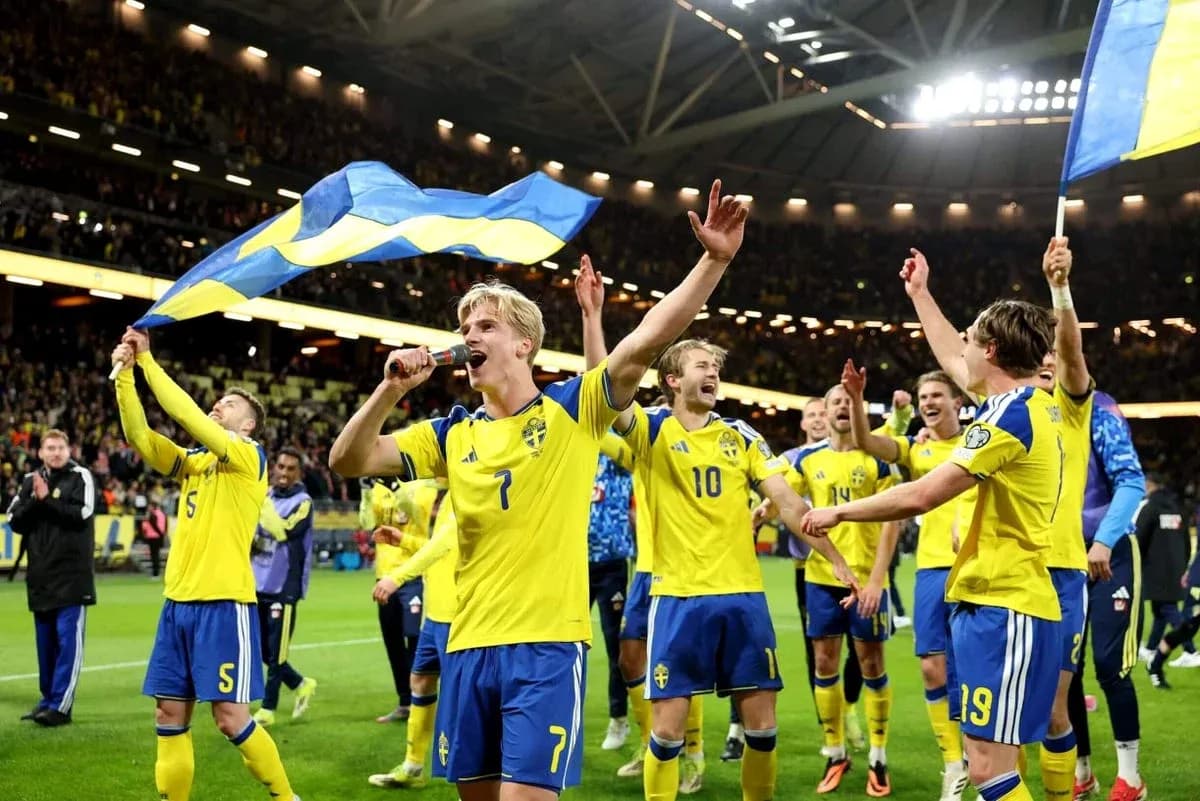
At the other end, they made their moments count. Elanga thrashed in a superb opener. Gustaf Lagerbielke rose to bury a header from a set-piece. Then, late on, chaos. The ball bounced, ricocheted, rebounded in the box, and Viktor Gyokeres eventually forced it over the line in a blur of limbs and noise. It was a pinball winner, ugly and perfect, greeted by a roar that felt like 10 years of tension leaving a football nation at once.
On any rational scale, this is one of the strangest, least merited European World Cup qualifications in decades. By June, none of that will matter.
The qualifying campaign already feels like a relic, not least because the man who oversaw most of it has gone. Jon Dahl Tomasson arrived with a distinguished playing career and a Danish passport, neither of which helped him win Swedish hearts once the results turned. Performances sagged, points disappeared, and the mood turned poisonous. His dismissal felt inevitable long before it was announced.
The replacement was not. Graham Potter, the Englishman who built his reputation by transforming Ostersund and once beat Arsenal with them, was a left-field choice and a familiar face. His affection for Sweden pulled him back, ostensibly on a short-term rescue mission. Before the playoffs even began, he had committed to a four-year deal running to the 2030 World Cup, despite failing to win either of his first two friendlies.
He walked into a treatment room as much as a dressing room.
Isak has not played since breaking his leg shortly before Christmas. Dejan Kulusevski, the captain and creative hub, has missed the entire season. Goalkeeper Viktor Johansson and right-back Emil Krafth were also out. In the semi-final against Ukraine, Atalanta defender Isak Hien limped off in the first half.
Potter’s XI for these games looked patched together. In goal, 36-year-old Kristoffer Nordfeldt finally had his moment. For 15 years he has been the perpetual understudy, the man behind the man. Under Potter at Swansea in 2018-19 he had produced some of his best club form, and the coach trusted him again. It paid off. Nordfeldt made two big saves against Poland and repeatedly turned defence into attack with booming kicks and quick throws that launched Sweden upfield.
Gyokeres, though, was the headline act.
His season at Arsenal has been uneven, but he remains the top scorer for the leaders of what many still call the strongest league in the world. Given full control of the attack in Isak’s absence, he tore Ukraine apart with a hat-trick, constantly spinning in behind and driving at a retreating back line. Against Poland he was quieter, more isolated, but when the ball broke loose late on, he was exactly where Sweden needed him.
One swing, one scramble, one eruption around the Strawberry Arena.
Strip away the chaos, and there is a serious team hiding in here. If Isak returns, Sweden regain one of the most devastating forwards in the game, the third-most expensive player in football history for a reason. If Kulusevski is fit, they add a playmaker who, at the start of last season, was posting attacking numbers in the Premier League bettered only by Mohamed Salah.
Behind them, the future looks bright. Yasin Ayari and Lucas Bergvall carry the air of central midfielders who could anchor this side for a decade. Many in Sweden argue this is the best generation the country has produced in years, which only makes the tortuous route to qualification feel more surreal.
Potter, with his much-discussed Master’s degree in leadership and emotional intelligence, seems to have done what Tomasson could not: steady the mood and knit the squad together. The football is not yet fluent, but the buy-in is clear. So is the belief.
The last time North America staged a World Cup, in 1994, Sweden finished third, a golden summer etched into national memory. This time, they could not even finish third in their qualifying group.
Yet here they are, ticket stamped, preparing for Tunisia in Monterrey, the Netherlands in Houston and Japan in Dallas.
Given everything that has happened, anything beyond the group would be a bonus. Then again, for a team that have already broken the rules of how you qualify, who dares predict where this strange journey stops?