Sevilla vs Valencia: Clash of Identities in La Liga
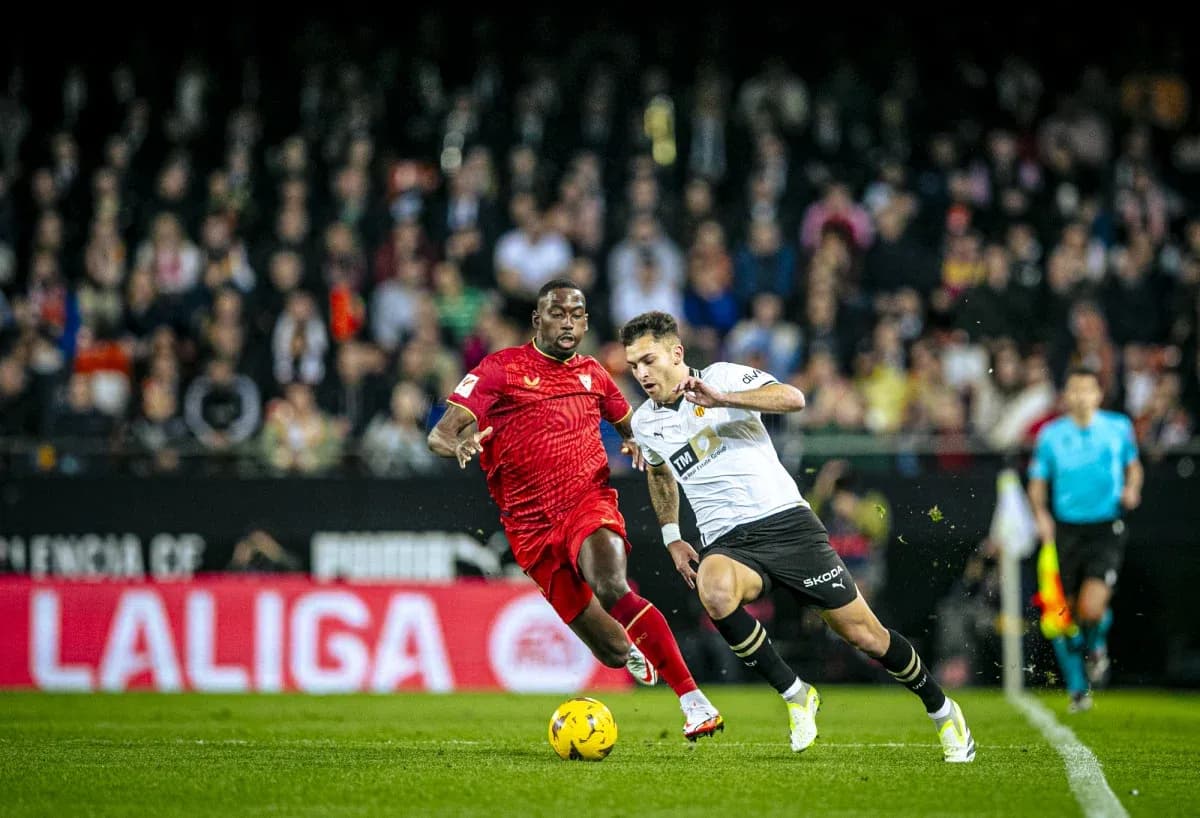
On a cool March night at Estadio Ramón Sánchez Pizjuán, this regular-season La Liga fixture felt more like a referendum on two divergent projects than a simple 2-0 Valencia win. By full time, the scoreboard, the patterns of play and the broader season context all told the same story: Sevilla are still searching for an identity, while Valencia are quietly becoming one of the division’s more coherent mid-table operators.
I. Clash of identities
The league table frames the narrative starkly. Sevilla sit 15th on 31 points, four behind 12th-placed Valencia, and with a worse goal difference (-12 to Valencia’s -10). Over 29 games, Sevilla have produced a respectable offensive volume — 37 goals, 1.3 per game — but that output has been drowned by a leaky back line conceding 49 (1.7 per game). At home, they are barely positive in attack (19 goals in 15 matches) and still porous (22 conceded).
Valencia arrive with a different statistical DNA. Their 32 goals from 29 matches (1.1 per game) paint a more conservative attacking picture, but they compensate with marginally better defensive control: 42 conceded (1.4 per game). The split is telling: at Mestalla they are compact and efficient (19 scored, 15 against), away from home they become a more fragile, reactive side (13 for, 27 against).
This match, however, inverted those away frailties. Carlos Corberan shifted Valencia into a 4-3-3, mirroring Matias Almeyda’s Sevilla shape, and his side dictated the key phases. Where Sevilla’s season-long form line reads like a seismograph of instability (LLWDWLWWLLLWLLDWLLLDWLDDWDDLL), Valencia’s is chaotic but trending upward (DLWLWDLLDLLDWDDLDLDWWLLWLWWLW). That underlying trajectory was visible in the way they managed the game once ahead: pragmatic, disciplined, and unflustered.
II. The butterfly effect: absences and tactical voids
Both squads came into the night carrying significant absences, and the knock-on effects were clear.
For Sevilla, the loss of Marcao to a knee injury removed a natural left-sided organiser from the back line. In his place, Kike Salas and Nemanja Gudelj formed the central pairing, flanked by Gonzalo Montiel’s replacement on the right, Cesar Azpilicueta, and the adventurous Gonzalo Suazo on the left. Without Marcao’s calm distribution, Sevilla struggled to progress cleanly through the thirds; long diagonals and rushed vertical passes replaced the more measured build-up Almeyda has often sought when using back-three structures earlier in the season.
Further forward, the absence of Peque due to an ankle injury deprived Sevilla of a secondary penalty-box presence and late runner from wide areas. The front three of Rafa Mir’s stand-in R. Vargas, Neal Maupay and Alexis Sanchez were forced to drop deeper to link play, leaving the box sparsely occupied when crosses did arrive.
Valencia’s injury list was even longer: J. Agirrezabala, J. Copete, Mouctar Diakhaby, Dimitri Foulquier, T. Rendall and F. Ugrinic all missed out. Yet Corberan’s side absorbed those blows better. Eray Comert and Cristhian Tarrega stepped into central defence and, crucially, were shielded by a compact midfield triangle of Javi Guerra, G. Rodriguez and Andre Almeida. The structure reduced the exposure of a makeshift back line, particularly in defensive transitions.
Disciplinary trends added another layer. Sevilla’s season card profile shows a team that increasingly lives on the edge as games wear on: 19.75% of their yellows arrive between 76-90 minutes and another 20.99% in stoppage time. That late-game volatility has already cost them rhythm and control in tight contests. Valencia, by contrast, cluster their yellows between 46-90 minutes but with a slightly more even spread, suggesting a side that can foul to disrupt without consistently tipping into chaos.
III. Narrative matchups
The Hunter vs. The Shield
Hugo Duro entered as Valencia’s primary scoring reference and one of La Liga’s most efficient strikers this season: 9 goals from just 24 total shots, with half of those on target. His 205 duels and 29 fouls drawn underline his role as both finisher and irritant.
Against a Sevilla defence that has already conceded 49 times and has a worst-case scenario of a 5-2 away collapse in its season history, Duro’s movement was always likely to stretch the seams. Gudelj and Salas had to choose between stepping into midfield with him or holding the line; whenever they hesitated, Valencia exploited the gaps with wide runners Luis Rioja and Largie Ramazani. The result was a first half in which Sevilla’s back four were constantly dragged into uncomfortable spaces, and Valencia capitalised to build the decisive 2-0 interval lead.
The Engine Room Duel
In midfield, Lucien Agoume and Djibril Sow were tasked with dictating Sevilla’s tempo. Agoume, one of La Liga’s most active enforcers with 9 yellow cards and 44 fouls committed, usually gives Sevilla a combative edge. Yet here, the balance tilted the other way.
Valencia’s trio played with superior vertical clarity. G. Rodriguez anchored, allowing Guerra to surge and Almeida to drift into half-spaces. This triangle not only disrupted Sevilla’s attempts to build through L. Agoume and J. Sanchez, it also launched quick transitions the moment possession was won. Sevilla’s midfielders were often chasing back towards their own goal rather than orchestrating in the opposite direction.
Depth and game-changers
On paper, Sevilla’s bench offered a range of profiles: the direct running of Isaac Romero, the creativity of Adnan Januzaj, and the control of Joan Jordan. Valencia, meanwhile, could call upon A. Danjuma’s unpredictability and the penalty-box presence of Umar Sadiq.
Yet the structural deficit meant Sevilla’s changes felt more like like-for-like swaps than genuine tactical levers. Without a stable platform behind them, the attacking substitutes were dropping into the same disjointed patterns. Valencia’s depth, even amid injuries, was used more strategically: fresh legs in midfield and wide areas to preserve the block, manage the clock and continue to threaten on the break.
IV. Statistical prognosis and verdict
Zooming back out to the season arc, the numbers reinforce what unfolded on the pitch. Sevilla’s 1.3 goals per game are undermined by a defence conceding 1.7, and they have failed to score six times. Valencia, despite scoring only 1.1 per game, have already collected eight clean sheets and limited opponents to 1.4 goals on average.
Home and away splits hint at where this result fits. Sevilla’s Sánchez Pizjuán has not been the fortress of old: 4 wins, 4 draws, 7 defeats, with only two home clean sheets. Valencia, though poor away (3 wins, 3 draws, 9 defeats, 13 scored, 27 conceded), arrived with a clear plan to sit in a mid-block, compress the centre and let their front three punish mistakes. They executed it with a maturity that belied those away numbers.
The decisive factor, both in this match and likely in the weeks ahead, is Sevilla’s tactical void in central defence and midfield balance. Without Marcao’s organising presence and with Agoume forced into perpetual firefighting, Almeyda’s 4-3-3 lacks the stability to unleash its attacking talent consistently. Valencia, by contrast, have found a functional spine: Dimitrievski’s authority, Comert-Tarrega’s rugged partnership, Guerra’s energy and Duro’s ruthless efficiency.
Unless Sevilla can tighten their structure and reduce the late-game disciplinary swings that so often erode their control, nights like this — where their offensive volume is smothered by smarter, more compact opponents — will continue to define their season. Valencia leave Sevilla not just with three points, but with the look of a side that understands exactly what it is.