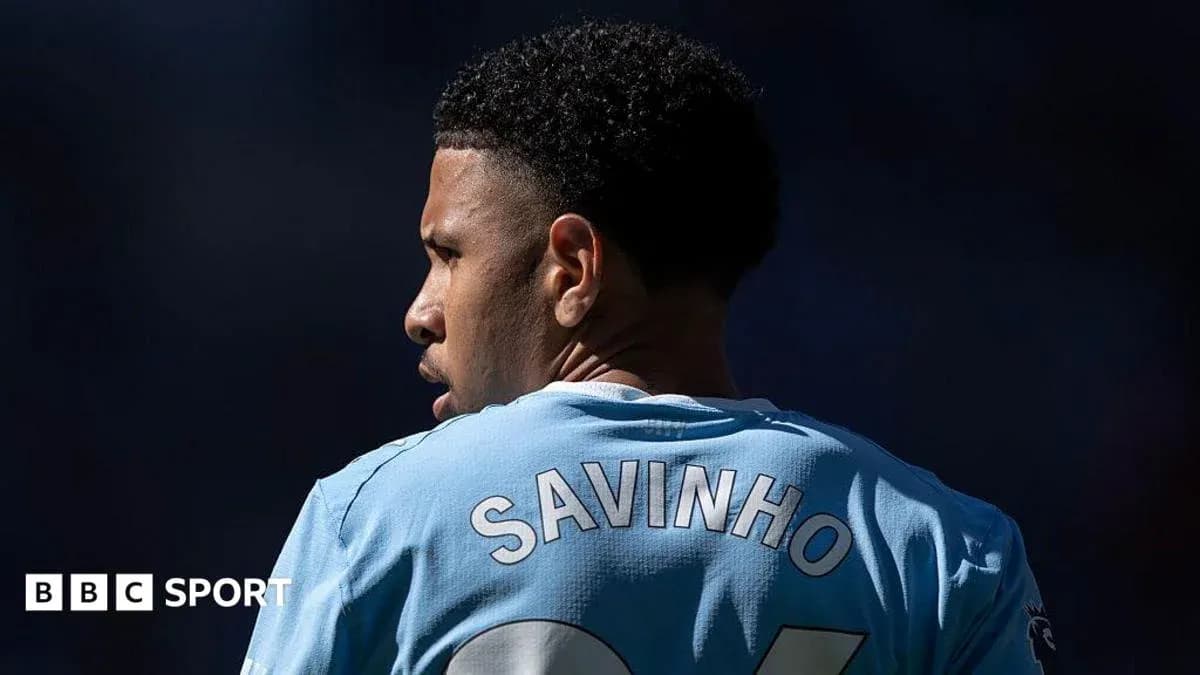
Savinho's Record Move: City Football Group's Talent Trading Success
For the City Football Group, Savinho’s sale to Tottenham is more than another big number on a balance sheet. It is the moment their global experiment in talent trading produces its clearest headline yet.
A £75m fee, with a further £10m in add-ons, makes the Brazilian winger the most lucrative sale in Manchester City’s history. From a teenager plucked out of South America to a record departure four years on, the arc is exactly the kind of story CFG has built its business model around.
From Troyes ghost to Girona star
Savinho’s journey through the network has not been straightforward. He arrived in Europe in 2022 as a record signing for Troyes from Atletico Mineiro, only to leave two years later without kicking a ball for the French club.
Instead, CFG sent him on the road. First to PSV in 2022-23, where he learned the rhythms of European football. Then to Girona in 2023-24, where everything clicked.
In Spain, the winger exploded. He played 37 league games, scored nine goals, delivered eight assists and helped Girona qualify for the Champions League for the first time in their history. His performances earned him a place in the La Liga team of the year and turned him from a project into a prized asset.
City moved quickly. They bought him from Troyes for £30.8m in 2024, a fee that immediately raised eyebrows. Was that the true market rate, or a clever piece of internal accounting by a multi-club empire that knows exactly what it owns?
City’s short stay, CFG’s big win
On the pitch in England, Savinho never quite became a superstar. Across two Premier League seasons he scored just twice, though he did rack up 12 assists. Not a flop, not a phenomenon. Somewhere in between.
But financially, he has been gold.
The profit margin tells its own story. If all bonuses are triggered, CFG will have turned an 18-year-old signing into almost £70m of profit in four years. In a football economy where player trading increasingly underpins everything from wage bills to stadium projects, that kind of deal is transformative.
City and CFG see more than numbers. They point to the pathway: South America to Europe, development loans, a starring role in La Liga, then a season in Guardiola’s squad. In his first year at City, Savinho made 48 appearances in all competitions and produced 16 goal contributions. His eight Premier League assists were the highest at the club that season.
For CFG’s managing director of global football, Brian Marwood, it is the template.
“It’s a success story for the group,” he told BBC Sport. “The idea is always ‘can we get them to the pinnacle in our group’, which is Manchester City. There might be some along the way that might be good assets for the group. And Savinho has clearly been a fantastic asset – because not only has he played for Manchester City but now he is leaving for a considerable amount of money.”
Girona wanted more, City chose the cash
At Girona, they would have happily kept him.
“Our intention from the moment that we reached the Champions League was to try to get him to stay for another year,” said sporting director Quique Carcel.
City had other ideas. Guardiola and sporting director Txiki Begiristain weighed up two options: keep Savinho at Girona for another season, now with Champions League exposure, or pull him into the first-team squad at the Etihad.
Carcel described that internal debate. City knew another year in Catalonia would be valuable. But once Guardiola and Begiristain made it clear they saw Savinho as capable of playing in City’s first team, the player’s mind was made up.
Tottenham’s bid has now settled the argument in another way. Some will insist Spurs have overpaid. Only his performances in north London will decide whether this is an audacious coup or an expensive gamble.
CFG, though, can sit back and watch. Their work with Savinho is done.
A conveyor belt of profit
This is not a one-off. Manchester City, as a club, have turned the sale of young players into a major revenue stream.
Over the past five years, they have brought in more than £250m from selling emerging talent. Morgan Rogers, Douglas Luiz, Cole Palmer, Liam Delap and Oscar Bobb are just some of the names who left the Etihad and either are, or have been, playing for rival Premier League clubs.
Some deals sting in hindsight. Rogers moved from City to Middlesbrough in February 2024 for an initial £8m. In August 2025, Chelsea paid £117m to sign him from Aston Villa. Palmer, sold to Chelsea for £40m in 2023, would now command a similar fee if he were to leave Stamford Bridge.
City know they do not always get the timing right. But the volume of sales shows a system working as designed.
“To find a balance between recruiting players for sporting success and ones that could become more of an asset in the future is difficult,” Marwood said. Young signings are always a gamble, but the club’s network and resources give them more throws of the dice.
He points to examples like Oleksandr Zinchenko, Taty Castellanos and Jack Harrison as players who came in young and built strong careers, even if their peak years came away from Manchester.
Some talents hit. Some miss. That is the nature of recruitment at scale.
The next wave already forming
Savinho’s departure does not close a chapter for CFG; it simply clears space for the next story.
Inside the group, there is growing excitement about Ryan McAidoo, the 18-year-old who has already made his senior debut for City. Vitor Reiss, who spent last season on loan at Girona, is tipped to follow Savinho’s route and make the grade at the top level.
The net is cast far wider than England and Spain. In Japan, 16-year-old attacker Shin Miidera is catching the eye at Yokohama F. Marinos, another CFG club. In the United States, 16-year-old midfielder Cavan Sullivan is developing at Philadelphia Union, with a deal in place to join Manchester City when he turns 18.
This is the machine at work: identify early, develop across the network, then decide – keep, loan or sell.
“In an ideal world you would love for them to stay with you from the beginning right through to the very end – but the reality is it’s probably not going to happen,” Marwood admitted.
“The challenge is can we produce the next one? OK – Savinho’s gone – but where is the next one? That’s the fascination of this business, you have to look three and four years ahead.”
CFG believe the answer lies in what Marwood calls a “hub of young talent”, constantly moving through their clubs, constantly being tested. The aim is a conveyor belt that feeds both the first team and the accounts.
Savinho’s record-breaking move to Tottenham shows what happens when the system works at full capacity. The question now is simple: who is the next name that will turn a teenage punt into another seismic sale?