Real Madrid's Controversial Penalty Decision Explained
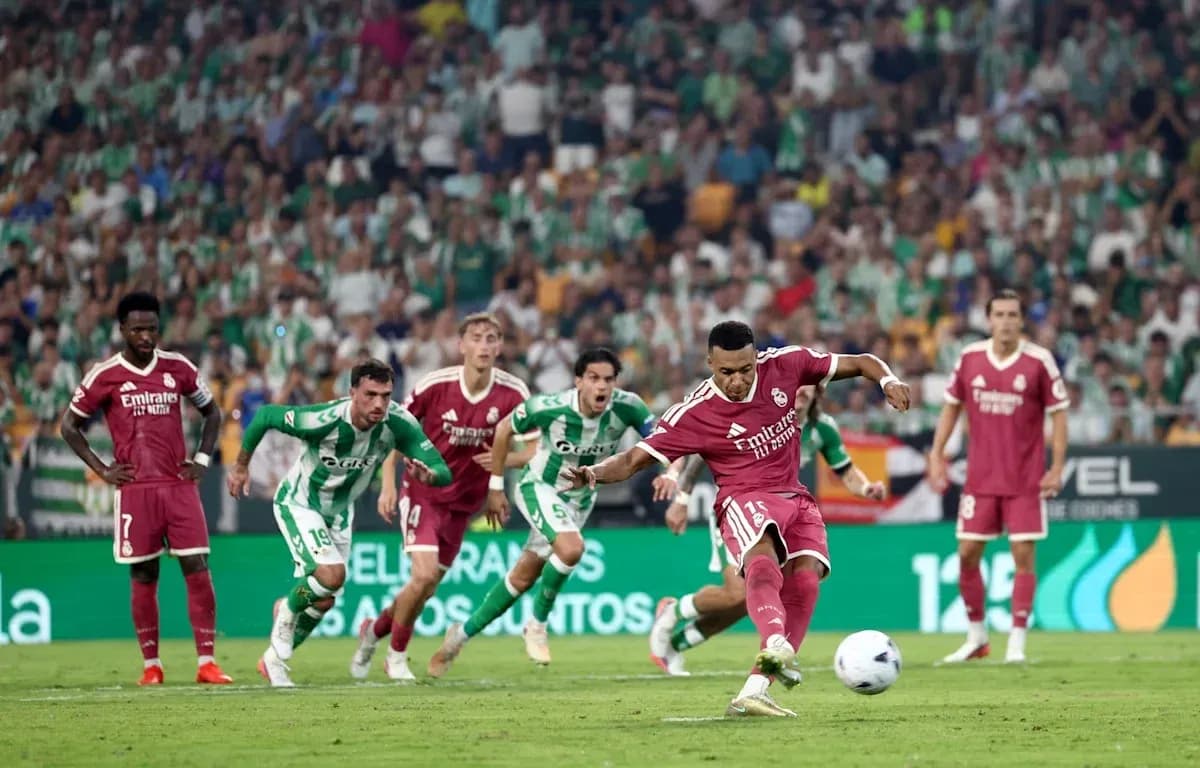
Real Madrid’s first defeat under Jose Mourinho has been ripped apart from every angle, but one image has dominated the debate: Marc Bartra hanging in mid-air as Kylian Mbappé strikes a stoppage-time penalty, and Álvaro Valles diving to save it.
For Madrid, that moment at the Benito Villamarín was the lifeline. Trailing late to Real Betis, they needed two goals in the final minutes to turn the night around. Vinicius Jr. carved out the chance, winning a penalty deep into added time. Up stepped Mbappé, with the game, the unbeaten run and the narrative all on his shoulders.
Valles guessed right. The stadium erupted. And then the freeze-frames started.
The controversy: Bartra in the box
Replays showed Bartra clearly inside the area before Mbappé struck the ball. The defender’s leap forward sparked an immediate question: should the penalty have been retaken?
From Madrid’s point of view, the answer felt obvious. A defender encroaches, the kick is saved, the law is clear… or is it?
Mundo Deportivo have now revealed that Spain’s refereeing committee, the CTA, stand firmly behind the decision on the pitch: no retake, no second chance for Mbappé.
What the laws actually say
Two reference points guide officials in these situations: the IFAB Laws of the Game and the CTA’s own CARD manual.
Under IFAB’s guidelines, a penalty is only retaken for defensive encroachment if the encroaching player directly impacts the taker, plays the ball, or challenges an opponent. It’s not enough just to be a step inside the box.
There is also a specific detail about players in the air. When a player jumps, their position is judged by where their feet would be projected to land if they were on the ground – but that clause only applies if the entire body is off the ground. It’s a technical nuance, but one that matters when still images of Bartra mid-leap are being used as evidence.
The CTA’s CARD manual runs along the same lines. It states that a penalty must be retaken for a defender’s encroachment only when that defender directly affects the taker, goes for the ball, or challenges an attacking player.
So the key question becomes simple: did Bartra’s movement have any real impact on the outcome?
Why there was no retake
By the letter of both manuals, Mbappé’s penalty would only be repeated if Bartra’s early step into the area interfered with the strike itself, his chance to pounce on a rebound, or involved any challenge on a Real Madrid player.
None of that happened.
Bartra did not touch Mbappé, did not play the ball immediately after the save, and did not prevent any Madrid player from attacking the rebound. His positioning may look ugly in a still frame, but in terms of active influence on the play, the defender stayed out of the decisive action.
On that basis, the officials stuck with the original outcome. The CTA have reviewed it and back the call: the penalty stood, the save stood, and there was no justification in law for ordering a retake.
Madrid’s unbeaten start under Mourinho died in Seville, not at the referee’s whistle, but at the hands of Valles and a penalty that, by the rulebook, only came once.