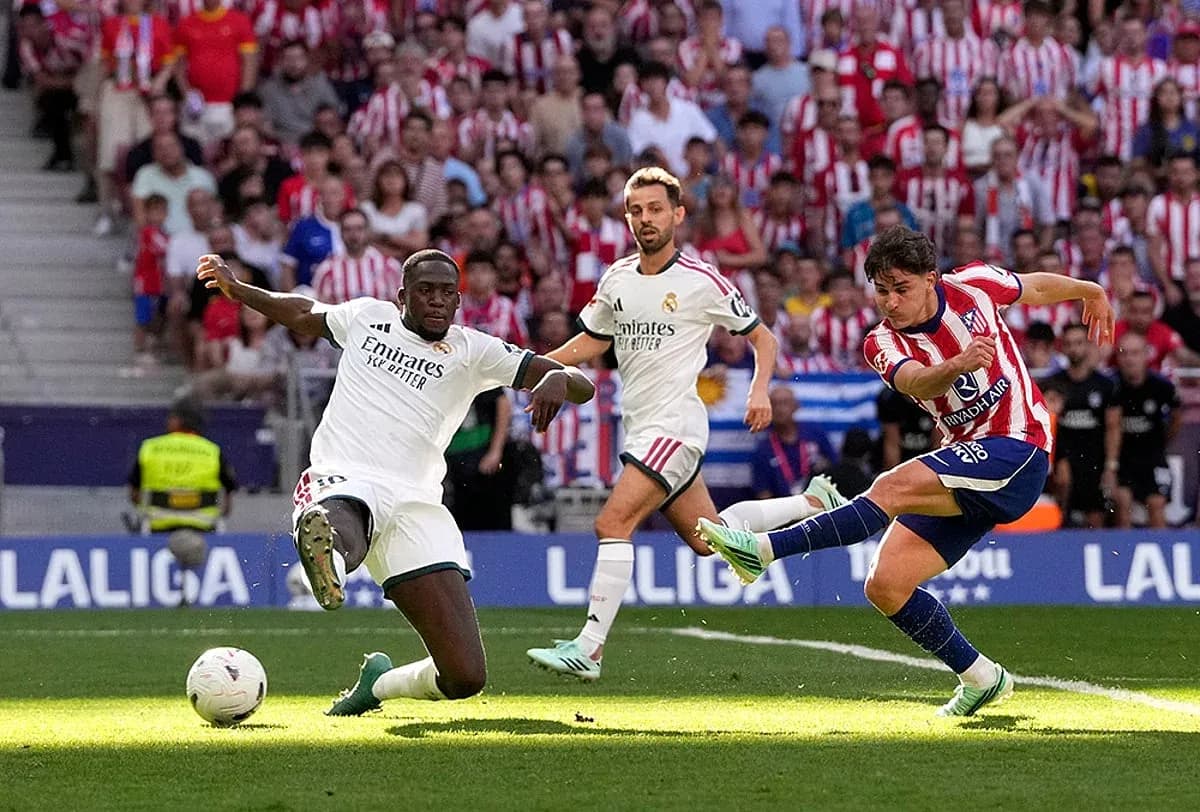
Real Madrid's Dramatic Comeback Against Atletico Madrid
The Bernabéu has seen its share of late‑season statement wins, but Real Madrid’s 3‑2 comeback over Atletico Madrid in Round 29 felt like something more: a clash of identities that tilted the title race’s psychology as much as the table.
Coming in, the numbers painted a meeting of heavyweights. Real, second in La Liga on 69 points after 29 games, had built a 2.2 goals‑per‑game attack and the division’s most balanced profile: 63 scored, 26 conceded, and only four defeats. At home they had been even more ruthless – 13 wins from 15, 36 goals scored and just 12 allowed – turning the Bernabéu into a 2.4 goals‑per‑game machine.
Atletico arrived fourth on 57 points, with a profile truer to Diego Simeone’s evolution than his stereotype. Their 49 goals to date came from a side that is far more expansive at the Metropolitano (34 goals in 15 home matches) than on the road, where they average 1.1 goals and concede 1.1. Four away wins, five draws and five defeats told the story of a team still elite, but vulnerable when dragged out of its comfort zone.
That is exactly what Real Madrid did after falling behind 0‑1 at half-time. The comeback to 3‑2 was not an outlier against the underlying trends; it was a distillation of them. A side with 11 clean sheets so far this campaign and a flawless 12‑from‑12 penalty record again found a way to tilt the margins at home, while Atletico’s away fragility resurfaced under sustained pressure.
The Butterfly Effect: Absences and Adjustments
Both squads walked in compromised, and the absentees shaped the tactical landscape.
For Real Madrid, the spine of the old guard was missing. Thibaut Courtois (thigh injury) and Éder Militão (hamstring) stripped the hosts of their usual security blanket in goal and their most dominant aerial defender. Ferland Mendy’s hamstring problem and Rodrygo’s knee injury further thinned Carlo Ancelotti’s typical defensive and attacking rotations, even if the coach’s name is not explicitly listed. Into that void stepped Andriy Lunin in goal and a young, aggressive back line featuring Antonio Rüdiger, Dean Huijsen and Fran García.
On Atletico’s side, Jan Oblak’s absence with a muscle injury was seismic. In stepped Juan Musso, a capable deputy but not the long‑term reference point behind Simeone’s block. Pablo Barrios, Rodrigo Mendoza and Marc Pubill were also ruled out, forcing Simeone to double down on experience and physicality across his 4‑4‑2.
The disciplinary profiles added another layer of jeopardy. Real Madrid’s yellow cards this season spike between 61‑75 minutes (24.53%), but there are also pronounced peaks in the 31‑45 (16.98%), 76‑90 (16.98%) and 91‑105 (20.75%) windows. This is a side that lives on the edge in the middle and late phases of games, and it has cost them: red cards are scattered through 31‑45, 61‑75, 76‑90 and 91‑105 minutes, each accounting for 14.29% or more. Atletico, by contrast, see their yellows cluster between 31‑45 (20%), 16‑30 and 76‑90 (both 18.18%), a reflection of Simeone’s team contesting momentum swings around the half‑hour mark and the closing stretch.
In a derby decided by fine margins, those patterns mattered. The more emotional Real side had to navigate the danger zones without imploding; Atletico had to walk the tightrope of aggression without losing a man. That neither side saw a dismissal owed as much to game management as it did to J. Munuera’s control of the contest.
The Chess Match: Hunters, Shields and Engines
This was billed as “The Hunter vs. The Shield” because of Kylian Mbappé’s presence on the Real Madrid bench. La Liga’s leading scorer – 23 goals, rated No. 1 in the league, with 83 shots and 51 on target – started among the substitutes but loomed over the fixture. His penalty profile (8 scored, 1 missed from 9 attempts) underlines the sheer volume of decisive moments he commands, even when he is not on the pitch from the first whistle.
Without him in the XI, Real leaned into a different kind of threat. Vinícius Júnior, ranked 10th in the league by rating, led the line with Brahim Díaz in a 4‑4‑2 that was more fluid than rigid. Vinícius’ season line – 11 goals, 5 assists, 60 shots, 35 on target – speaks to a forward who can both finish and destabilize. His 159 dribble attempts (70 successful) and 61 fouls drawn make him one of La Liga’s most disruptive weapons. He also walks the disciplinary line: seven yellow cards so far, among the most in the division, underline how combustible his duels can become.
Behind them, the “Engine Room Duel” was defined by contrasting profiles. Arda Güler, ranked fourth in the league for assists with eight, is Real’s chief conductor between the lines. His 63 key passes and 91% passing accuracy show a midfielder capable of dictating tempo while still threading high‑risk balls. Federico Valverde, fifth in the assist charts with seven, adds verticality and defensive bite – 37 tackles and 20 interceptions – making him the two‑way fulcrum that allows Güler to roam.
Atletico’s answer came in the form of Giuliano Simeone on the right of midfield. With six assists and 30 key passes, he is their creative outlet in wide areas, but his 34 tackles and 17 interceptions reveal why his father trusts him in big games. He is both playmaker and enforcer, tasked with disrupting Real’s right side while offering transition threat.
Up front, Antoine Griezmann and Julián Álvarez offered a different profile of menace, more about combinations and half‑spaces than sheer volume. The pure “Hunter” tag for Atletico actually belongs to Alexander Sørloth off the bench: 10 league goals, 44 shots (28 on target) and a bruising duel profile (235 contests, 111 won). He also carries disciplinary risk – four yellows and a red – but as a late‑game battering ram he remains one of Simeone’s most direct tools.
Defensively, Atletico’s “Shield” has been split‑personality. At home, they concede just 0.8 goals per game; away, that climbs to 1.1, with 16 goals conceded in 14 matches. Real Madrid’s attack, by contrast, does not meaningfully drop off between home (2.4 goals per game) and away (1.9). That discrepancy surfaced again as Atletico’s back four of Marcos Llorente, Robin Le Normand, Dávid Hancko and Matteo Ruggeri struggled to contain wave after wave once Real tilted the field.
On the Real side, the defensive axis of Rüdiger and Huijsen carried an added edge. Huijsen’s season numbers – 11 blocked opponent attempts, 17 interceptions and a place among the league’s top red‑carded players – mark him as an aggressive front‑foot defender. Fran García, more natural going forward, had to balance his instincts with the knowledge that Álvaro Fernández Carreras, another high‑card, high‑block full‑back, was waiting on the bench.
Depth, Game‑Changers and the Verdict
The benches ultimately underlined the gap in depth. For Real Madrid, having Mbappé, Jude Bellingham, Eduardo Camavinga, Álvaro Carreras and teenage wildcard Franco Mastantuono in reserve is an absurd luxury. Each brings a different vector: Mbappé as the league’s premier finisher and transition threat; Bellingham as a late‑arriving scorer and press leader; Camavinga as control and ball‑winning; Carreras as an overlapping, high‑volume passer from left‑back; Mastantuono as the unknown quantity defenders hate.
Atletico’s bench was solid but less transformational. Sørloth is a genuine game‑changer, and Nahuel Molina adds thrust from right‑back, while Thiago Almada offers creativity between the lines. But beyond that, the drop‑off from starters to substitutes is steeper than on the Real side.
In the end, the statistical prognosis played out: Real Madrid’s superior attacking volume, deeper bench and Bernabéu scoring rate dismantled Atletico’s away resistance. A side that has already strung together an eight‑match winning streak this season found another gear when it mattered, while Atletico’s away record slipped further into the realm of “dangerous but beatable.”
The deciding factor was not just one player, but the convergence of two patterns: Real’s ability to accelerate games after the interval, and Atletico’s tendency to concede more once stretched away from home. In a derby where the margins were fine, the numbers had been pointing to this kind of script all along – and Real Madrid, once again, dictated it.