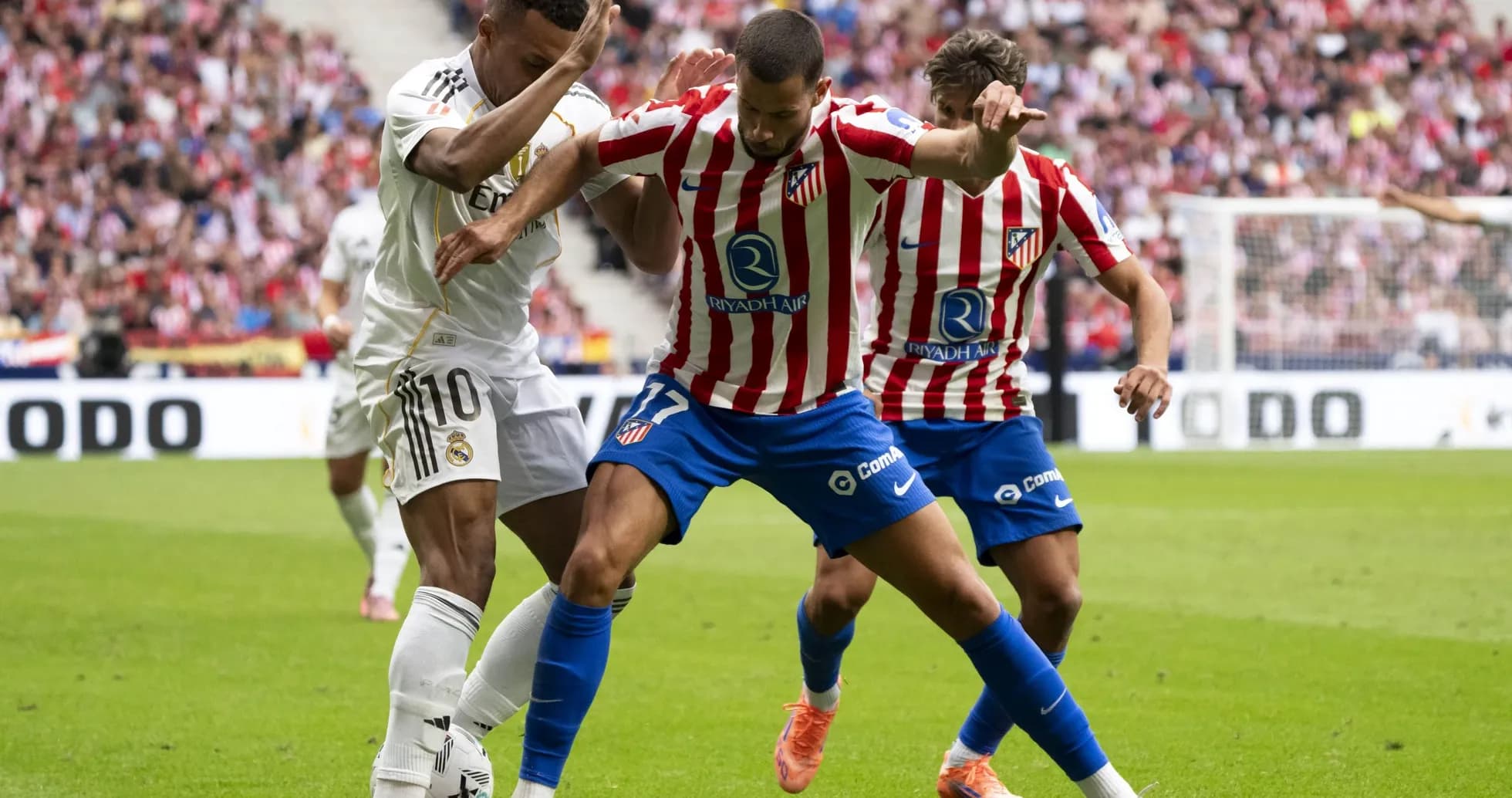
Real Madrid Triumphs 3-2 Against Atletico Madrid in Tactical Showdown
Real Madrid’s 3-2 win over Atletico Madrid at the Santiago Bernabéu unfolded as a tactical arm-wrestle between two 4-4-2 systems, with the home side’s superior attacking structure and in-possession fluidity eventually overcoming Atletico’s compact, transitional game and late adjustments.
Carlo Ancelotti’s side (nominally under Alvaro Arbeloa here) lined up in a 4-4-2 with A. Lunin in goal, D. Carvajal and F. Garcia as full-backs, A. Rudiger and D. Huijsen as the central pairing. In midfield, F. Valverde started to the right, A. Guler from the left, with A. Tchouameni and T. Pitarch as the central duo, behind a front two of B. Diaz and Vinicius Junior. On paper this is a flat 4-4-2, but in practice it morphed into a 4-2-3-1/4-3-3 hybrid, with Guler tucking inside and Valverde stepping into the half-space, allowing Garcia and Carvajal to advance.
Atletico Madrid mirrored the 4-4-2 shape: J. Musso in goal; a back four of M. Ruggeri, D. Hancko, R. Le Normand and M. Llorente; a midfield line of A. Lookman, Koke, J. Cardoso and G. Simeone behind A. Griezmann and J. Alvarez. Diego Simeone’s plan was clearly more direct and transitional: use Lookman and G. Simeone to spring wide-to-central counters and rely on Griezmann and Alvarez to attack early balls into space.
The first half belonged structurally to Atletico. Despite Real Madrid finishing with 52% possession and 559 passes at 91% accuracy, Atletico’s 48% and 505 passes at 89% tell you they were not simply sitting deep; they were comfortable in spells of controlled possession. Their opener on 33 minutes, finished by A. Lookman from a G. Simeone assist, reflected their wide overload concept: Lookman attacking the channel from the left midfield slot, Simeone arriving from the right to combine centrally. Real’s double pivot of Tchouameni and Pitarch struggled initially to screen both half-spaces, leaving the back four exposed when full-backs advanced.
Out of possession, Real Madrid’s 4-4-2 press was relatively conservative early on. Diaz and Vinicius screened passes into Koke, but Atletico found progression via the full-backs and diagonal balls toward Lookman. The low foul count for Real (2 fouls) underlines how rarely they broke their structure with desperate challenges; instead they tried to maintain compactness between the lines, albeit at the cost of allowing Atletico to reach the final third in controlled phases.
The match pivoted after the break through a combination of individual quality and touchline intervention. Vinicius Junior’s penalty at 52 minutes came from Real finally exploiting Atletico’s defensive line with more direct, vertical runs. That goal forced Atletico’s block to drop a few metres, which in turn opened the central lane for Valverde’s strike three minutes later. His 55-minute goal was emblematic of Real’s second-half pattern: midfielders arriving late on the edge of the box, fed by circulation that moved Atletico’s narrow 4-4-2 from side to side until a seam appeared.
Simeone’s triple substitution on 57 minutes was a clear tactical reset. At 2-1 down, he introduced A. Sorloth for A. Griezmann, N. Gonzalez for J. Cardoso, and N. Molina for A. Lookman. Structurally, this shifted Atletico toward a more direct and aggressive right side: Molina as an attacking full-back, Gonzalez adding vertical running, and Sorloth providing a more traditional target presence next to Alvarez. The immediate payoff came on 66 minutes when N. Molina scored from a J. Alvarez assist, a move that underlined Atletico’s emphasis on right-sided thrust and early service into the box.
Real’s response was equally strategic. On 64 minutes, Ancelotti removed T. Pitarch for K. Mbappe and replaced D. Carvajal with T. Alexander-Arnold. At 64', K. Mbappe (IN) came on for T. Pitarch (OUT). At 64', T. Alexander-Arnold (IN) came on for D. Carvajal (OUT). This reconfigured Real’s shape into something closer to a 4-2-3-1, with Mbappe joining Diaz and Vinicius in a fluid front three and Valverde and Tchouameni anchoring behind them. Alexander-Arnold’s introduction added a new passing dimension from right-back: early diagonals and underlapping runs. His influence was immediate: at 72 minutes he assisted Vinicius Junior’s second goal, a sequence that showcased Real’s superiority in combining down the right and attacking the space between Atletico’s full-back and centre-back.
The later substitutions consolidated those structural shifts. At 71', A. Baena (IN) came on for G. Simeone (OUT), adding fresh legs and more central creativity for Atletico. For Real Madrid, at 74', E. Camavinga (IN) came on for B. Diaz (OUT), and at 74', J. Bellingham (IN) came on for A. Guler (OUT), further strengthening the midfield’s ability to manage transitions and retain the ball under pressure. Finally, at 87', A. Carreras (IN) came on for Vinicius Junior (OUT), a clearly protective move to shore up the left flank and preserve the 3-2 lead.
Federico Valverde’s red card at 77 minutes, following his earlier goal, forced Real Madrid into a late-game reconfiguration. With ten men, they dropped into a deeper 4-4-1, Mbappe and later the midfielders prioritising compactness over pressing. The statistical profile supports this: despite the numerical disadvantage, Atletico finished with only 13 total shots (7 on goal) to Real’s 17 (10 on goal), suggesting Real’s block remained relatively stable and that Atletico struggled to translate possession into volume in the closing stages.
From a chance-quality perspective, Real Madrid’s xG of 2.41 versus Atletico’s 1.0 underlines the home side’s superior attacking construction. The 3-2 scoreline is broadly aligned with those underlying numbers. Both goalkeepers registered 5 saves, and defensive resilience was high on both sides: Real Madrid saw 1 of their shots blocked, while Atletico Madrid had 1 attempt stifled by the opposition. The “goals prevented” metric at team level (-1 for each) indicates that both defences, collectively, allowed slightly more than expected from the chances they faced, which aligns with a high-quality attacking contest rather than a defensive masterclass.
Crucially, Real Madrid’s possession edge (52%) was not sterile. Their 559 passes at 91% accuracy reflect controlled, purposeful circulation, particularly after the introduction of Alexander-Arnold, Mbappe, Camavinga and Bellingham. Atletico’s 48% and 505 passes at 89% show they remained competitive in the ball share but were more reliant on moments and transitions than on sustained positional attacks.
In tactical terms, this derby was decided by Real Madrid’s capacity to evolve their structure in-game: from a relatively rigid 4-4-2 that struggled against Atletico’s compactness, into a more fluid, high-ceiling attacking shape once the bench was activated. Atletico’s adjustments did bring them back to 2-2, but they could not match the variety and precision of Real’s right-sided combinations and central overloads, especially in the critical window between 60 and 75 minutes when the match was ultimately won.