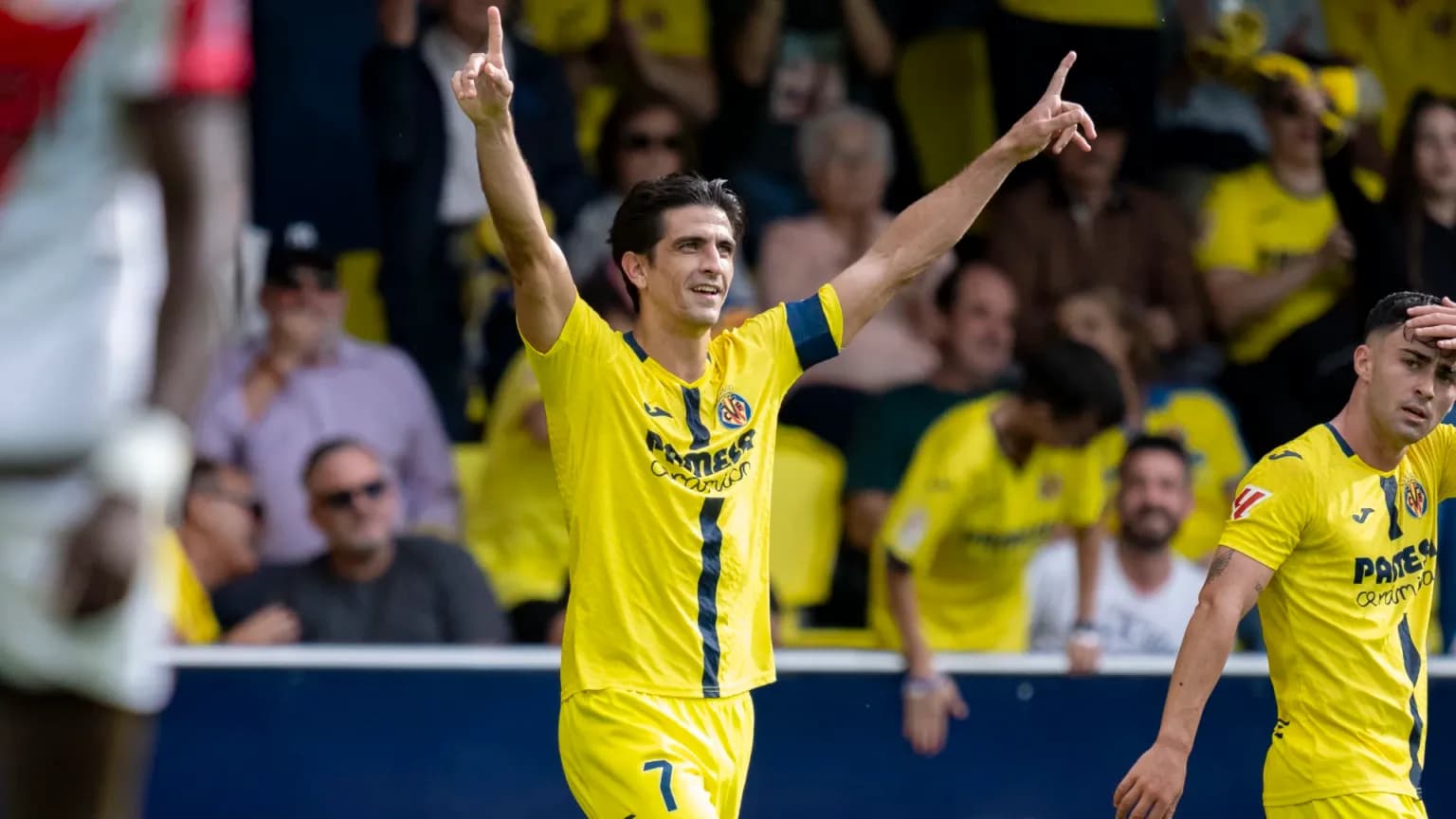
Rayo Vallecano's Tactical Masterclass Against Villarreal
Rayo Vallecano’s 2-0 win over Villarreal at Campo de Futbol de Vallecas was built on a clear tactical plan executed with discipline and efficiency. Inigo Perez’s 4-2-3-1 controlled the game’s rhythm, tilted the territory in Rayo’s favour, and turned a modest xG of 1.53 into two well-constructed goals. Villarreal, in Marcelino’s 4-4-2, never fully solved Rayo’s press or their occupation of the half-spaces, generating 1.0 xG but only two shots on target and rarely destabilising the home back four.
Rayo’s structure without the ball was the foundation. The nominal 4-2-3-1 behaved like a compact 4-4-2 in the first line, with Alemao staying high and Sergio Camello stepping up from the left-sided No.10 role to press alongside him. Oscar Trejo, as central playmaker, oriented his positioning to screen passes into the double pivot of Santiago Comesana and Pape Gueye, while Jorge de Frutos narrowed in from the right to keep Villarreal’s central lanes crowded. Behind them, Unai López and Oscar Valentin formed a disciplined shield, shuttling laterally to close spaces in front of Florian Lejeune and Pape Ciss.
The pressing triggers were clear: backward passes to Villarreal’s centre-backs or slow switches across the back line. With 53% possession and a 472-pass volume (404 accurate, 86%), Rayo were not a pure counter-pressing side, but their mid-block was aggressive enough to force Villarreal into riskier vertical balls than Marcelino’s team were comfortable playing. Villarreal completed 403 passes (338 accurate, 84%), but much of that circulation was in front of Rayo’s block, with limited penetration.
The opening goal on 28 minutes encapsulated Rayo’s wide dynamics. Full-back Andrei Ratiu, starting on the right of a back four, was encouraged to advance whenever de Frutos drifted inside. His assist for Camello came from exactly that pattern: Rayo created a wide overload on their right, Ratiu received in space and delivered into the box, where Camello arrived from a nominal “midfield” line to finish. It was a classic exploitation of Villarreal’s 4-4-2 wide channels, drawing out the full-back and isolating the near-side centre-back.
Villarreal’s response at half-time was immediate and telling. At 46', Alexander Gonzalez (IN) came on for Tajon Buchanan (OUT), a like-for-like change on paper but a clear attempt to add more direct running and one-versus-one threat on the flank. Yet within a minute of the restart, Rayo struck again. At 47', Alemao finished a move assisted by Trejo, whose positioning between the lines had been a persistent problem for Villarreal’s midfield. The second goal highlighted Rayo’s capacity to progress centrally once Villarreal’s first line was bypassed: Trejo found space in the pocket, turned, and released Alemao attacking the channel between full-back and centre-back.
From there, the tactical battle shifted towards game management. Villarreal, chasing a 2-0 deficit, leaned harder into their 4-4-2 verticality. At 63', Gerard Moreno (IN) replaced Tani Oluwaseyi (OUT), adding a more refined dropping forward who could connect play. One minute later, at 64', Thomas Partey (IN) came on for Santiago Comesana (OUT), giving Villarreal more ball progression from deep. At 72', Dani Parejo (IN) replaced Pape Gueye (OUT), further tilting the midfield towards creativity and control. The back line was also refreshed at 77', when L. Costa (IN) came in for W. Kambwala (OUT), likely to add more attacking thrust from full-back.
Despite these changes, Villarreal’s 11 total shots produced only two on target. Rayo’s defensive line remained compact, with Lejeune organising and Ciss aggressive in duels. The full-backs, Ratiu and P. Chavarria, chose their moments to engage, and when they sat deeper Rayo’s shape resembled a low 4-4-1-1, Trejo dropping alongside the double pivot. Rayo conceded nine corners but defended the box with authority, limiting clear chances and allowing goalkeeper A. Batalla to make just two saves. His goals prevented figure of -0.25 suggests the conceded shot quality was slightly lower than the goals he might be expected to concede; in practice, that underlines how well the defence restricted high-value looks.
Rayo’s substitutions were aimed at maintaining intensity and securing the structure. At 66', P. Diaz (IN) came on for Trejo (OUT), adding fresh legs and more defensive balance in the No.10 zone. At 73', F. Perez (IN) replaced Camello (OUT), preserving pressing energy on the left side of the attacking band. One minute later, at 74', C. Martin (IN) took over from Alemao (OUT), ensuring Rayo always had a vertical outlet to stretch Villarreal’s back line. At 81', Pacha (IN) replaced P. Chavarria (OUT), a like-for-like full-back swap to keep the defensive flank stable. Finally, at 82', A. Mumin (IN) came on for Unai López (OUT), sliding into the back line and allowing Rayo to close the game with extra defensive presence.
Discipline and time management were part of the tactical picture. Rayo received two yellow cards, Villarreal one, all of which shaped the match’s tone. The disciplinary log, in exact chronological order, was:
61' Florian Lejeune (Rayo Vallecano) — Foul
82' Unai López (Rayo Vallecano) — Time wasting
90+6' Santiago Mouriño (Villarreal) — Foul
Lejeune’s booking reflected Rayo’s willingness to break up transitions when their block was briefly exposed. Unai López’s late card for Time wasting at 82' underlined a deliberate slowing of tempo once Rayo had their substitutions in place and the game under control. Mouriño’s stoppage-time booking for Foul was emblematic of Villarreal’s frustration as they pushed without reward.
Statistically, the match validated Rayo’s approach. Their 15 total shots to Villarreal’s 11, and 7 shots on goal to Villarreal’s 2, show a clearer attacking edge despite only a slight possession advantage (53% to 47%). Rayo’s passing structure was more secure: 472 passes, 404 accurate (86%), compared to Villarreal’s 403 passes, 338 accurate (84%). The xG split of 1.53 to 1 in Rayo’s favour aligns with the 2-0 scoreline: the hosts created marginally better chances but, crucially, finished clinically through Camello and Alemao.
Both goalkeepers posted identical goals prevented figures of -0.25, indicating that neither dramatically outperformed xG on target. For A. Batalla, that was sufficient behind a disciplined block; for A. Tenas, it meant Villarreal’s defensive structure allowed Rayo to generate chances of a quality that eventually told. In tactical terms, Rayo’s superior spacing between the lines, clearer pressing scheme, and more coherent use of their full-backs turned a relatively even statistical base into a controlled, deserved home win.