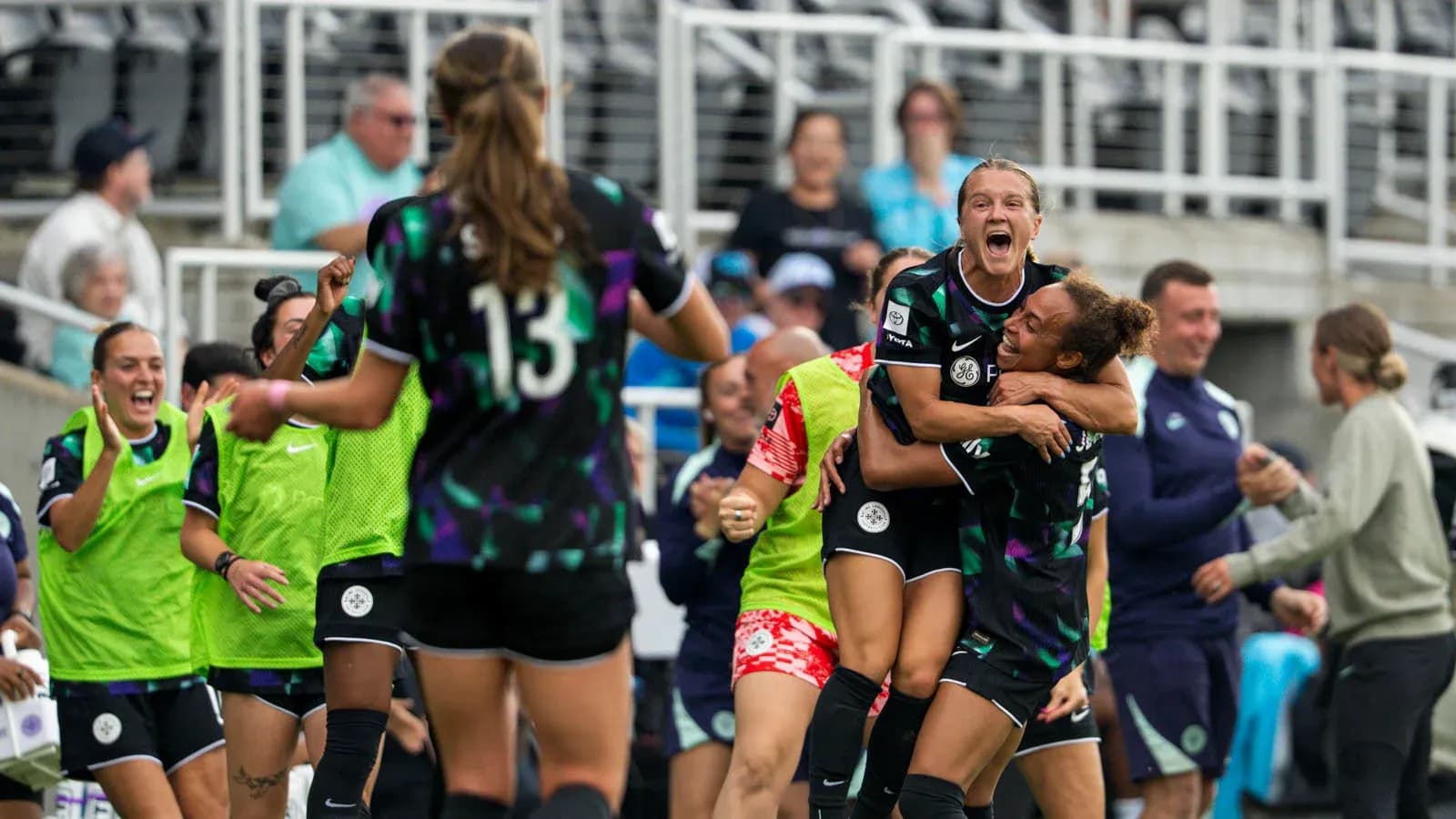
Racing Louisville W Defeats Orlando Pride W 3–2 in High-Event Clash
Racing Louisville W edged a high‑event Group Stage contest 3–2 over Orlando Pride W at Lynn Family Stadium, overturning an xG‑defying shot deficit with ruthless efficiency and a resilient low block. In a match controlled territorially by Orlando (61% possession, 27 shots), Beverly Yanez’s side leaned on compact spacing, direct transitions, and standout goalkeeping from Jordyn Bloomer to protect an early lead and then manage the game after a rapid second‑half surge. Orlando’s late pressure, driven by Barbra Banda’s brace and Seb Hines’ aggressive in‑game adjustments, could not fully erase Louisville’s three‑goal return from just five shots on target.
First Half
The scoring opened on 19' when right‑back Lauren Milliet, pushing high from the 4‑2‑3‑1, finished a Racing transition move. Kayla Fischer provided the assist, exploiting space behind Orlando’s advanced fullbacks. Orlando’s territorial dominance finally translated into a leveller at 45+6', as Barbra Banda converted from open play after combination work with Angelina Alonso Costantino. The halftime scoreline of 1–1 reflected Orlando’s volume but not their wastefulness in the box.
Second Half
Racing struck twice in quick succession after the interval to flip the tactical landscape. At 47', centre‑forward Sarah Weber finished clinically from service by holding midfielder Katie O'Kane, punishing Orlando’s loose rest‑defence. Just three minutes later, at 50', Milliet arrived again from deep, this time assisted by Emma Sears, to make it 3–1 and force Orlando into a more chaotic, risk‑heavy chase phase.
Seb Hines responded with a triple substitution wave aimed at injecting verticality and fresh attacking profiles. At 56', Summer Yates (IN) came on for Marta (OUT), adding more off‑ball running from the No. 10 zone. On 63', Simone Jackson (IN) replaced Solai Washington (OUT), while Hannah Anderson (IN) came on for Oihane Hernández (OUT), and Seven Castain (IN) entered for Ally Lemos (OUT). Collectively, those moves tilted Orlando into a higher‑tempo, wing‑driven 4‑2‑3‑1, with greater emphasis on wide isolations and second‑ball pressure.
Yanez answered at 70' with her own double change to stabilise the flanks and midfield legs. Macey Hodge (IN) came on for Kayla Fischer (OUT), shoring up central coverage and ball retention, while Makenna Morris (IN) replaced Emma Sears (OUT), providing fresh energy and defensive work rate on the right. Orlando then pushed even harder by sacrificing left‑back Coriana Dyke at 75', bringing on Julie Doyle (IN) for Dyke (OUT) to create a back three in possession and overload the final third.
The closing phase was defined by Orlando’s siege and Racing’s game management. Morris picked up a yellow card for a foul at 90+1', reflecting the increased defensive desperation as Louisville tried to disrupt Orlando’s rhythm and slow transitions. At 90+3', Banda struck again, this time assisted by Hannah Anderson, narrowing the score to 3–2 and validating Orlando’s aggressive substitution pattern. In the immediate aftermath of that goal, frustration surfaced on the visiting side: Haley Hanson received a yellow card for argument at 90', underlining the emotional edge of Orlando’s late push.
Racing then used final substitutions to kill tempo and reset their defensive structure. Quincy McMahon (IN) came on for the influential Milliet (OUT) at 90', and Maja Lardner (IN) replaced Weber (OUT), allowing Louisville to refresh their front line’s pressing and channel‑blocking responsibilities for the final moments.
Tactical Analysis
Tactically, both sides lined up in a 4‑2‑3‑1, but the interpretations were starkly different. Racing’s double pivot of O'Kane and Taylor Flint sat relatively deep, screening central lanes and forcing Orlando into wide circulation. The attacking midfield trio of Sears, Fischer, and Ella Hase operated as a compact, counter‑oriented unit, springing forward quickly once possession was regained. Weber’s role as a single striker was less about volume of touches and more about pinning Orlando’s centre‑backs and exploiting gaps when the visitors’ fullbacks advanced.
Orlando’s 4‑2‑3‑1, by contrast, was ball‑dominant and high‑risk. Lemos and Angelina Alonso Costantino tried to dictate tempo from the double pivot, with Banda nominally starting as a wide midfielder but constantly drifting into central and half‑space pockets to act as a second striker alongside Marta. Fullbacks Hernández and Dyke pushed high to create width, which generated the 27 total shots and 9 corners but also exposed large transition lanes that Racing repeatedly punished, especially around the 47' and 50' goals.
Goalkeeping Performance
Goalkeeper reality was decisive. Bloomer made 9 saves for Racing Louisville, anchoring a Defensive Index that outperformed the underlying shot volume. Her interventions, particularly against Orlando’s inside‑box attempts (15 for the Pride), allowed Louisville to maintain a narrow block without collapsing. At the other end, Anna Moorhouse faced only 5 shots on target and made 2 saves, meaning Louisville scored three times from limited but high‑quality looks, underlining their clinical edge rather than any sustained attacking dominance.
Statistical Overview
Statistically, Orlando’s overall form profile in this match reads as the stronger possession and chance‑creation side: 61% of the ball, 413 total passes at 78% accuracy, and 27 shots (11 on target). Racing, with 39% possession, 262 passes at 65% accuracy, and just 11 shots (5 on target), played a low‑volume, high‑efficiency game. Both teams finished with one yellow card apiece, but the timing and nature of those bookings mirrored the tactical story: Morris’ late foul booking reflected Racing’s deep‑block strain, while Hanson’s card for argument captured Orlando’s frustration at converting territorial control into only two goals.
Without explicit xG values, the shot and on‑target distribution strongly suggests Orlando’s chance volume exceeded their finishing output, while Louisville’s three‑goal return from five efforts on target marks them as the more ruthless side on the night. In synthesis, Racing’s Defensive Index — built on Bloomer’s 9 saves, compact spacing, and well‑timed substitutions — outstripped Orlando’s superior overall form metrics, delivering a tactically disciplined 3–2 win against the run of raw statistical play.