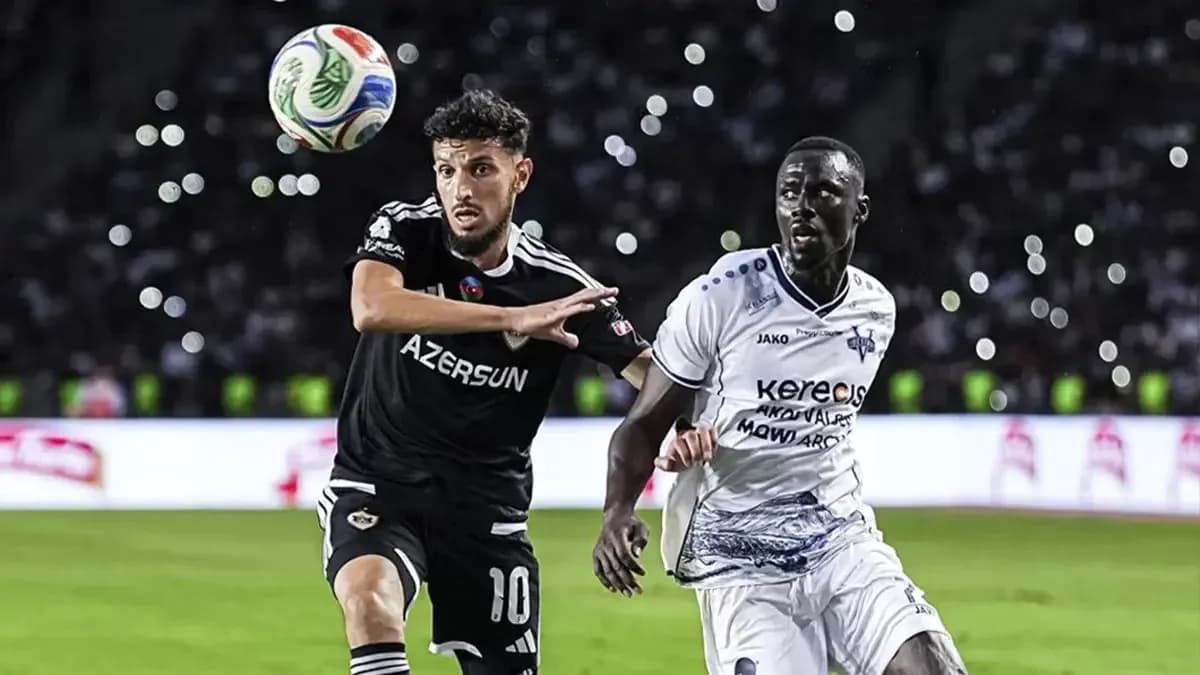
Qarabag Dominates Vestri in UEFA Europa League Qualifier
Vestri’s 0-3 home defeat to Qarabag at Throttarvollur in the UEFA Europa League 1st Qualifying Round was defined less by volume of chances – which the raw data does not quantify – and more by the structural gap between a well-drilled 4-2-3-1 and a side still searching for a clear collective identity. Qarabag imposed their positional blueprint early and never relinquished control, while Vestri’s largely ad hoc shape struggled to cope with the Azeri side’s rotations between the lines and wide overloads.
First Half
Qarabag’s 4-2-3-1 was textbook in its spacing. The back four of Matheus Silva, B. Huseynov, B. Varkonyi and B. Langa provided a broad platform, but the real control came from the double pivot of Pedro Bicalho and M. Jankovic. From the opening minutes, they created a stable “rest defence” against transitions while also dictating circulation into the attacking trio of J. Mouaddib, Kady Borges and A. Zoubir behind lone forward Z. Sawo. The first goal on 5 minutes encapsulated this structure: Qarabag advanced in their usual 2-4-3-1 attacking shape, with full-backs high and the double pivot anchoring. Mouaddib arrived in the right half-space to finish, fed by Sawo, who had drifted off the front line to link play. The move showed how Qarabag consistently occupied all five vertical lanes, forcing Vestri’s back line into constant lateral shifting.
The second goal on 29 minutes further underlined Qarabag’s superiority in central control. Again, Sawo provided the assist, this time for Pedro Bicalho. With Vestri unable to apply coordinated pressure on the double pivot, Bicalho could step into advanced pockets, effectively becoming a third midfielder arriving late at the edge of the box. The lack of pressing triggers from Vestri’s midfield duo and their difficulty in tracking runners from deep allowed Qarabag to recycle possession until the right gap opened.
Game Management
At 2-0, Qarabag managed the game with professional calm. Their defensive block often resembled a 4-4-1-1 without the ball, with Mouaddib dropping alongside Borges and Zoubir to form a compact midfield four, while Sawo screened passes into Vestri’s central midfield. Vestri, whose starting formation is not defined in the data, appeared to rely on a back-heavy selection: defenders Edson Eduardo, G. Einarsson, S. Fall, M. Hagbardsson and B. Eydal all started, suggesting a deep, safety-first line. But without a clear pressing scheme ahead of them, that numerical density at the back translated into passivity rather than stability.
The third goal on 56 minutes – Sawo finishing from a Kady Borges assist – was a natural outcome of Qarabag’s layered attacking patterns. Borges, operating as the central creator, repeatedly found pockets between Vestri’s midfield and defence. Here, his ability to receive on the half-turn and slide passes into the channels punished Vestri’s flat back line. Sawo’s movement, alternating between pinning centre-backs and dropping into pockets, was too dynamic for Vestri’s defenders, who were often left defending large spaces without midfield protection.
Substitutions
Vestri’s response came primarily through substitutions and energy rather than systemic change. The triple substitution on 63 minutes – G. Hauksson (IN) for J. Stensson (OUT), B. Hermannsson (IN) for E. Gardarsson (OUT), and K. Cheshmedjiev (IN) for S. Fall (OUT) – suggested a desire to inject fresh legs and perhaps push the full-backs higher. Later changes, with T. G. Hafthorsson (IN) for J. Selven (OUT) on 69 minutes and C. Morfelt (IN) for B. Eydal (OUT) on 78 minutes, pointed to an attempt to add more ball-playing profiles and creativity in midfield zones. However, with no evidence of a significant shift in momentum or a goal to reward these changes, it appears the alterations improved intensity but not the underlying structure.
Qarabag’s substitutions were almost purely about game management. At 63 minutes, O. Kashchuk (IN) for J. Mouaddib (OUT), R. Cephas (IN) for A. Zoubir (OUT), and S. Lobato (IN) for Pedro Bicalho (OUT) allowed coach Qurban Qurbanov to refresh all three advanced midfield roles without altering the 4-2-3-1 framework. The pattern was clear: maintain the same positional map but rotate the runners. Later, at 74 minutes, C. Makreckis (IN) for B. Huseynov (OUT) and E. Cafarquliyev (IN) for B. Langa (OUT) kept the back line fresh, preserving concentration and physicality to protect the clean sheet.
Goalkeepers
In goal, M. Kochalski (Qarabag) and M. Steinarsson (Vestri) both completed the full 90 minutes. The statistics do not provide explicit numbers for saves or goals prevented, so the evaluation of their performances rests on the scoreline and tactical context. Kochalski benefited from the strong structure in front of him; Qarabag’s compactness and control meant he was rarely exposed to chaotic situations. Steinarsson, by contrast, operated behind a defence frequently stretched by half-space runs and wide overloads, particularly when Qarabag’s full-backs and wingers combined on the flanks.
Discipline
Discipline-wise, the match was remarkably clean. Neither side received a yellow or red card, indicating that Qarabag could dominate without resorting to tactical fouling, and Vestri, despite chasing the game from the 5th minute onward, did not break their defensive shape with reckless challenges. This absence of cards also suggests that Qarabag’s pressing and counter-pressing were efficient enough to prevent Vestri from launching dangerous transitions that might have required professional fouls.
With no reliable data on possession, shots, or passing, the tactical verdict hinges on the qualitative pattern: Qarabag’s 4-2-3-1 imposed its rhythm from the outset, leveraging a double pivot for control, a creative central 10 in Kady Borges, and a mobile centre-forward in Z. Sawo. Vestri, lacking a clearly defined pressing identity and overloading their back line without sufficient midfield coordination, were forced into a reactive game they never truly escaped. The 0-3 scoreline aligns with the structural superiority Qarabag displayed across all phases.