Premier League 2026/27: A Season of Change and Opportunity
The Premier League is back. Not quietly, not gently – but with a sense that the entire division is being rewired at once.
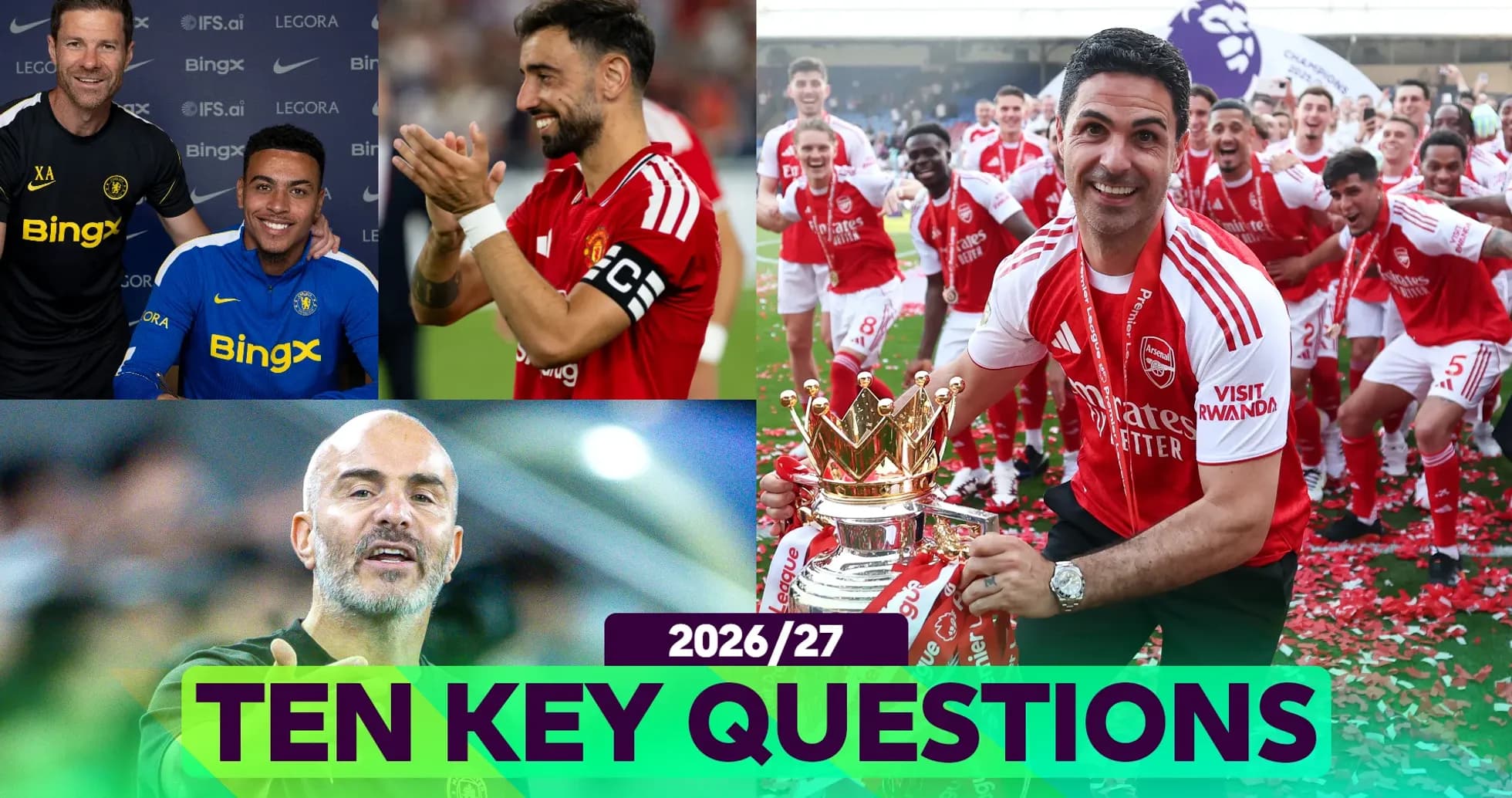
Five of the traditional "Big Six" are effectively starting over. Nine new managers arrive. One era has already ended at Manchester City. Another might just be beginning at Arsenal.
At the heart of it all sits Mikel Arteta, the only title‑winning coach left in the league.
Arteta’s chance to join the elite
Pep Guardiola. Sir Alex Ferguson. Jose Mourinho. In 34 Premier League seasons, only those three have managed to retain the title.
Arteta now has a rare opening to join them.
The 2026/27 campaign is framed by upheaval almost everywhere else. Arsenal, by contrast, look settled. Their title, five years in the making, has finally broken the psychological barrier. The squad is stable, the system ingrained, the anxiety of “can they do it?” replaced by the authority of champions.
Around them, the chaos is striking. Michael Carrick and Roberto De Zerbi are only just beginning their first full seasons at Manchester United and Tottenham. Liverpool, Chelsea and Manchester City all start under new managers.
That context matters. Arsenal are no longer the plucky challengers trying to dethrone a juggernaut. They are the calm in the storm – and they are coached by the only man in the division who has already proved he can navigate a title run-in.
With Guardiola gone, the door is open. The question is whether Arteta can stride through it and become the fourth man to defend the Premier League crown.
Life after Pep: City at the crossroads
Manchester City have never faced a season quite like this.
The Guardiola era is over. Eight league titles are in the cabinet, countless records broken, and the club’s identity has been built almost entirely in his image. Now Enzo Maresca walks into the job that defines modern English football greatness.
This is a fork in the road. Either City pull off a Liverpool‑style handover – Arne Slot picking up seamlessly from Jurgen Klopp – or they find out just how hard it is to follow a dynasty, as Unai Emery and David Moyes did in the immediate aftermath of Arsene Wenger and Ferguson.
City’s hierarchy have tried to control the variables. They have not ripped up the blueprint. Instead, they have doubled down on it, appointing a Guardiola disciple.
Maresca is steeped in that philosophy: possession heavy, structure obsessed, tactically aligned almost note‑for‑note with his former mentor. On paper, continuity. On the pitch? That’s far less certain, especially with key figures like Bernardo Silva and John Stones gone from the dressing room.
City are not just replacing a manager. They are testing whether a club can keep the magic alive when the architect leaves.
Alonso and Chelsea: a new heavyweight in the making?
If there is one appointment that feels like it could reshape the league’s future, it is Xabi Alonso at Chelsea.
He arrives with the aura of a coach on the rise. An invincible Bundesliga season with Bayer Leverkusen in 2023/24 turned him into one of the most coveted managers in the world. Now he steps into a Premier League that has just waved goodbye to Guardiola and Klopp, with a chance to become the next defining figure of the era.
The conditions for lift-off are there. Chelsea have no European football, a huge advantage for a coach trying to imprint complex ideas. Antonio Conte used that same clear midweek schedule to power Chelsea to the 2016/17 title in his first season. Only six managers have ever won the Premier League at the first attempt; three of them did it at Stamford Bridge.
Alonso has the profile to join Mourinho, Ancelotti and Conte in that select group.
The squad already looked talented but raw. This summer has brought a different kind of signing: experience. Danny Welbeck and Jordan Henderson are the first over‑30s of the BlueCo era, a symbolic break from the previous youth‑only obsession and a sign that the project is maturing.
Alonso now has time on the training ground, tactical clarity, and a more balanced dressing room. Chelsea, dormant as a title force for a decade, suddenly feel dangerous again.
The return of chaos football?
Last season left some supporters cold. The goals-per-game figure barely dipped – from 2.40 to 2.36 – but the underlying numbers told a different story. Open-play Expected Goals fell sharply, from 2.28 xG per match in 2023/24 to just 1.82 in 2025/26.
Set-pieces and structure nudged aside the wild, end‑to‑end chaos that had defined the league at its most thrilling.
This year’s managerial churn threatens to flip that back again.
De Zerbi now has a full pre-season to impose his high‑pressing, high‑risk attacking blueprint at Spurs, after time constraints limited him late last year. At Liverpool, Andoni Iraola brings back the “heavy‑metal” energy supporters craved, having already lit up the division with his aggressive Bournemouth side.
Alonso’s Leverkusen and Real Madrid teams scored freely. Bournemouth’s new boss Marco Rose comes from the RB Leipzig/Borussia Dortmund school of fast, vertical German attacking football. At Crystal Palace, Pierre Sage is another coach who wants transitions, hard pressing and speed.
Taken together, it looks like a collective swing back toward open, attacking games. If 2023/24 was the peak of Premier League chaos, this season is being built to chase it.
Can Carrick drag Manchester United back into the title fight?
Manchester United have flirted with rebuilds for a decade. Carrick has something more tangible: numbers.
Appointed caretaker on 14 January, he beat Manchester City 2-0 three days later and never really looked back. Over his 17 league matches in charge – almost half a season – United topped the form table.
Across that stretch, they took 39 points. Arsenal managed 36. City 35. Bournemouth, remarkably, went unbeaten but drew ten of their 17.
If United simply repeat that form twice over a full campaign, they win the Premier League for the first time since 2013.
Football rarely follows such clean arithmetic, and the step from half a season’s surge to a 38‑game title tilt is huge. But Carrick has given United something they have lacked for years: a credible statistical argument that they belong in the conversation.
He does not need a revolution. He just needs to prove that those five months were a foundation, not a purple patch.
A season built for comeback stories
All those new managers mean clean slates everywhere. That spells opportunity – and perhaps a season defined by players who had drifted to the margins.
Phil Foden and Cole Palmer both come into the campaign with something to prove after disappointing years and missing out on England’s World Cup squad. Marcus Rashford and Mason Mount are fighting not just for form but for relevance at Manchester United.
Harvey Elliott, Omar Marmoush and Andy Robertson will all expect more minutes after frustrating campaigns. Yoane Wissa will hope a new voice on the training ground can unlock better form.
Then there are the forgotten stars returning from injury. Levi Colwill and Alexander Isak, in particular, feel like players who could transform their teams’ ceilings if they stay fit.
With so many new regimes and tactical resets, this is the perfect landscape for redemption arcs.
Villa and Newcastle: from stability to shock therapy
Twelve months ago, Aston Villa and Newcastle United were the continuity projects. Same managers, settled squads, clear upward trajectories. Both were tipped as Champions League contenders on that basis.
That stability has gone.
At Newcastle, the upheaval is brutal. Eddie Howe has resigned, Matthias Jaissle is in, and the new coach must start without three of the club’s biggest stars: Bruno Guimaraes, Anthony Gordon and Sandro Tonali.
In their place comes a new core: Lukas Hornicek, Bazoumana Toure, Aladji Bamba, Sean Steur and Ewen Jaouen. Each arrives for a significant fee, each with a strong CV, but together they represent a radical reset of the dressing room.
Villa’s shift is less dramatic but still feels like the end of one chapter and the start of another. Emery remains in charge, but Youri Tielemans, Morgan Rogers and Lucas Digne have all gone. The incoming names – Alejandro Garnacho, Johan Manzambi and Joao Gomes – bring a different profile and energy.
Both clubs now face the same question: can they evolve on the fly without losing the edge that made them contenders in the first place?
Europe: dream stage or domestic trap?
Nine Premier League clubs reached Europe last season. For those new to the rhythm of Thursday nights and long away trips, the thrill comes with a warning label.
The recent evidence is mixed. Aston Villa won the Europa League and still finished fourth. Crystal Palace dropped to 15th but traded that league position for a Conference League trophy most fans would never give back.
Nottingham Forest, Spurs and Newcastle, though, all sank into the bottom half while juggling the extra fixtures.
This year, Brighton & Hove Albion head into the Conference League for the first time in their history and only their second European campaign ever. They will look at Palace’s run and see a template, while Palace themselves should now be experienced enough to handle a Europa League schedule.
Bournemouth and Sunderland, both Europa League qualifiers, have more reason to worry. Squad depth will be stretched, and the cost could be paid on domestic weekends.
That dynamic opens the door for others. Leeds United, who have recruited aggressively, might feel their chances of a top‑nine finish improve simply because rivals are tied up on Thursdays. Brentford, who narrowly missed out on Europe last season, again have empty midweeks to drill Keith Andrews’ detailed plans.
The race for those European spots may become a rolling carousel rather than a closed shop.
Mid-table no more: the rise of the ambitious middle class
Leeds and Brentford are not alone in aiming higher.
Fulham have turned to former Real Madrid coach Alvaro Arbeloa, who brings two Real signings with him. That alone is enough to fuel optimism at Craven Cottage, where Marco Silva already left a solid platform and a side that finished just one point outside the European places.
Nottingham Forest now have Oliver Glasner, the man who delivered both the Conference League and FA Cup for Crystal Palace. Even after selling Elliot Anderson to Manchester City, Forest will believe they can emulate their seventh‑place finish from two years ago.
Everton, too, feel stronger. They should finally be settled in their new stadium and, crucially, have continuity in David Moyes – a rarity in a league full of fresh starts. The arrivals of Hayden Hackney, Christian Norgaard and Brennan Johnson clearly raise the level of the squad.
Put it all together and the Premier League looks brutally deep. There are almost no obvious soft touches. Every “mid‑table” club seems to have a plan and a punch.
The new boys: ready or about to be exposed?
Coventry City, Ipswich Town and Hull City enter a league that just watched Sunderland and Leeds not only survive promotion but thrive, ending a two‑year run of immediate relegations and even pushing into Europe.
Unsurprisingly, all three have been busy.
Their strategy is striking. Rather than loading up on Premier League cast‑offs, they have largely targeted established internationals from mainland Europe, betting on quality over familiarity. Ipswich and Hull have still dipped into the domestic market – Issa Diop and Sasa Lukic for Ipswich, Matt Targett and Jack Butland for Hull – but the broader approach is bolder.
Predicting how they will cope is almost impossible. Sunderland and Leeds were widely tipped to go straight back down in 2025/26. They didn’t.
Coventry arrive as Championship winners by a distance, with Frank Lampard offering top‑level experience on the touchline. Ipswich have recent Premier League history and have hired Gary O’Neil, who has already kept Bournemouth and Wolverhampton Wanderers up.
Hull look the most vulnerable. Opta’s “Expected Points” table had them 23rd out of 24 in the Championship last season, based on xG for and against. On paper, they are favourites to finish bottom.
And yet this is their first Premier League campaign since 2017. Excitement will drown out caution for now.
Everywhere you look, there is a story: a fallen giant trying to rise, a superclub learning to live without its genius, a new managerial wave promising goals and chaos, promoted sides gambling on ambition over fear.
The league has rarely felt this strong from top to bottom. The only certainty is that somebody, somewhere, is about to discover that “mid-table” comfort no longer exists.