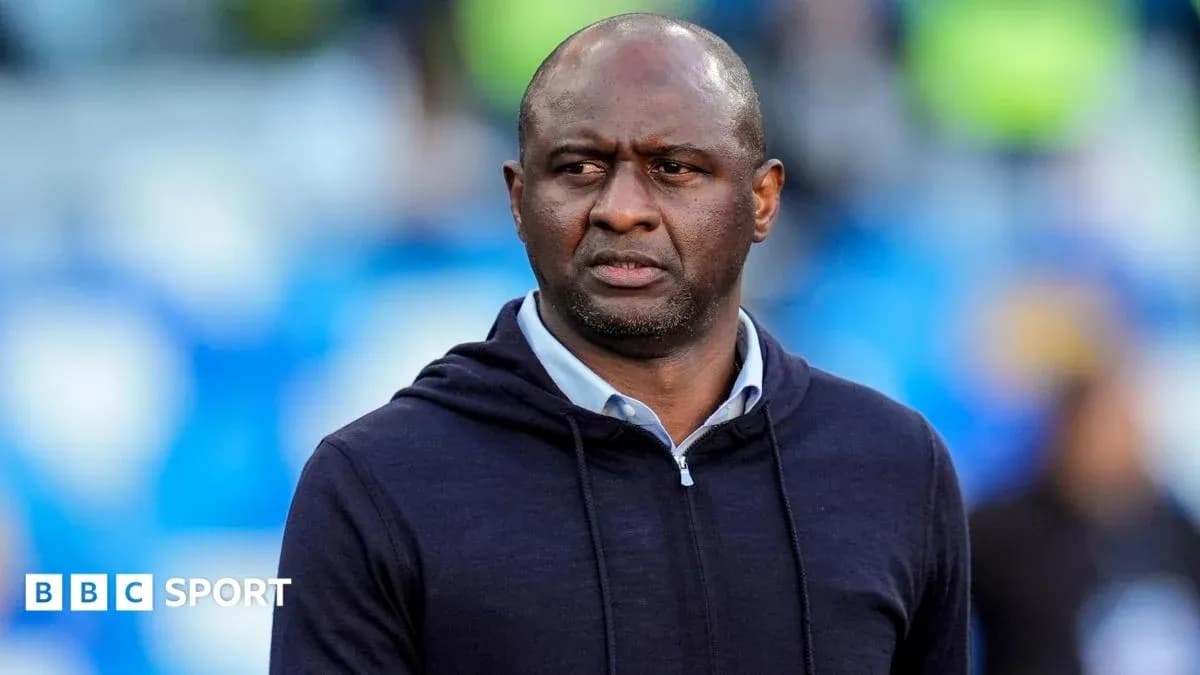
Patrick Vieira Appointed as Senegal's New Head Coach Amid Turmoil
Patrick Vieira has been announced as Senegal’s new head coach. On paper, it sounds like a landmark moment: one of the great midfielders of his generation returning to the country of his birth to lead the African champions.
In reality, nothing is straightforward. Not even his job.
Vieira, 50, has not yet signed a contract. No date has been set for his official presentation. Senegal’s football federation (FSF) says talks over the “administrative and contractual arrangements” are still ongoing. For now, the Teranga Lions have a new boss in name only.
A federation under pressure
The timing could hardly be more fraught. The FSF is wrestling with internal turmoil, political isolation and a looming legal verdict that could shake its very foundations.
Vieira was unanimously approved as the man to succeed Pape Thiaw at an FSF meeting on Monday, with Patrick Kluivert among the other candidates discussed. Habib Beye, Oumar Daf and Patrice Carteron were also on the shortlist.
Yet the dismissal of Thiaw is still not cleanly resolved. He was sacked after Senegal’s dramatic last-32 exit to Belgium at the Fifa World Cup, a decision taken without formal endorsement from the government, which funds the national team.
Thiaw is demanding several months of unpaid wages and a series of bonuses. The total reportedly approaches $815,000 (£600,000). Until that dispute is settled, the handover from one era to the next remains blurred.
Over all of this hangs a ruling from the Court of Arbitration for Sport (Cas) in Lausanne, expected by Friday, on the contested election of the current FSF leadership. That decision could question the very legitimacy of the federation’s hierarchy – and, by extension, its choice of Vieira.
The FSF finds itself increasingly isolated, lacking strong backing from government or public opinion, and boxed in by the Cas timetable. Yet the calendar offers no sympathy.
Clock ticking towards Afcon qualifiers
On 23 September, Senegal open their 2027 Africa Cup of Nations (Afcon) qualifying campaign away to Mozambique in Group J. A meeting with Ethiopia follows just days later.
Those games do not wait for legal arguments or political manoeuvring. The federation felt it had to move, even with Cas about to speak and Thiaw’s contract situation unresolved. Hence Vieira’s appointment, announced before the ink is dry on any deal.
That urgency brings risk. If Cas undermines the FSF leadership, it could cast a shadow over Vieira’s status before he even steps onto the training pitch.
A legend’s mixed record on the touchline
Vieira’s name carries enormous weight. As a player for Arsenal, Inter Milan and France, he defined an era: power, authority, leadership. As a coach, the story has been more uneven.
His managerial record does not yet match his playing legacy. That is the reality he walks into in Dakar, where expectation is sky-high and patience is rarely abundant.
Yet he is no outsider parachuted in for a quick fix. He never truly cut ties with Senegal.
Late in his playing days, Vieira made a major investment in the Diambars Institute, an academy project that would grow into one of Africa’s most respected football schools. Less than 20 years on, Diambars stands as one of the pillars of Senegal’s modern success.
Idrissa Gana Gueye, Bamba Dieng and Abdoulaye Seck are among its products, all of them contributors to the national team’s rise since 2018. In a sense, Vieira helped build part of the foundation he is now being asked to remodel.
From golden era to uncertain rebuild
Senegal are not just any African side in transition. They are the standard-bearers of the continent’s recent years.
They finally climbed the mountain in February 2022, winning their first Afcon title at the delayed 2021 tournament. They then claimed a second crown with a 1-0 extra-time victory in January’s Afcon final.
Even that triumph is not fully settled. Cas will also decide the ultimate destination of that trophy, after Thiaw ordered his players off the pitch in stoppage time following a controversial penalty awarded to hosts Morocco.
So the new coach steps into a dressing room heavy with medals and legal uncertainty. His job is to turn the page without tearing it out of the book.
The old guard – Sadio Mane, Edouard Mendy, Kalidou Koulibaly and Gana Gueye – have written one of the most successful chapters in Senegal’s history. Behind them, a new wave is emerging, rich in promise but burdened by comparison.
That is the core of Vieira’s challenge: to build a fresh team identity while the echoes of glory still ring in every stadium they visit.
All eyes on Vieira
The Frenchman did little to hide his interest in the role. His recent holiday in Senegal attracted unusually intense coverage, and he dropped enough hints to make clear he was in the frame.
Now the spotlight burns brighter. He has the job, but not the contract. He has the pedigree, but not yet the proof as an international coach. He has the affection of many Senegalese fans through Diambars, but will soon face the scrutiny that comes with every team selection, every substitution, every result.
The legal verdicts will come. The federation’s power struggles will play out. The fixture list will keep rolling.
The real question is simple: when Senegal walk out in Mozambique next month, will Patrick Vieira be the man leading them from the touchline – or just the name that briefly flickered over the hotseat before the storm swallowed it whole?