Osasuna vs Girona: Tactical Analysis of La Liga Clash
At Estadio El Sadar, Osasuna edged Girona 1–0 in a tight La Liga regular-season contest (Round 29) defined by contrasting interpretations of the same 4-2-3-1 structure. Osasuna, slightly behind in possession, built a far more incisive attacking platform, generating 19 shots and 1.71 xG, while Girona’s sterile dominance of the ball yielded no shots on target and just 0.21 xG. The match ultimately turned on Osasuna’s superior territorial control and penalty-box presence, capped by A. Budimir’s decisive 80' strike, while Girona’s back line and goalkeeper P. Gazzaniga were forced into constant emergency defending to keep the scoreline respectable.
Scoring Sequence & Disciplinary Log
The first half unfolded as a tactical arm-wrestle: Girona circulated possession (eventually 52%) but rarely penetrated the final third with conviction, while Osasuna’s compact 4-2-3-1 shape focused on rapid vertical attacks once possession was regained. The only notable disciplinary moment before the break came at 39', when Viktor Tsygankov received a yellow card for a foul.
After the interval, Osasuna increased their attacking volume, pinning Girona deeper. On 59', Javi Galán collected a yellow card for a foul, reflecting Osasuna’s aggressive counter-press when possession was lost. The decisive phase began with a flurry of substitutions: at 60', for Girona, C. Echeverri (IN) came on for J. Roca (OUT), followed by a key Osasuna change at 69', when K. Barja (IN) replaced A. Oroz (OUT), adding direct running and crossing threat on the flank.
The breakthrough arrived on 80'. A. Budimir converted after a delivery from K. Barja, rewarding Osasuna’s sustained pressure in and around the box. Immediately after the goal, Alessio Lisci reshaped his side: at 83', for Osasuna, R. Garcia #9 (IN) came on for A. Budimir (OUT), A. Bretones (IN) replaced R. Garcia #14 (OUT), and A. Osambela (IN) came on for I. Munoz (OUT), adding fresh legs to protect the lead. Girona responded with further changes at 75' and 86', but without altering the attacking pattern. The final card came at 90+3', when Jon Moncayola received a yellow card for time wasting, emblematic of Osasuna’s late-game game-management approach.
Tactical Breakdown & Personnel
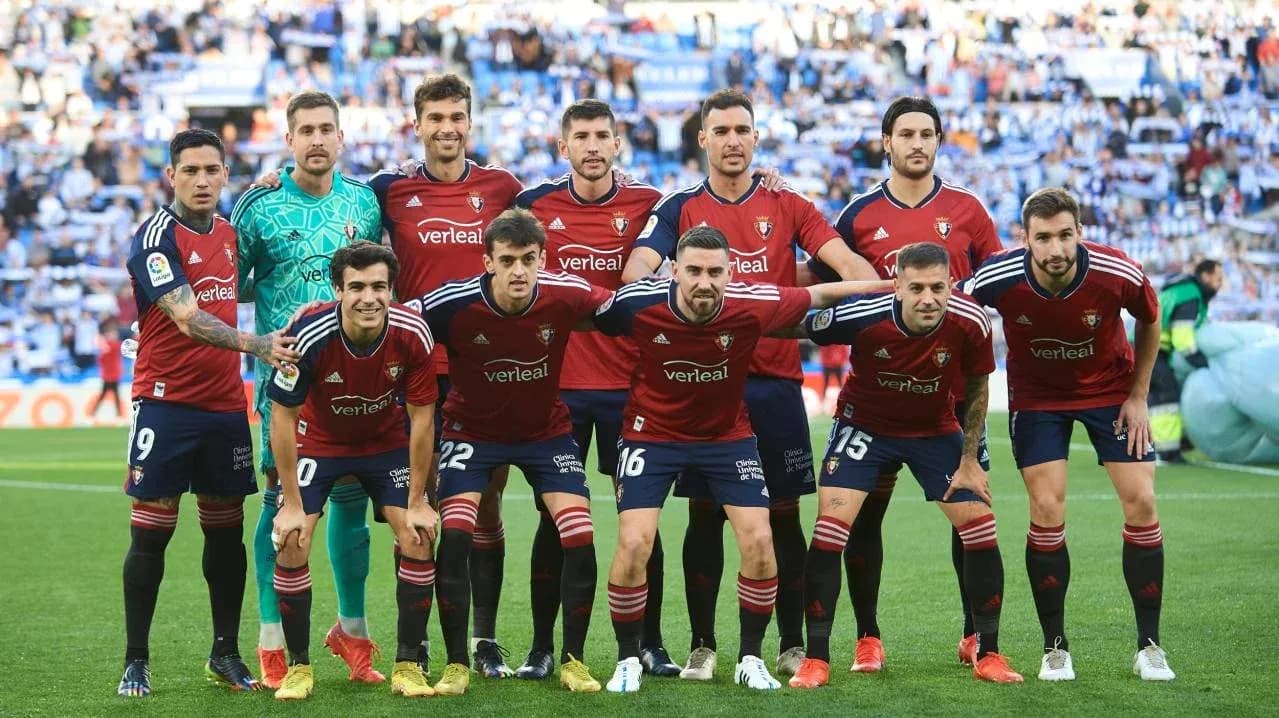
Both teams lined up in a 4-2-3-1, but their usage of the structure diverged sharply. Osasuna’s back four of V. Rosier, A. Catena, F. Boyomo and J. Galan sat behind a double pivot of J. Moncayola and I. Munoz. This base allowed the advanced midfield trio of R. Garcia #14, A. Oroz and V. Munoz to occupy aggressive half-spaces and support lone striker A. Budimir.
In possession, Osasuna built with patience but clear vertical intent. The 441 total passes at 88% accuracy show a technically secure side, but the key was field position: 15 of their 19 shots came from inside the box, evidence of structured occupation of the penalty area and well-timed runs off Budimir. V. Munoz and A. Oroz frequently tucked inside to overload central zones, while the full-backs, especially J. Galan, provided width. R. Garcia #14, operating as a central attacking midfielder, linked play between lines, enabling quick combinations that repeatedly forced Girona’s center-backs Vitor Reis and D. Blind into last-ditch interventions.
Defensively, Osasuna’s 4-4-1-1 out of possession was compact and aggressive. The front unit pressed triggers on sideways passes into Girona’s double pivot of F. Beltran and A. Witsel, forcing play wide and limiting progression through the middle. The figure of 18 fouls shows a readiness to disrupt Girona’s rhythm, though without excessive card accumulation. Crucially, S. Herrera in goal was largely untested, facing zero shots on target and registering 0 saves. Girona’s 0.21 xG reflects how effectively Osasuna collapsed space around the box, with F. Boyomo and A. Catena stepping out decisively to intercept, while the double pivot screened passing lanes into V. Vanat.
Girona’s own 4-2-3-1 was more possession-oriented. With 494 passes at 86% accuracy and 52% of the ball, they circulated through the back four and double pivot, but struggled to convert this into depth. A. Ounahi and V. Tsygankov were tasked with creative duties behind V. Vanat, yet Osasuna’s narrow block forced them into wide or backward passes. The introduction of C. Echeverri at 60' was an attempt to inject more line-breaking ability, while later changes — A. Moreno (IN) for A. Martinez (OUT), I. Martin (IN) for V. Vanat (OUT), T. Lemar (IN) for V. Tsygankov (OUT), and A. Ruiz (IN) for F. Beltran (OUT) — reconfigured Girona’s attacking structure but could not alter the fundamental issue: an inability to access dangerous central zones.
Defensive resilience was high on both sides: Osasuna saw 3 of their shots blocked, while Girona had 3 attempts stifled by the opposition. The difference was that Girona’s last line, shielded by Gazzaniga, was under constant strain. The goalkeeper’s 10 saves were pivotal in keeping the margin at a single goal, especially given that Osasuna’s xG of 1.71 suggested scope for a wider scoreline.
The Statistical Verdict
The numbers underline the tactical story. Girona’s 52% possession and higher pass volume did not translate into threat, as their 5 total shots and 0.21 xG confirm a sterile control of the ball. Osasuna, with 48% possession, produced 19 shots, 11 on target, and 15 from inside the box, reflecting a deliberate, high-quality shot profile.
Osasuna’s team defense, credited with 2 goals prevented, highlights how well the collective block and structural compactness limited Girona’s opportunities before they could test S. Herrera. On the other end, Girona’s defensive unit and P. Gazzaniga collectively registered 2 goals prevented as well, consistent with the 10 saves and the volume of high-quality chances conceded.
In synthesis, the match was a clear triumph of purposeful structure over sterile possession: Osasuna’s 4-2-3-1 was geared toward verticality and box occupation, while Girona’s mirrored shape lacked penetration. Budimir’s goal was the logical outcome of that divergence, and the statistics merely confirm what the tactical patterns made evident over 90 minutes.