Orlando Pride W Defeats North Carolina Courage W: A Statement of Identity
Under the Orlando lights at Inter&Co Stadium, Orlando Pride W edged North Carolina Courage W 1–0, a result that felt less like a single group-stage tick in the NWSL Women calendar and more like a statement of identity. Following this result, the table snapshots underline the contrast: Orlando sitting 7th with 11 points and a positive goal difference of 1 (12 goals for, 11 against), the Courage down in 13th on 9 points and a goal difference of -2 (9 for, 11 against). The margins are small, but the trajectories feel different.
I. The Big Picture – Structure and Seasonal DNA
Orlando stayed faithful to their season-long blueprint: a 4-2-3-1 that has started all 8 league fixtures. Seb Hines again built the side around a clear spine: Anna Moorhouse in goal, a back four of Oihane Hernández, Rafaelle Souza, Coriana Dyke and Hailie Mace, double pivot protection from Haley Hanson and Ally Lemos, and a fluid band of three behind lone striker Barbra Banda.
The numbers back the method. Overall this campaign Orlando average 1.5 goals for per game and 1.4 against, with Inter&Co Stadium providing a slightly more chaotic version of their football: at home they score 1.4 and concede 1.6 on average. The 1–0 here, then, was a controlled deviation from the usual end-to-end feel, suggesting a growing defensive maturity rather than a simple off-night in attack.
North Carolina, by contrast, arrived as tactical chameleons. Across the season they have used five different formations, but Mak Lind opted for a 4-3-3 that leaned into their technical midfield and wide forward quality. Kailen Sheridan anchored a back line of Ryan Williams, Uno Shiragaki, Natalia Staude and Dani Weatherholt, with a central trio of Riley Jackson, Shinomi Koyama and Manaka Matsukubo supplying the front three: Lauryn Thompson, Evelyn Ijeh and Ashley Sanchez.
On their travels this campaign, the Courage have been tight and cagey: 0.8 goals scored and 0.8 conceded away from home. That away profile played out again in Orlando – structurally solid, but lacking the final-third clarity to turn containment into control.
II. Tactical Voids and Discipline
With no official absentees listed, both coaches had near-full decks. The real “voids” were structural. Orlando’s 4-2-3-1 naturally cedes early build-up to the opposition, relying on compactness between the lines. That fits a side that has kept 3 clean sheets overall and failed to score only once; they trust that their attacking talent will find a moment.
The disciplinary data explains part of Hines’ approach. Across the season Orlando’s yellow cards skew late: 30.00% of their cautions arrive between 61–75 minutes, with another 20.00% in the 76–90 window and 20.00% deep into 91–105. This is a team that grows more combative as fatigue and game state sharpen. The 1–0 win here, without the chaos of late cards turning the tide, suggests a more measured game management – a sign of a squad learning when to hold their nerve.
For the Courage, the card profile is even starker. Their yellow cards peak at 46–60 minutes (40.00%), precisely when matches often tip from tactical sparring into open exchanges. More tellingly, their only red card of the season sits in the 76–90 range at 100.00% of their dismissals. That late-game volatility hangs over every tight contest; even when they are structurally sound, there is always the risk of discipline undercutting the plan. Players like Evelyn Ijeh, who already has 2 yellows in just 299 minutes, embody that edge: aggressive, willing, but on a disciplinary tightrope.
III. Key Matchups – Hunter vs Shield, Engine Room vs Enforcer
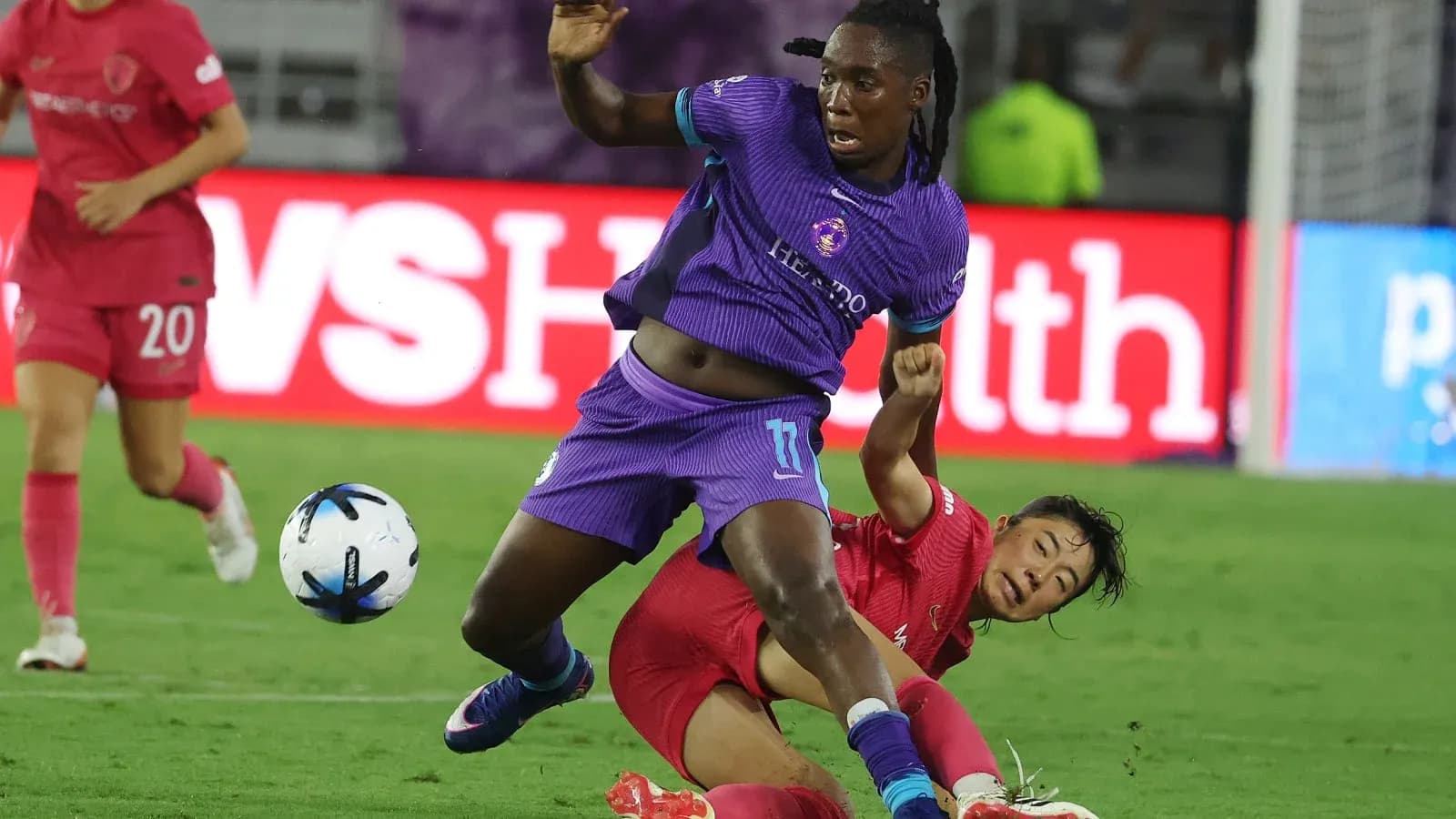
The headline duel was always going to be Barbra Banda versus a Courage defence that, overall, concedes 1.4 goals per match but only 0.8 on their travels. Banda entered this fixture as the league’s most ruthless finisher: 7 goals in 8 appearances, from 30 shots with 19 on target, supported by 11 key passes and an imposing 79 duels contested. She is less a classic poacher and more a gravitational force, bending entire defensive structures around her runs.
North Carolina’s answer was collective rather than individual. Staude and Shiragaki had to compress space behind Koyama and Matsukubo, while Williams and Weatherholt balanced overlapping ambition with the need to double up on Banda’s channels. For long spells they succeeded in limiting clear sights of goal, a reflection of that strong away defensive average. But the mere presence of Banda warped the Courage’s block, freeing the trio of Solai Washington, Angelina Alonso Costantino and Summer Yates to find pockets between the lines. The winning goal, when it came, felt like the inevitable product of those accumulating positional advantages.
In midfield, the “engine room” battle pitched Orlando’s double pivot of Hanson and Lemos against a Courage trio that has been the team’s tactical constant. Hanson’s role as shield and recycler allowed Lemos to step higher, connecting with Washington and Costantino. Their job was twofold: deny Sanchez the transition spaces she thrives in, and prevent Koyama from dictating tempo.
Sanchez, the league’s second-ranked scorer with 5 goals and 11 key passes, is North Carolina’s creative heartbeat. But in a 4-3-3 that already asks a lot of its wide forwards, she was often forced to drop deep to find the ball, turning her from final-third assassin into overworked connector. Orlando’s compact 4-2-3-1 funneled her into traffic; every time she drifted inside, she met a purple wall of Hanson, Lemos and one of the centre-backs stepping in front.
On the flanks, the duel between Ryan Williams and Orlando’s left side was a micro-battle of its own. Williams, with 3 assists and 10 key passes this season, is one of the league’s most productive full-backs. Yet the Courage’s need to maintain a tight back four against Banda limited her license to surge forward. Whenever she did step up, Orlando looked poised to spring into the vacated space, another subtle way the home side’s structure bent the match to their terms.
IV. Statistical Prognosis – What This Result Tells Us
Following this result, the numbers suggest Orlando are edging toward a more sustainable identity. Overall, their goal difference of 1 from 12 scored and 11 conceded is modest, but the underlying patterns are encouraging: 3 clean sheets, only 1 game without scoring, and a stable formation that maximises their star power. If their home defensive average of 1.6 conceded begins to drift closer to their overall 1.4 – as this clean sheet hints – they will look every inch a playoff-calibre side.
For North Carolina, the prognosis is more nuanced. Overall, they score 1.1 and concede 1.4 per match; away, they are harder to break down but also less threatening, at 0.8 goals for and 0.8 against. The 1–0 loss in Orlando fits that pattern: structurally competitive, but lacking the attacking edge to tilt tight games. With Sanchez and Williams carrying so much creative load, Lind must find ways to involve supporting threats like Matsukubo and Thompson more consistently, while managing the disciplinary risk posed by aggressive forwards such as Ijeh and impact options like Allyson Schlegel, whose single red card already shapes how late-game substitutions are perceived.
In tactical terms, this felt like a small but significant inflection point. Orlando showed they can win not just by outgunning opponents but by compressing games into their preferred rhythm, leaning on Banda’s gravity and a more disciplined block. North Carolina showed resilience, but also the limits of a side that defends well away from home without consistently turning that platform into points.
If the Expected Goals models could be laid over this contest, they would likely underline the story the eye already told: Orlando crafting the higher-quality moments through structure and star power, the Courage hovering on the margins of danger without quite stepping into it. In a league where the playoff line is often decided by single-goal margins, this 1–0 at Inter&Co Stadium may be remembered as one of those nights when a team’s seasonal DNA finally came into sharp focus.