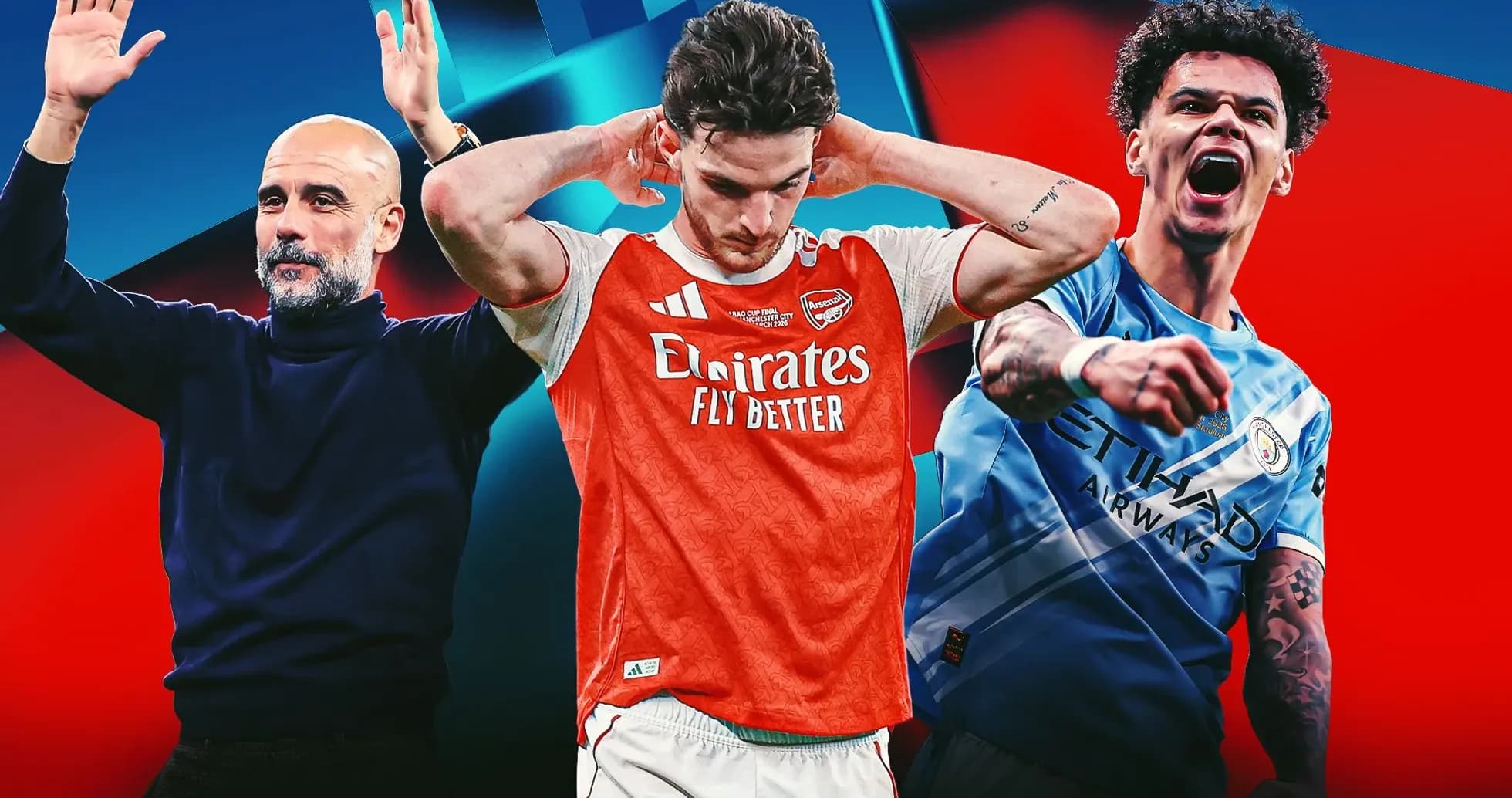
O’Reilly Shines at Wembley in City’s League Cup Victory
At Wembley, the tifo went up before the noise did. A vast image of Dennis Tueart, mid-bicycle kick, hung over the City end like a memory made flesh. The hero of 1976, “The King of All Geordies,” the man whose acrobatics delivered City’s last trophy before a 35-year drought.
Fifty years on, another local lad wrote his own chapter.
O’Reilly’s Wembley day
Nico O’Reilly grew up in Collyhurst, north Manchester, with City in the house and “0161” inked into his skin. He once turned down Manchester United as a kid. On this evidence, he chose correctly.
His rise from academy hopeful to first-team regular has been one of the few unfiltered joys of City’s season. Recently, his goals came from midfield. At Wembley he was pushed back to left-back and promptly played like he’d channelled Yaya Toure in a sky-blue shirt, then added a finisher’s instinct Erling Haaland would recognise.
The breakthrough came from chaos. A routine cross from Rayan Cherki, no real venom on it, drifted into the Arsenal box. Kepa Arrizabalaga came, saw, and misjudged. He flapped, spilled, and O’Reilly pounced, tearing in at the back post to ram the loose ball home. Hunger, pure and simple.
Less than four minutes later, he was there again, this time gliding into the area to glance in Matheus Nunes’ cross. A full-back on the teamsheet, a No 8 in his running, a No 9 in his timing.
By the final whistle, the 21-year-old – named in the England squad on Friday, celebrating his birthday on Saturday – had spent Sunday joining Tueart in City’s Wembley pantheon. A three-day stretch that changes a career.
Kepa’s Cup curse continues
The Carabao Cup and Kepa have history, and not the good kind. In 2019, he refused to come off for Chelsea in this same final, only to lose to City on penalties. Three years later, brought on as Liverpool’s shootout specialist, he conceded 11 spot kicks and then ballooned his own into the London sky.
So when word leaked on Saturday that he would start this final for Arsenal, the storyline wrote itself: redemption or ruin.
The answer came in instalments. Early in the second half, he raced from his line and clattered into Jeremy Doku outside the box, badly misreading a long ball over the top. That should have been the warning. It wasn’t.
Then came Cherki’s cross and the moment that broke Arsenal. Kepa’s weak attempt to claim it opened the door for O’Reilly to stroll in and score. From there, Arsenal never looked like a side capable of dragging themselves back. Kepa’s Carabao Cup saga found its final, brutal entry. It is hard to imagine him in this final again.
At the other end, James Trafford was everything Kepa was not. Composed, decisive, sharp. His triple-save in the first half, denying Kai Havertz and Bukayo Saka in a frantic passage, set the tone for his afternoon and underlined why City were content to stockpile two elite goalkeepers.
Guardiola strikes back
Pep Guardiola had endured a punishing March. Drab, damaging draws against Nottingham Forest and West Ham had nudged the title race Arsenal’s way. Real Madrid, his Champions League nemesis, had beaten him twice. Questions began to circle: was the great machine finally grinding down?
Not for long.
At Wembley, he out-thought his former assistant and outplayed his fiercest domestic rival of recent years. In doing so, he became the first manager in English football history to win the League Cup five times.
Guardiola treated the competition with the same seriousness he reserves for the Champions League. No sentimental selections, no experimental line-ups. Ruben Dias dropped out before kick-off, yet City barely felt the loss. Trafford kept his place as cup goalkeeper. Doku and Antoine Semenyo started together again despite their struggles against Madrid. Phil Foden, poster boy and fan favourite, watched until the 90th minute.
The calls were ruthless. They were also right.
This was the first trophy of the Guardiola era lifted without Txiki Begiristain in attendance, but his successor, Hugo Viana, watched his work dominate the stage. Semenyo and Cherki, two of his headline signings, tormented Arsenal. Trafford, re-signed from Burnley only to see Gianluigi Donnarumma arrive two months later, produced a performance that justified the awkwardness of that decision.
Viana has spent heavily – around £260 million across summer and winter – but most of it has landed. Cherki, at £34m, looks like one of the bargains of this era, the same fee Manchester United paid for Joshua Zirkzee a year earlier. Known for his mischief on the ball, he even indulged in kick-ups to tease Arsenal, drawing a disbelieving shake of the head from Guardiola. Yet it was his graft and guile that really hurt them.
Semenyo battered Piero Hincapié all afternoon, stretching Arsenal with pace and power, then doubling as an auxiliary defender out of possession. City’s structure, energy and edge all bore the fingerprints of a recruitment team that, Donnarumma awkwardness aside, got far more right than wrong.
As for Trafford, who admitted recently he had been blindsided by Donnarumma’s arrival and hinted at a summer move for more minutes, this was vindication. “I didn't expect the situation to happen, but it happened, so just get on with it,” he said not long ago. He did more than that. He produced the kind of Wembley display that sticks in a manager’s mind.
Late on, with City cruising, he still flung himself to deny Riccardo Calafiori and preserve his clean sheet. “This moment means a lot to me,” he said. “Four or five years ago when they beat Spurs to win it, I think I was fourth or fifth choice, and I always imagined that I would win it one day.” Now he has.
Arteta’s chance, Arsenal’s void
For Mikel Arteta, this felt like a crossroads. A first domestic trophy in nearly six years within reach. A chance to finally prise a major honour away from his mentor. A chance to silence the lingering doubts about whether his Arsenal can turn pretty dominance into hardened winners.
It slipped away without much of a fight.
Arsenal’s performance was so blunt that it barely offered a metaphor. This was the top team in the country, on paper, playing like imposters under the arch. The first League Cup final between the top two sides in the pyramid, yet only one of them carried themselves like it.
This collapse had been coming. Too many Arsenal displays in 2026 have ended with them crawling over the line when their squad depth says they should be sprinting. Results have masked performances. If City were closer in the league table, the debate would not be about aesthetics or philosophy. It would be about whether this side is truly operating at its ceiling.
At Wembley, they never really threatened to find out. Arteta’s in-game management told its own story. With his team 1-0 down and drifting, he readied Noni Madueke and Calafiori, but by the time they stepped onto the pitch, City had already scored their second. Guardiola’s men had seized the start of the second half, taken control of the contest and never let it go.
Arsenal’s attempt at the quadruple now lies in pieces. They were the latest English club to reach February and March alive in all four competitions, and the latest to discover the final step is a chasm. Arteta, asked recently about the difficulty of winning all four, gave an answer that now sounds like a warning he couldn’t quite heed: it’s never been done, so that’s how hard it is. Go game by game, earn the right to stay in the fight, then see what happens.
What happened at Wembley was familiar. The final third of the season has repeatedly exposed this version of Arsenal. In 2021-22, they threw away Champions League qualification. A year later, they spent more days on top of the Premier League than any team in history without winning it. In 2023-24, they rattled off 16 wins in their last 18 league games, yet the result most remembered is a 0-0 at the Etihad that felt like a concession.
Rodri’s words at the end of that campaign still echo. He questioned their mentality, recalling that goalless draw: Arsenal came to the Etihad, he said, and played for a point. “And that mentality, I don't think we would do it the same way. And we caught them.”
Wembley did little to challenge that verdict. When the moment demanded aggression, Arsenal chose caution. When the occasion cried out for risk, they stuck to the plan and watched the game slip away.
Guardiola, bruised by Madrid and stung by the league table, walked away with another trophy and a fresh reminder of his grip on English football’s big days. O’Reilly walked away with his dream made real. Trafford walked away with his doubts quietened.
Arsenal walked away with another question: how many times can a team reach this stage of a season, this close to everything, and still look like strangers to the finish line?