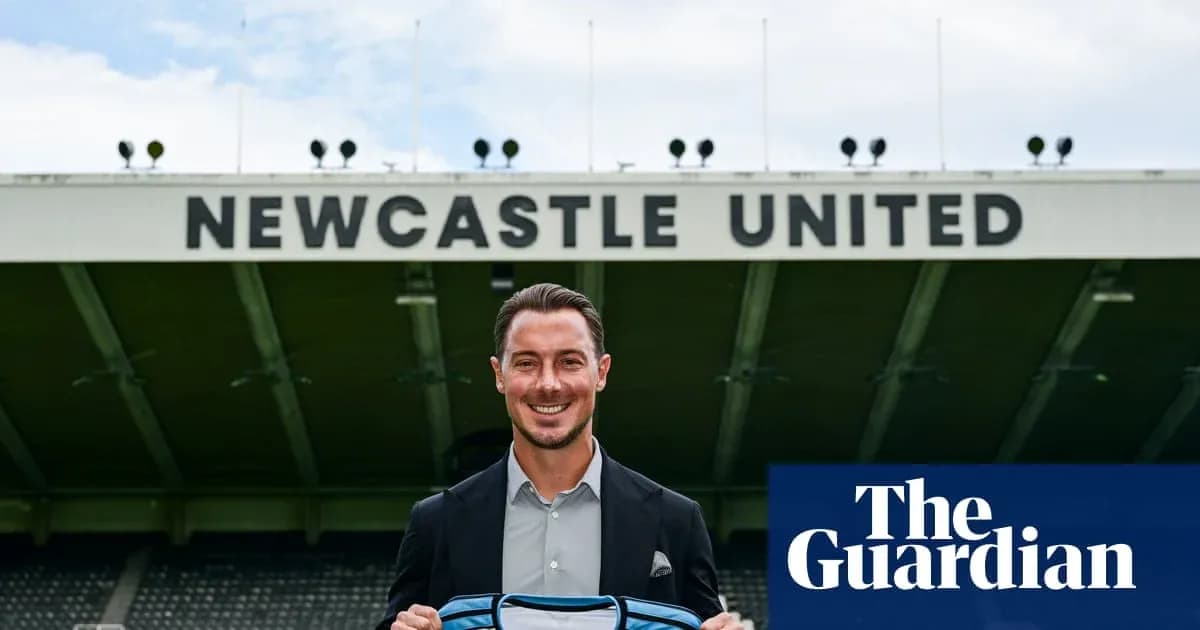
Newcastle's New Era: Jaissle's Calm Amidst Change
As grand declarations go, “I am quite optimistic” is hardly one for the marble plinth. It’s not “ask not what your country can do for you…”, and it’s certainly not “I think I am a special one”. For a club that once imagined itself surfing a tidal wave of petrodollars, Matthias Jaissle’s first words as Newcastle manager landed with a soft thud rather than a thunderclap.
No “fire”. No “rock star”. Those were the pre-match promises from the club’s top executive to the journalists waiting at St James’ Park. What they got instead was calm, measured, almost understated. Given the summer on Tyneside, it felt less like a letdown and more like common sense.
The Toon Army’s expectations have been dragged back down to earth since the night Geordies cracked open the Tin, wrapped tea towels around their heads and hailed the end of Mike Ashley’s reign. Back then, the arrival of a consortium backed by Saudi Arabia’s Public Investment Fund was supposed to usher in a new footballing order. Lionel Messi was never going to be mowing the pitch or flogging the pies, but that didn’t stop some from dreaming.
Reality has been far more complicated.
Newcastle have not stormed the Premier League nor turned the Bigger Cup into a private party. Depending on your persuasion, that’s either the fault of craven football authorities protecting a hated red cartel, or a sign that the takeover euphoria was always built on sand. The truth, as usual, sits awkwardly in the middle.
Eddie Howe’s final season exposed plenty of cracks. The much-hyped “here we go” signings didn’t reach the level required. Results frayed, the squad thinned, and the momentum that had once carried Newcastle into the Champions League began to ebb. Yet to pretend Howe’s time was anything other than a success is to rewrite history. Under him, Newcastle found their feet, lifted an actual trophy and twice climbed aboard the Bigger Cup fun bus. For a club long addicted to chaos, that was no small feat.
The Saudi connection, though, has not turned Barrack Road into a river of black gold. St James’ Park is not paved with Texas tea. One of the hidden traps of being acquired by a geopolitical heavyweight is that geopolitics tend to have other priorities. Gulf states have plenty to deal with right now, and PIF’s interests run far beyond a football club perched on the north-east coast of England, 3,000 miles from Riyadh.
So the project enters a new phase. Anthony Gordon has gone. So has Sandro Tonali. Bruno Guimarães too. Three pillars of Howe’s Newcastle, sold. To some, that exodus screams loss of interest from Saudi Arabia. Yet Jaissle’s arrival from Al-Ahli, another club under the same PIF umbrella, points to something more nuanced. The hands on the tiller have not disappeared; they may simply be steering a different course.
Jaissle, for his part, handled his unveiling with poise. Those in the room agreed: he spoke well. He described stepping into St James’ Park for the first time with his staff, the kind of detail that plays well in a city that lives through its club. “We were looking at each other with smiles and goosebumps,” he said, painting the picture of a coaching team awed by the scale and noise of their new home.
Then came the realism. He acknowledged a “vacuum” left by the sale of key assets, a blunt admission that this is not the squad he might have imagined inheriting. No wild promises. No chest-beating. None of the touchline theatrics and volcanic energy that some profiles of him had teased. Instead, a quiet, almost studied composure.
He also observed the now-standard ritual for Newcastle managers: walking the room and shaking the hand of every journalist. It looked, depending on your view, like either a small act of class or a subtle power play. A way of saying: I see you, I’ll face you, but we do this on my terms.
Behind the handshakes and soundbites, the club has slipped back into a familiar state: flux. Howe’s exit and the departure of Gordon, Tonali and Guimarães have stripped away much of the certainty that had briefly settled over Tyneside. For years, that sense of instability was Newcastle’s natural habitat. Under Howe, they escaped it. Under Jaissle, they are right back in the middle of it.
So the questions write themselves.
How long can Jaissle’s calm, collected demeanour hold if results dip and the stadium that gave him goosebumps turns restless? How long can “quite optimistic” carry a fanbase that once believed it was on the brink of a golden age?
Newcastle, a black-and-white town in every sense, now find themselves in the grey.