
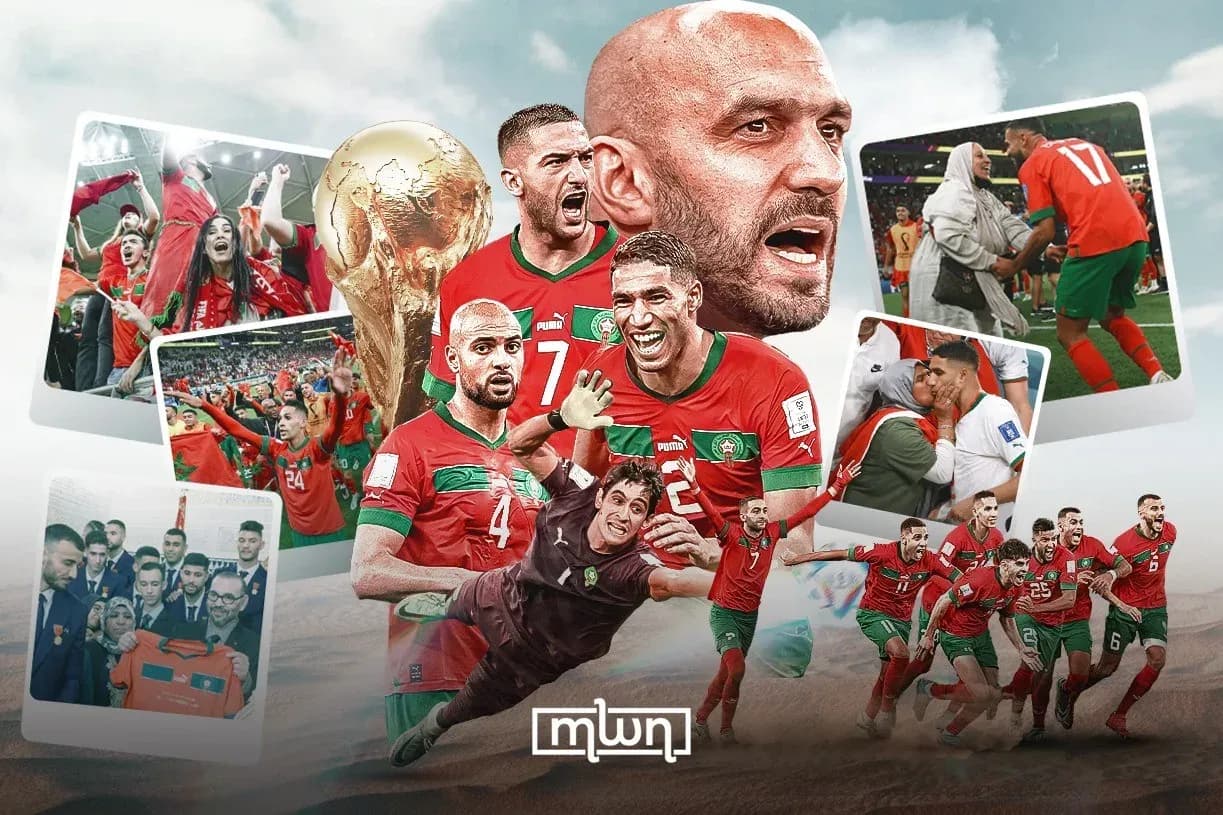
A Nation’s Story: Morocco's Journey to World Cup Semi-Final
The anthem comes first. No commentary, no montage, just the sound of a nation rising with its team on the night of a World Cup semi-final. Then FIFA+’s documentary A Nation’s Story opens its eyes and steps inside the Morocco camp, into the noise, the nerves, and the conviction that turned Qatar 2022 into something far bigger than a football tournament.
This is not a tactical breakdown. It is a study in belief.
Romain Saïss appears early, voice steady, message clear. Morocco had not travelled to Qatar to make up the numbers. “We weren’t there just to play three matches. We were there to truly make history.”
That line hangs over everything that follows.
Building a mentality
The film walks through the tournament in order, but the real timeline it traces is psychological. The group-stage opener, a 0-0 draw with Croatia, is not treated as a cagey stalemate against the eventual finalists. It becomes the first brick in Morocco’s new self-image.
“It allowed us to enter the competition well,” says head coach Walid Regragui. “It gave us a lot of confidence, because entering the tournament with a defeat is never good.”
The camera and the voices keep circling back to the same pivot point: Regragui’s arrival and the shift he engineered in the players’ heads. Yassine Bounou puts it bluntly.
“The coach managed to remove the inferiority complex we felt.”
Regragui’s message is stripped of romance and excuse. This squad did not need to dream of belonging at the elite level. It already did.
“There were players playing at big clubs,” he says. “There was no excuse not to be at the same level as the opponent.”
From there, the film builds its spine. Morocco are not cast as a collection of gifted individuals on a fairy-tale run. They are a group bound by sacrifice, the language of “we” and “family” repeated until it sounds less like a slogan and more like a code.
“We are first a family, first a team, and we will win together.”
Spain and the art of suffering
The round-of-16 clash with Spain is where the documentary’s pulse quickens. On the pitch, Morocco spent long stretches chasing shadows, sprinting after one of the world’s most technically polished sides. On the screen, that imbalance of possession becomes something else entirely.
“They made us run a lot,” Regragui admits. “It’s an extraordinary team in terms of play.”
The key is what comes next. Morocco’s deep defending is framed not as panic, but as a conscious embrace of discomfort.
“The most important thing is that they accepted they were going to suffer,” Regragui says. “They stayed concentrated. They didn’t give up.”
By the time the match slides into penalties, the tension in the footage is matched by a quiet certainty in the players’ voices. This is not a lottery for them; it feels like an opportunity they have been moving toward all night.
“We are lucky to have one of the best goalkeepers in the world,” a voice says over close-ups of Bounou, expression unreadable, preparing for the shootout. “I think he will go down in the history of Moroccan football.”
Around them, the world narrows to a spot on the grass and a whistle. Around the stadium, something else is happening. The documentary widens its lens, letting the roar of Moroccan fans in Qatar pour into the story.
“At every minute, it felt like we were playing in Morocco,” the narration says.
Regragui underlines what those images show: families, flags, and thousands of journeys made for a once-in-a-lifetime chance.
“We are passionate people. Many people made sacrifices to support us.”
Portugal and a barrier shattered
By the quarter-final against Portugal, the stakes have changed. Morocco are no longer outsiders sneaking into the knockouts. They are chasing a frontier.
“The ultimate goal for us was to become the first African nation to qualify for a semi-final.”
The rivalry carries history. The film nods to Mexico 1986, when Morocco beat Portugal 3-1 to become the first African and Arab nation to reach the Round of 16. It then jumps to Russia 2018, where Portugal edged a tight group-stage meeting 1-0 and Morocco went home early despite playing well.
Qatar brings the story to a boil.
On screen, Youssef En-Nesyri rises in the 42nd minute. The numbers come later – a 2.78-meter leap – but you don’t need them to feel the shock as he towers above the Portuguese defence and slams in the header. The goal lands like a statement.
From there, the match becomes a test of endurance. Saïss, already patched up, is lost to injury. Other defenders follow. Morocco drop deeper, then deeper still. A “low block” becomes a last stand, and when they go down to 10 men in stoppage time, the clock seems to slow.
Cristiano Ronaldo, who started on the bench and entered in the 51st minute, prowls the final third. The documentary does not linger on his touches, but it does not need to. His exit, in tears, down the tunnel after the final whistle, is one of the defining images of the World Cup, and here it serves a different purpose: the symbol of a power structure being rewritten.
Morocco’s 1-0 win does more than send them to a semi-final. The film treats it as a demolition of a long-standing ceiling.
By beating Portugal, Morocco tear apart the notion that African teams exist only to entertain or to treat a place in the knockout rounds as the summit. This is a new altitude.
When the final whistle blows, the documentary frames the moment not as a shock, but as a long-awaited correction.
France, pain, and a new reality
The semi-final against France carries a different weight. The tone drops. The smiles fade. This is where the physical bill for Morocco’s run comes due.
“He is our captain. He is our leader,” Regragui says of Saïss. “If he could be ready, even at 80%, I would take the risk.”
The risk is real. France score early, and the camera keeps returning to the faces on the Moroccan bench, to the bandages, to the grimaces that replace the euphoria of earlier rounds.
“When you are in a World Cup semi-final and losing 1-0, you know you have to give everything,” Regragui says.
They do. Even as Saïss and Nayef Aguerd fall to injury, Morocco refuse to retreat into self-pity. They push higher, they take the ball, they dictate spells of play against the reigning champions. The film lingers on Jawad El Yamiq’s audacious overhead kick that crashes against the post, a moment of wild improvisation that comes within inches of rewriting the night.
But bodies can only carry so much. “On a simple pass, the thigh gives way again,” Regragui recalls of Saïss’ injury. “That’s it. It stops.”
France, just a fraction sharper, find the decisive moment. Kylian Mbappé slaloms through a crowd, the ball breaks, and Randal Kolo Muani taps in the 79th-minute goal that seals Morocco’s fate.
The documentary refuses to let that be the final word.
“At the end of the match, we were disappointed because we truly believed,” Bounou says. “We wanted to play in that final.”
Then the film pivots. What had been sold to the world as a “miracle run” is rebranded from within. This is the “end of the miracle,” yes, but also the “start of a new reality” for African football. Semi-finals are no longer an impossible dream, but a target to chase, a level to reach again.
A loss, the film insists, that is in reality a win.
The last push and what remains
The third-place match against Croatia looks and feels different. There is no sense of destiny now, only fatigue. Bounou captures it in four words.
“You’re at the end.”
Morocco, battered and patched up, still swing. They fall behind, equalise, then concede again. The documentary does not dwell on the details of the 2-1 defeat, but it does spotlight the final act: En-Nesyri rising one more time in the 95th minute, his header flashing agonisingly close.
Fourth place. No bronze medal. On paper, the story closes with back-to-back defeats.
On screen, it ends another way. The closing images are not of players slumped on the turf or staring blankly into space. They are laughing, embracing, reaching out to supporters who turned foreign stadiums into Casablanca and Rabat for a month.
Morocco leave Qatar without a trophy, but A Nation’s Story never measures their success solely in metal or in scorelines. It measures it in the way a team walked into a World Cup with a promise to “truly make history” and walked out having changed what an entire continent believes is possible.
The question now is not whether that was a one-off. It is who dares to follow.



