
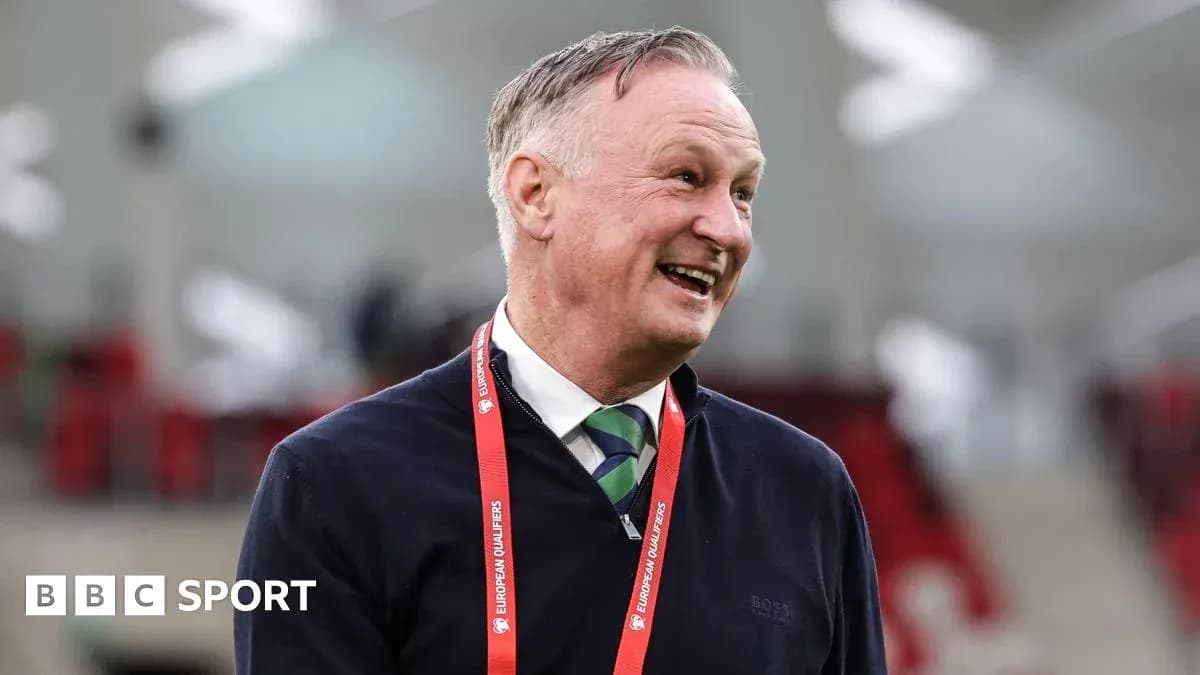
Michael O’Neill Extends Northern Ireland Contract Until 2032
Michael O’Neill has tied his future to Northern Ireland for the long haul, signing a four-year contract extension that will keep him in charge until 2032 and cementing one of the most significant managerial reigns in the country’s history.
The decision ends months of uncertainty around his dual role. O’Neill had been juggling his national team duties with a spell as interim Blackburn Rovers boss since February, steering the Championship club while still fronting the international side. Earlier this month, Blackburn confirmed he would not be taking the job on a permanent basis. The path was cleared. His focus is now fully, unequivocally, on Northern Ireland.
For the Irish FA, it is a statement. For O’Neill, it is personal.
“This is a role that means a great deal to me,” the 56-year-old said, underlining the emotional pull that has brought him back not once, but twice. “I continue to believe strongly in the potential of this group of players and the direction we are moving in. There is a lot of work ahead, but I am excited by the future.”
A Record-Breaking Reign
O’Neill has already rewritten the record books. Across two spells, he has managed Northern Ireland in 104 games, more than any other coach. The defining early chapter came at Euro 2016, when he led the country to its first major tournament in three decades and reawakened a fanbase that had grown used to watching summers pass them by.
He first took the job in 2011, inheriting a side low on confidence and identity. Over eight years he reshaped it, dragged it back onto the major-tournament stage, and then departed in 2019 to become permanent manager of Stoke City after an initial period of combining both roles.
The pull of home, though, never really loosened. In 2022, after leaving Stoke, he returned to Windsor Park and resumed a project he had started more than a decade earlier. Between his two stints, O’Neill has now been at the helm for 11 years in total, a level of continuity rare in modern international football.
Rebuild After Setbacks
The second spell has not carried the same immediate highs as 2016. Northern Ireland missed out on Euro 2024 qualification and most recently suffered the sting of a play-off defeat by Italy, which ended their hopes of reaching the 2026 World Cup. That loss cut deep. It also sharpened the sense that this team is still in transition.
O’Neill has responded by ripping up the old script and backing a new core. Conor Bradley, Shea Charles and Isaac Price have emerged as central figures in a younger, more energetic side that he believes can grow together over the next cycle. The rebuild has not been smooth, but it has been deliberate.
There have been signs the work is starting to bite. Northern Ireland finished top of League C3 in the 2024/25 Nations League, collecting three wins, two draws and just one defeat. It was not a marquee competition triumph, but it restored some momentum and, crucially, a bit of belief.
Tests on the Horizon
The next steps arrive quickly. Northern Ireland face Guinea in a friendly on 4 June before travelling to meet France four days later. One fixture offers experimentation and minutes for emerging players; the other, against the world-class depth of the French squad, provides a hard, unforgiving benchmark.
Those matches serve as tune-ups for a Nations League campaign that starts in September. O’Neill’s side have been drawn in Group B2 alongside Hungary, Georgia and Ukraine – a group that offers opportunity but no guarantees. It is the kind of section where a young team can either mature fast or be exposed.
The extension means there is no short-termism in the planning. O’Neill can shape this squad with 2032 in mind, but his immediate target is much closer.
Eyes on Euro 2028
Everything now tilts towards Euro 2028. With the tournament being staged across the United Kingdom and the Republic of Ireland, Northern Ireland have a rare chance to qualify for a major finals effectively on home soil. The stakes are obvious. So is the appeal.
O’Neill has already shown he can navigate a qualification campaign and handle the pressure of a finals environment. The difference this time is the cast: younger, less battle-scarred, but brimming with potential. He believes in them. The Irish FA has made it clear it believes in him.
A decade on from that magical summer in France, the architect of Northern Ireland’s modern high point has been handed the time and authority to build again. The question now is simple and stark: can Michael O’Neill turn this promising, raw group into a team ready to walk out at Euro 2028?



