Max Dowman Shines in Arsenal's Win Over Ipswich
Max Dowman has spent the early weeks of this season waiting his turn. On Tuesday night, he kicked the door down.
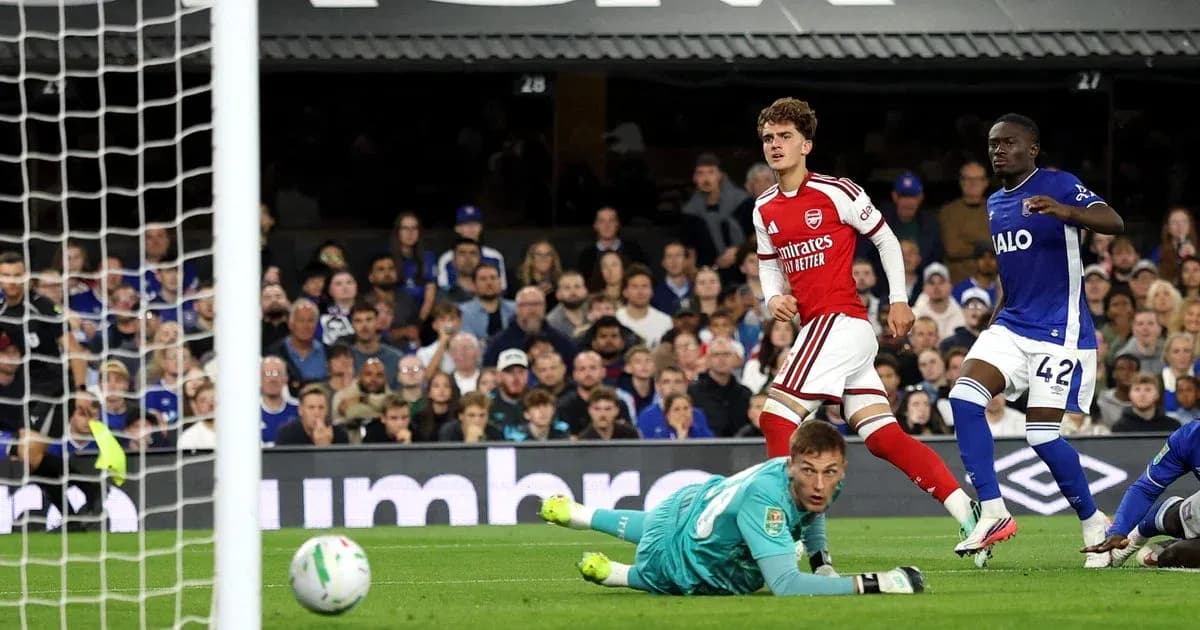
Six minutes into Arsenal’s 4-2 win at Ipswich, the 16-year-old announced himself all over again. One burst, two touches, one feint — and Portman Road was watching a rerun.
He picked up speed, full throttle, gliding straight at the heart of the Ipswich defence. Two right-foot touches to set the angle, then that familiar swivel of the hips. A sharp drag onto his stronger left left Cedric Kipre scrambling on all fours. Christian Walton braced for the far-post finish. Dowman looked that way, then snapped a right-foot shot inside the near corner instead.
Everyone has seen that move before.
It was almost a copy-and-paste of the goal that made him the Premier League’s youngest scorer against Everton in March, when a similar shimmy sent Kiernan Dewsbury-Hall to the turf and the Emirates into chaos. The stage was smaller this time, the pitch bumpier — more Mansfield Town than north London carpet — but the effect was the same: one flash of movement, defenders left behind.
Mikel Arteta has seen enough of those actions to know they are no accident.
“That’s something very natural for him, and he can deliver those actions effortlessly, I would say,” the Arsenal manager said afterwards when asked about what is fast becoming the Dowman signature. “That’s his biggest quality. And defensively, his application, his capacity as well to sustain the actions, which is not easy.
“He’s 16 and he can create moments but consistently to go through the game, every phase with the demands that we put on him. To be able to do that is extremely difficult. And he’s coping better and better and better.”
Dowman did not stop at one. His second was a different kind of showreel clip, a nutmeg finish rolled into the far corner, the sort of detail that turns a good night into a statement.
These were his first senior minutes of the campaign, but he has not been idle. He went 90 for the Under-21s in a 1-1 draw with Crystal Palace on August 22, setting up their only goal, and played an hour in a 5-0 defeat to Chelsea on September 12. Those outings were not a demotion, just the reality of a senior schedule light on midweek fixtures — the same path Myles Lewis-Skelly followed at the start of his own breakthrough last season.
Arteta had promised Dowman’s chances would come after the first team beat Sunderland 2-0 on the same night the Under-21s lost to Chelsea. When they did, the teenager showed he is not just a highlights player.
His pressing triggered Arsenal’s second goal, harrying Walton into the mistake that allowed Noni Madueke to score. Arteta highlighted that as much as the finishes.
“He did the action where he regained the ball and wins it for the first goal, too,” Arteta said. “That’s the thing that we need to reiterate with him because he’s an unbelievable player.
“He really wants to do it (pressing). The more he plays, the more he trains with us, and the more ready he is physically to sustain that level, he will do it. And that will help in his attacking phase because he will force errors from the opponent, and then be in a really open situation to exploit his qualities.”
The work without the ball did not fade after half-time. If anything, it sharpened another key theme of the night: Dowman’s evolving role.
Freedom between the lines
Last season, most of his senior minutes came off the right flank. He grew up in the Arsenal academy as a midfielder, but breaking in as a young attacker is often easier out wide, away from the traffic in central zones. He did get two starts in the middle — at Mansfield Town and Crystal Palace — and returned to that position at Portman Road.
This was not the classic No 10 performance Arsenal fans have seen from Martin Odegaard or Ethan Nwaneri in recent years, operating in one tight pocket. Dowman roamed. He drifted left to give Bruno Guimaraes a clearer passing lane into him, then popped up early around the box, constantly asking questions of the Ipswich back line.
When the game began to stretch and lose shape, he moved out to the right again. The shift did not blunt his edge. At one point he tore back towards his own goal to shut down a Jack Clarke counter-attack, a lung-busting sprint that drew loud chants of “Super Max Dowman” from the away end.
Arteta knows what that kind of noise can do around a 16-year-old.
“If he does what he does on the pitch, I understand it’s not easy (to quieten the hype),” he said. “We have to look after him. He’s 16. You don’t see that in this league. In other leagues in Europe, that’s a totally different context. But with the demands that the (Premier League) has, we need to make sure every time we throw him in, he’s in the right context with the right preparation.
“You don’t (normally) see players (of Dowman’s age) with the capacity to handle just the physicality of the game. Not only that, but the demands that you have to put your body through in the week to be able to be in a good condition to compete, the amount of information, the challenges that you have to face. But he’s doing it really well.
“But he will dictate that in terms of how he behaves every single day and how many reasons he gives to play because he’s part of our squad.”
No real blueprint
This is where Dowman’s story starts to look unusual even by modern standards.
Last season, at 15 and 16, he played 13 times for the first team. Nwaneri became Arsenal’s youngest debutant at 15 years and 181 days, but did not truly break through until he was 17 in the 2024-25 campaign. Barcelona’s Lamine Yamal stepped onto the pitch for the first team at 15 years and 289 days in April 2023, then did not feature again that season.
He exploded a year later, with 37 La Liga appearances as a 16-year-old, but as Arteta points out, the physical profile of the Spanish top flight is different. Cesc Fabregas, Jack Wilshere and Lionel Messi all debuted at 16 for Arsenal or Barcelona, yet their first sustained senior seasons came at 17. Even Wayne Rooney’s 33 league games (14 starts) as a 16/17-year-old in 2002-03 sit in a separate category because of how physically developed he already was.
So there is no neat template. No obvious path to copy. Arsenal are feeling their way through this, trying to balance the “wow” moments with the quiet, unseen work of building a career.
The next step may come away from the club. The first England youth squads of the season are due to be named this week, with Dowman seemingly ready to move up from the Under-19s. That would be a natural progression, another marker on a fast-moving journey.
If that call does not arrive just yet, nothing really changes. Arsenal know what they have. England do too. The only real question now is how quickly Max Dowman decides to climb.