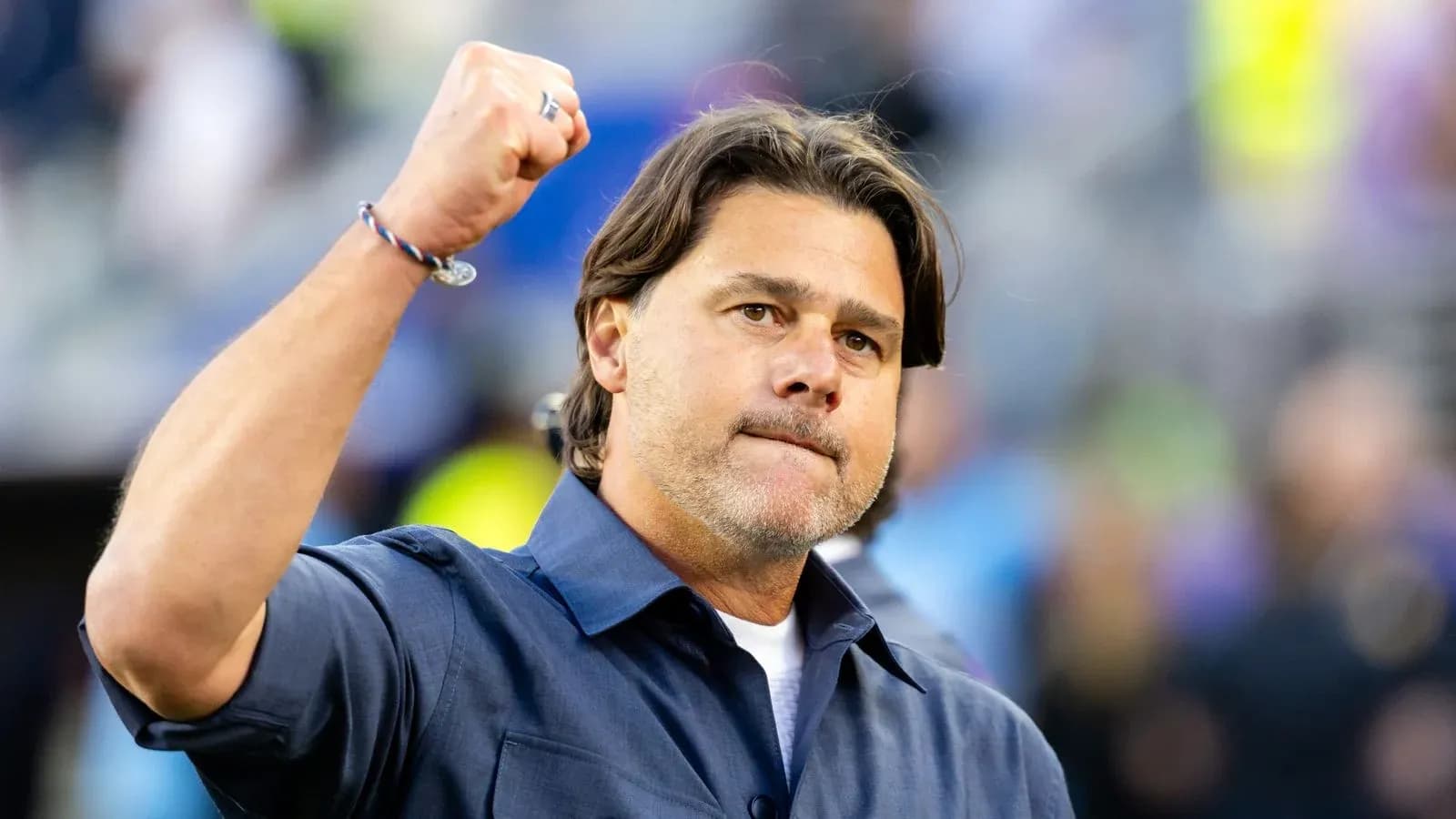
Mauricio Pochettino Reflects on World Cup Experience and Future Ambitions
Mauricio Pochettino walks into the room with the same easy warmth as ever. Hugs, handshakes, a burst of summer small talk. He has recharged, but not rested. Not really. His summer has been far too intense for that.
The 52-year-old has just taken the USA to the last 16 of a home World Cup, only to see the dream torn apart by Belgium. On paper, it reads like a solid run. In reality, it was a whirlwind.
There was Donald Trump – of course there was – and that infamous changing-room team talk. There was Trump, FIFA, and the extraordinary saga of Folarin Balogun’s “suspension of his suspension”. Somewhere in the chaos, Pochettino even turned into an unlikely fashion story.
Then, when the noise started to die down, came another twist. He signed on for four more years with the USA. A surprise to many. Not to him.
‘We are much better coaches now’
Ask him where to begin and he goes straight back to the World Cup. Not the noise around it. The work.
“For us, the biggest takeaway is how much we learned,” he says, referring to himself and long-time assistant Jesus Perez. “We are much better coaches now.”
The tournament has sharpened him. Reinforced his obsession with detail. Reminded him how hard it is to get every call right when you see your players in short, intense bursts rather than over the long rhythm of a club season.
“Everything needs to be perfect,” he says, and you sense he means every meeting, every drill, every line of every team talk.
The World Cup is chaotic at the best of times. Add a home tournament and a president who relishes the spotlight and it becomes something else entirely. Pochettino chooses his words carefully around Trump, focusing on the support and backing the team received, not the circus around it.
The Balogun case, though, he addresses head-on. The striker’s disciplinary situation, and the late decision by FIFA to allow him to play against Belgium, dragged the game into a political storm.
He admitted at the time that “politics and manipulation” overshadowed the tie. He understood the anger. But his role, he insists, stayed simple.
“If you pay attention to the noise, you become crazy,” he says. When the letter from FIFA arrived the day before the game confirming Balogun was available, the decision was, in his words, “straightforward”.
Balogun’s future and a collapsed move
Balogun has been back in the headlines since, this time for club reasons. His proposed move from Monaco to Everton collapsed late on Deadline Day. Pochettino has not called him yet.
He has kept his distance on purpose. He knows how bruising a failed transfer can be and wants to give the forward space. He would have liked to see Balogun in the Premier League. Instead, the striker remains in Ligue 1.
Pochettino simply hopes he finds his rhythm again at Monaco and arrives at the next international window in a good place.
The touchline suit that took off
Then there was the fashion.
Pochettino has always cared about how he presents himself, but even he did not expect his navy touchline look to go viral. Social media latched on to it, headlines followed, and then Wayne Rooney went out and bought the same outfit.
“I saw him,” Pochettino grins. “He looked good on him, like a top coach.”
It summed up the summer. Football, politics, controversy, style. A manager at the centre of it all.
Four more years with USA – but Premier League dream lives on
As soon as the World Cup ended, the rumour mill started. Pochettino’s name bounced around every vacancy. Yet the speculation fizzled quickly once news broke that he had committed to the USA until 2030.
If he sees out the deal, that would be six years away from club football. For a coach so closely associated with the Premier League, it feels like a long exile.
Is that chapter closed?
He shakes his head. Not even close.
“I have the ambition,” he says. “My dream now is to be in the USA for four years, but after that, why not? We are still young, and I think coming back is always my goal; to win the Premier League, to be in the Premier League and to build a project with the possibility of winning.
“I love the football here. I think to have the chance again is one of my wishes and I hope that happens.”
The Spurs question that never goes away
That hunger to return inevitably drags the conversation back to Tottenham.
Around 18 months ago, he spoke openly about wanting to go back one day. Since then, Spurs have lurched through more turbulence. Ange Postecoglou has gone. Thomas Frank and Igor Tudor have both come and gone too, as the club flirted dangerously with relegation.
So, did the call ever come? Was a rescue mission on the table?
“Always I say, one day, why not?” he replies when asked about a return in general.
Pressed on whether it was a real possibility this time, he is clear.
“People talk and maybe we receive some approach, but it never was close.” Not this time.
Other options floated around. At one stage AC Milan looked like a genuine route back into club football.
“We were not open during the World Cup to talk with different clubs that were interested,” he explains.
Were there many? He gives a familiar half-smile.
“Yes, always,” he says, as if it is simply part of the job. “Yes, always have different, you know, options.”
Did any of them tempt him? He shakes his head.
“We never gave the opportunity to be close. We always closed the door before it got close.”
The USA project, for now, is non-negotiable.
Spurs, Chelsea and a changing Premier League
Talk turns to his old clubs. Starting with Spurs.
“It is never dull at Tottenham,” he is reminded. He laughs, because it never has been.
“They are investing like other clubs,” he says, seeing a clear shift in strategy. After a couple of difficult years, Spurs have pivoted towards spending heavily on players already proven in the Premier League.
It is a stark contrast to his own era. Back then, he pushed Tottenham to the brink of glory in the league and in Europe on a far tighter budget. Asked, with a mischievous smile, what he might have done with £300m to spend, he feigns innocence. He pretends he cannot even imagine what £300m looks like.
So will this new approach work?
“You never know,” he replies. “We need time to see if that works or not.
“Like in all the games, when you make a decision like a coach that can work well or not. I think it’s a different strategy and a different way to operate. I always wish the best for Tottenham because it’s in my heart.”
Chelsea, another of his former employers, have also shifted gear. The role he held two years ago – head coach – has now been redefined as manager. The transfer policy has changed too. Under Xabi Alonso, the club have targeted Premier League-ready players rather than long-term projects.
Pochettino is wary of direct comparisons, but he recognises the intent.
Buying players like this, he concedes, means you “can expect to fight, to be a contender for the Premier League.”
Chelsea’s defeat to Arsenal has already checked some of the early optimism around Alonso, yet Pochettino calls for calm.
“Of course they are disappointed after the defeat against Arsenal, but I think we need to give time to Xabi’s first season after three games in the Premier League,” he says.
“I think we need to give time, and of course for Tottenham the same.”
‘Mikel is the best coach in the Premier League today’
If patience is his message for Spurs and Chelsea, his verdict on Arsenal is far more decisive.
“For Pochettino, Arsenal are very much in pole position,” he is told. He does not argue.
“Mikel [Arteta] is the best coach in the Premier League today,” he says. “Knowing what he needs to do, it’s going to be tough to beat them.”
From a man who once stood on the other side of that North London divide, it is a striking admission. But it also underlines where he sees the bar set in English football.
Pochettino will spend the next four years trying to take the USA to that same level of clarity and control. After that, he wants another crack at the league he calls home.
The World Cup has hardened his ideas, sharpened his edge and, by his own account, made him a better coach. The question is not whether he comes back to the Premier League.
It is who will be brave enough to hand him the keys to a project built to win.