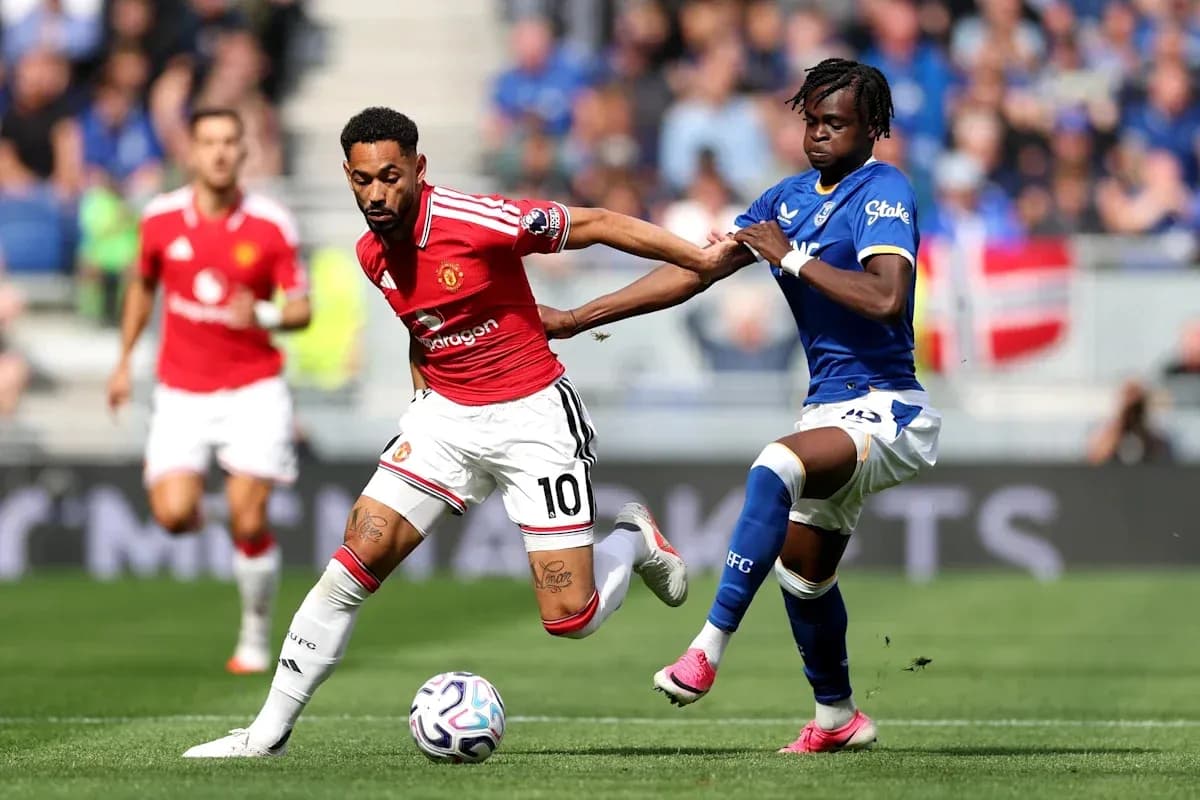
Manchester United Draw at Everton: Defensive Issues Persist
Manchester United walked out of Goodison Park with a 2-2 draw and the familiar sting of a game they should have killed long before stoppage time chaos.
They had the structure. They had the chances. They even had the lead. Twice.
What they didn’t have was the finish – at either end of the pitch.
Attacking ideas, missing edge
United’s play for long stretches looked sharp. The first half in particular carried a sense of control: neat combinations, good movement between the lines, and enough territory to suggest this could be a comfortable away win.
They twice went ahead from restarts, a sign of planning and focus. The patterns were there, the rotations too. But when it came to turning pressure into clear, ruthless chances, United kept coming up short.
Three creative forwards gave the attack some bite and invention, yet the box often felt empty. Runs across the near post, darting movements between centre-backs, that instinctive striker’s presence – all of it was sporadic. United moved the ball well until the final act, then the picture blurred.
That’s where the conversation inevitably turns to personnel. Benjamin Sesko’s return to fitness offers one obvious solution. Bryan Mbeumo stepping back into a central striker role is another. On the right, Amad’s absence continues to bite. Shea Lacey has talent but not yet the readiness for this level of responsibility, and there is no real indication that Matheus Cunha will be redeployed as a right winger any time soon.
United can live with the occasional misfire in attack. What they cannot live with is the trend at the other end: two goals conceded in each of their first three matches of the season. That is not a blip. That is a pattern.
A back four that never settles
If the attack lacked a finisher, the defense lacked a foundation.
Six goals shipped to Hull City, Ipswich Town and now Everton is a red flag on its own. Doing it while facing an Everton side that has struggled for fluency in attack only underlines the scale of the issue.
There were, oddly, signs of life from Luke Shaw. After two poor outings at left back, he delivered a much-improved performance: important blocks, energetic overlaps with Marcus Rashford, and a series of dangerous crosses, one of which Sesko buried in the 88th minute and looked for all the world like the winner.
Yet even Shaw’s revival came with a sting. For Tyrique George’s first equaliser on 83 minutes, Shaw drifted too far into the middle of the box, leaving George the room he needed to smash a vicious effort into the near-post top corner. Arnaud Lammens got a hand to it, might even feel he should have kept it out, but the ball still tore into the net.
He was not alone in his uncertainty. Harry Maguire, Lisandro Martinez and Diogo Dalot all turned in subpar displays. As a unit, they allowed Everton far too many looks at goal.
Maguire escaped punishment in the 42nd minute when Thierno Barry failed to keep his header down from close range – a chance that should, by rights, have levelled the match. Dalot then hacked a clearance straight to Jarrad Branthwaite in first-half stoppage time, only for the defender to fire directly at Lammens. Later, a wayward Dalot cross in midfield left Shaw and Martinez scrambling to recover against Brennan Johnson, who still managed to force a block over the bar.
The deeper problem lay in United’s mentality with a 1-0 lead. Rather than squeezing the game, they retreated. Everton took control of the ball, pinned United back and kept turning the screw. United sat off, invited pressure, and paid the price when the home side found the space – and confidence – to unleash the kind of long-range strikes that defined the afternoon.
Substitutions that backfired
Once George’s first thunderbolt dragged Everton level, Michael Carrick turned to his bench. Noussair Mazraoui came on at left back, Leny Yoro at right back. The idea was clear: fresh legs, more defensive security, a chance to ride out the final minutes.
It had the opposite effect.
In the 90th minute, Mazraoui lost George again, allowing him another crack at the near post. Lammens bailed United out and the flag went up for offside, but the warning lights flashed bright.
United didn’t heed them.
Deep into stoppage time, with Everton chasing one last attack, Hayden Hackney drifted past Yoro far too easily and slipped the ball into the box. Kiernan Dewsbury-Hall lurked, Mazraoui tried to hack clear, and the ball broke straight to Ainsley Maitland-Niles on the edge of the area. What followed was pure, ruthless technique – a Puskas-level strike that ripped into the top corner and ripped two points out of United’s hands.
Carrick’s changes had not settled the back line. They had destabilised it. The uncomfortable question hangs there: if Dalot and Shaw had stayed on, would the ending have been any different?
Structural flaw, not just bad form
The temptation is to pin this on individual mistakes. Shaw’s positioning. Dalot’s loose clearances. Yoro’s soft defending. Mazraoui’s failed clearance. Lammens’ near-post hand.
But the wider issue is structural. United’s back four looks exposed every time the opposition runs at them with pace.
Shaw still offers quality, but the recovery speed that once masked his positioning errors has faded. When United push numbers forward, he can be left chasing shadows. Dalot suffers from a similar problem on the opposite flank, and the centre-backs are repeatedly dragged into huge spaces trying to cover for their fullbacks.
Better sides will see this immediately. They will drag United wide, isolate the fullbacks, and attack the gaps behind them again and again.
The irony is that there are positives elsewhere. The new-look midfield shows promise. The forward line, even without a classic No 9 in peak form, carries threat and imagination. United can score goals this season. They can dominate stretches of games.
But the balance of the squad is off. The summer’s energy went into fixing the middle of the pitch. The back line, particularly the fullback positions, feels like an afterthought.
Matthijs de Ligt’s return, potentially his first game since November 2025, looms as a welcome reinforcement. Yet even that raises its own question: how much can one centre-back really change when the entire defensive structure is creaking?
Ayden Heaven’s name will start to surface more loudly in debates about selection. At some point, Carrick may have to decide whether fresh blood is less of a risk than persisting with a unit that keeps conceding in twos.
United head into their first Champions League match of the season with an attack that can hurt anyone and a defense that can be hurt by almost everyone. The goals are flowing. So are the doubts.