Manchester City vs Liverpool: A Tactical Analysis of the Match
This was a high-level contest of control rather than sheer dominance. Manchester City edged the ball with 53% possession and a superior passing profile (465 passes at 85% accuracy versus Liverpool’s 390 at 78%), reflecting their intent to dictate tempo and circulate through midfield. Yet Liverpool’s 4-2-3-1 was clearly designed to contest space rather than hoard the ball, compressing central zones and looking to spring forward quickly. The relatively balanced possession underlines a game of alternating spells: City probing patiently, Liverpool accepting slightly less of the ball but trying to be more vertical, especially before the late red card tilted the territorial balance.
Offensive Efficiency
Both sides generated volume, but City carried the sharper cutting edge. They finished with 17 total shots to Liverpool’s 15, and crucially 7 shots on target versus Liverpool’s 4. The expected goals numbers reinforce this: City at 2.75 xG against Liverpool’s 1.21, a clear indication that Guardiola’s side manufactured the higher-quality chances rather than speculative efforts.
Interestingly, both teams had 9 shots inside the box, suggesting Liverpool did manage to penetrate City’s area with their transitional attacks and wide rotations from the line of Salah, Wirtz and Gakpo. However, City’s extra threat from distance (8 shots outside the box to Liverpool’s 6) shows their willingness to test Alisson when Liverpool’s block held firm.
Set plays were not a major differentiator: Liverpool had 5 corners to City’s 4, but that slight edge did not translate into a territorial siege. Instead, City’s superiority came from sustained, structured attacks that forced 5 saves from Alisson, compared to Donnarumma facing only 3. The combination of more shots on goal, higher xG and fewer saves required from their own keeper underlines a game plan built on chance quality and ruthless late-game execution.
Defensive Discipline & Intensity
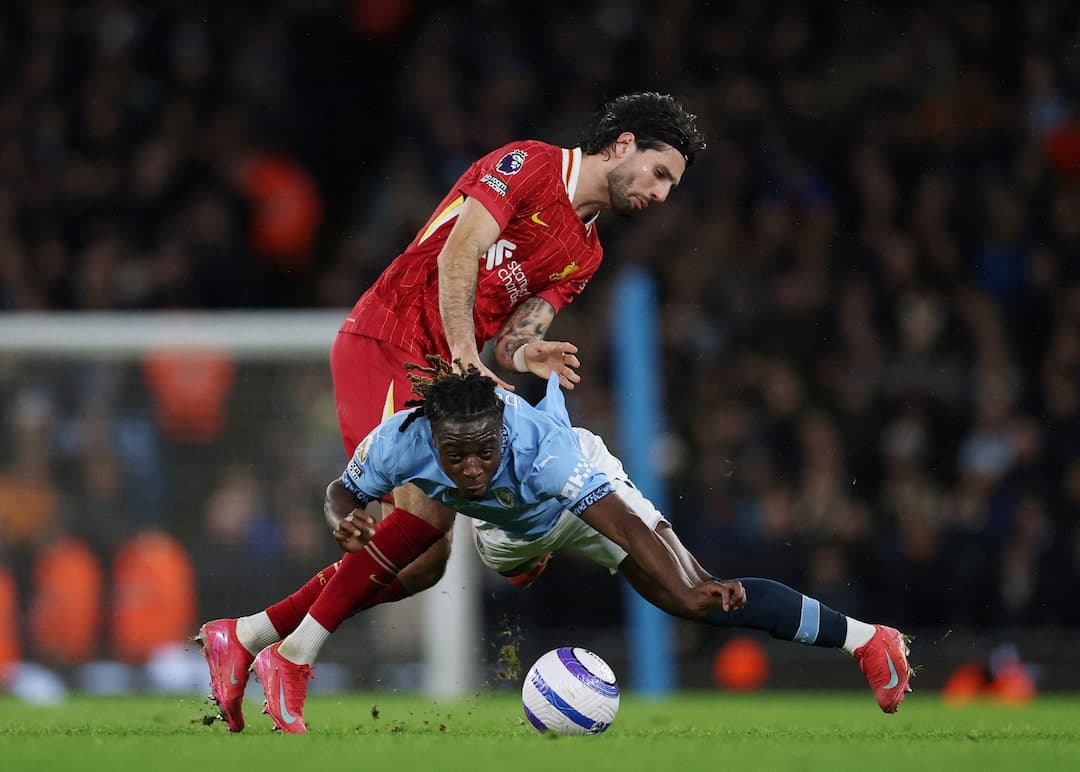
The match was intense and physical. City committed 16 fouls and collected 4 yellow cards, pointing to a deliberate, disruptive out-of-possession approach to halt Liverpool’s transitions and break up rhythm. Liverpool’s 13 fouls and 2 yellows, plus a late red card for Dominik Szoboszlai, show they were equally combative, especially as they tried to protect space against City’s late pressure.
Defensively, Liverpool’s keeper was busier: 5 saves for Alisson versus 3 for Donnarumma, aligning with City’s higher xG and shot volume. Blocked shots were close (4 for City, 3 for Liverpool), indicating both back lines were active in front of their goal. Liverpool’s 6 offsides against City’s 2 hint at repeated attempts to attack the space behind City’s defence, but also at City’s effective control of depth.
Conclusion
Ultimately, Manchester City’s superior chance creation (2.75 xG, 7 shots on target) and slightly stronger territorial control (53% possession, 465 accurate passes) overcame Liverpool’s energetic, transition-focused approach. Efficiency in the final third and better game management in a physical contest proved decisive over Liverpool’s more direct but less clinical plan.