Manchester City Dominates Burnley in Premier League Clash
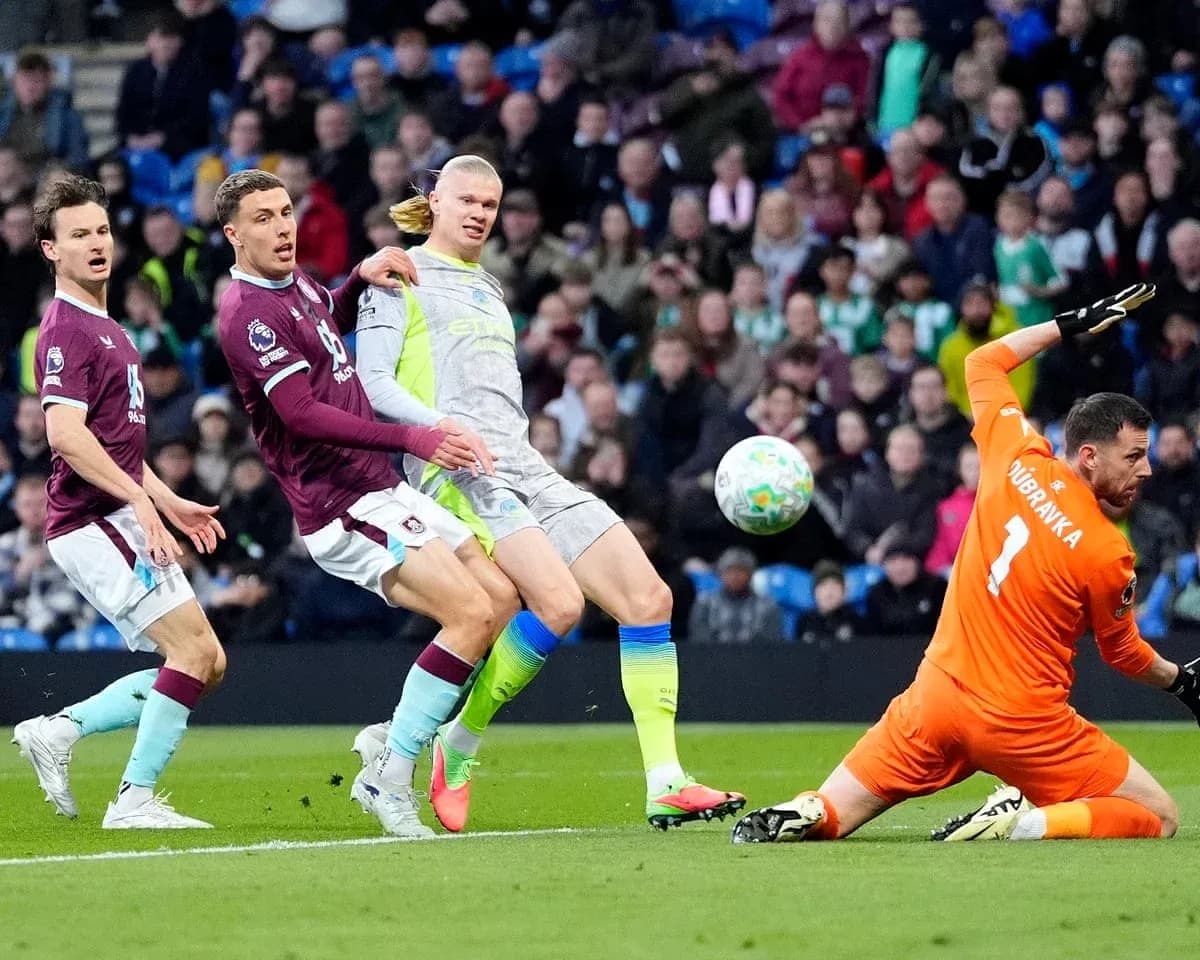
Burnley’s 5–4–1 at Turf Moor was set up to absorb and survive, but Erling Haaland’s early strike for Manchester City decided a match that, on the balance of territory and chances, could have been far more emphatic. City’s 1–0 away win in this Premier League Round 34 fixture was built on total control of space and tempo, reflected in 65% possession, 28 shots and 3.36 xG, but also on a lack of ruthlessness in front of goal. Burnley defended deep and narrow, relied on Martin Dúbravka’s eight saves, and rarely broke City’s pressing structure, finishing with just 0.63 xG and a single shot on target.
The scoring action arrived almost immediately. In the 5th minute, City broke Burnley’s initial block with vertical precision: Jérémy Doku isolated on the flank and found Erling Haaland, who converted a normal goal to give the visitors a 1–0 lead. That moment set the tactical tone – Burnley’s back five forced to retreat even deeper, City able to settle into their positional play with the security of an early advantage. There were no further goals and no cards of any kind; the referee Andy Madley oversaw a match with 10 Burnley fouls and 12 from City but without disciplinary sanctions.
Changes began on the hour to manage intensity rather than to correct structure. At 65', Antoine Semenyo (OUT) was replaced by Savinho (IN), a like-for-like swap in the right attacking lane that kept City’s 4–2–3–1 intact while refreshing their pressing and dribbling threat. Simultaneously at 65', Rayan Aït-Nouri (OUT) made way for Nico González (IN), with City effectively rotating their left defensive channel while preserving the same back-four shape and build-up patterns. Burnley responded later, in search of more presence up front. At 72', Loum Tchaouna (OUT) was replaced by Lyle Foster (IN), shifting the home side toward a more direct outlet and adding a clearer reference point for long balls. In the 82nd minute, Vincent Kompany’s side doubled down on this attacking tilt: Bashir Humphreys (OUT) was replaced by Florentino Luís (IN), and Zian Flemming (OUT) by Armando Broja (IN), moves that reduced a defender and added extra central and forward occupation. Finally, at 87', Jaidon Anthony (OUT) was replaced by Mike Trésor (IN), and Josh Laurent (OUT) by Marcus Edwards (IN), giving Burnley fresh wide and half-space runners for the closing stages. None of these changes altered the scoreline, but they did shift the late-game dynamics towards a looser, more open contest.
Structurally, Burnley’s 5–4–1 was designed to compress the central lane. The back five of Kyle Walker, Bashir Humphreys, Hjalmar Ekdal, Maxime Estève and Quilindschy Hartman stayed compact, with James Ward-Prowse and Josh Laurent screening in front. The wide midfielders, Loum Tchaouna on the right and Jaidon Anthony on the left, dropped to form almost a 5–2–3 or 5–2–1–2 shape in deeper phases, with Zian Flemming working between the lines but often forced into a first-defender role rather than as a link forward. This block did one thing reasonably well: it pushed many of City’s 19 shots inside the box into crowded zones, explaining the high number of blocked shots (Burnley blocked 4, City 10). However, the structure struggled to progress the ball. With only 35% possession, 356 total passes and a pass accuracy of 79%, Burnley rarely escaped City’s counter-press in a controlled manner. The frequent offsides (four) underline that when they did go forward, it was often via rushed, hopeful vertical balls toward Flemming or later Foster and Broja.
City’s 4–2–3–1, by contrast, offered a clear positional grid. Abdukodir Khusanov and Marc Guéhi anchored the central defence, with Matheus Nunes nominally at right-back and Rayan Aït-Nouri on the left. In practice, Nunes often inverted into midfield alongside Bernardo Silva, while Nico O’Reilly provided a secondary pivot or advanced eight depending on the phase. This created a stable 3–2 base in build-up, allowing Rayan Cherki and Jérémy Doku to hold wide positions and stretch Burnley’s back line horizontally. Antoine Semenyo, and later Savinho, attacked the far post and half-spaces, while Haaland pinned the central defenders. The result was relentless occupation of Burnley’s penalty area: 19 of City’s 28 shots came from inside the box, a figure consistent with their 3.36 xG.
Goalkeeper realities underlined the tactical story. Martin Dúbravka made eight saves, a high workload that reflected both City’s shot volume and Burnley’s willingness to concede territory. His “goals prevented” metric was listed at 0, which suggests the model rated City’s finishing as underperforming their chances rather than Dúbravka overperforming expectations, but the raw shot-stopping still kept Burnley competitive on the scoreboard. At the other end, Gianluigi Donnarumma faced only one shot on target and made a single save. With Burnley generating just 0.63 xG, City’s Defensive Index on the day was strong: the visitors limited central entries, forced Burnley to shoot rarely and under pressure, and protected Donnarumma to the point he was largely a spectator.
Statistically, City’s dominance was comprehensive. Their 65% possession and 689 passes at 90% accuracy contrasted sharply with Burnley’s 356 passes at 79%. Eleven corner kicks to Burnley’s three highlighted sustained territorial pressure, and the shot count (28–9 in City’s favour) aligned with the xG disparity (3.36 vs 0.63). The fact that the score remained 1–0 speaks more to City’s inefficiency in the box and Dúbravka’s volume of interventions than to any underlying balance. With no yellow or red cards for either side, discipline did not distort the tactical picture; it was a pure contest of structure and execution. Overall Form on the day clearly belonged to Manchester City, who controlled every major metric, while Burnley’s Defensive Index – anchored by a deep block and a busy goalkeeper – was just good enough to avoid a heavier defeat but never close to flipping the game’s underlying dynamics.