Mallorca vs Villarreal: Tactical Insights from a 1-1 Draw
Under the bright midday light at Estadi Mallorca Son Moix, this was framed as a meeting of opposites: Mallorca, the rugged survivalists of La Liga, against Villarreal, a free-scoring side cruising in the upper reaches. By full time, the 1-1 draw felt like a neat encapsulation of both teams’ seasonal DNA and of the tactical tug-of-war that defined the afternoon.
I. The Big Picture – styles colliding on level ground
Following this result, the table still underlines the contrast. Mallorca sit 15th with 39 points from 35 matches, their overall goal difference at -9, the product of 43 goals for and 52 against. At home, though, they are a very different animal: 8 wins from 18, with 28 goals scored and only 21 conceded, an average of 1.6 goals for and 1.2 against at Son Moix. This is a side that leans heavily on home soil and the crowd’s energy.
Villarreal, by contrast, remain a Champions League-chasing machine in 3rd on 69 points, with a positive goal difference of 25 (65 scored, 40 conceded overall). Their attacking power is clear: 1.9 goals per match in total, with 2.4 at home and 1.3 on their travels. Away from home they are more human – 7 wins, 5 draws, 6 defeats, with 24 goals scored and 25 conceded – but still dangerous enough that a point in Palma is no disaster.
Tactically, this was a fascinating clash. Martin Demichelis rolled out a 4-3-1-2, a shape that speaks of compactness and vertical thrust. Villarreal, under Marcelino, stayed loyal to their season-long 4-4-2, the structure that has underpinned 21 wins from 35 league games.
II. Tactical voids – absences that shaped the story
Mallorca came into this fixture badly bruised by injuries. L. Bergstrom, M. Joseph, J. Kalumba, M. Kumbulla, A. Raillo and J. Salas were all ruled out, stripping Demichelis of depth and, crucially, leadership in the back line. The suspension of Pablo Maffeo for yellow cards removed one of La Liga’s most combative full-backs; his 10 yellows and 22 successful blocks this season speak to a defender who relishes duels and front-foot defending. Without him and Raillo, the hosts’ back four had a patched-up feel, with M. Morey Bauza, M. Valjent, O. Mascarell and J. Mojica asked to hold the fort.
For Villarreal, the absence of J. Foyth with an Achilles tendon injury removed a versatile defender who can lock down a flank and step into midfield. Yet Marcelino could still field a strong back line, with S. Mourino – himself a disciplinary magnet with 9 yellows and a yellow-red this season – anchoring the right side of defence.
Both squads carried disciplinary subplots into this game. Mallorca’s season-long card profile shows a tendency to get dragged into physical battles after the interval: 22.08% of their yellows arrive between 46-60 minutes, with another late swell of 15.58% in 76-90 and 15.58% in 91-105. Villarreal are even more volatile late on: 25.00% of their yellows come in the 76-90 window, and they have seen 2 of their red cards in that same period (66.67% of their reds). It is no surprise the second half here simmered with tension even if it never boiled over into dismissals.
III. Key matchups – Hunter vs Shield, and the engine room war
Hunter vs Shield: Muriqi vs Villarreal’s away defence
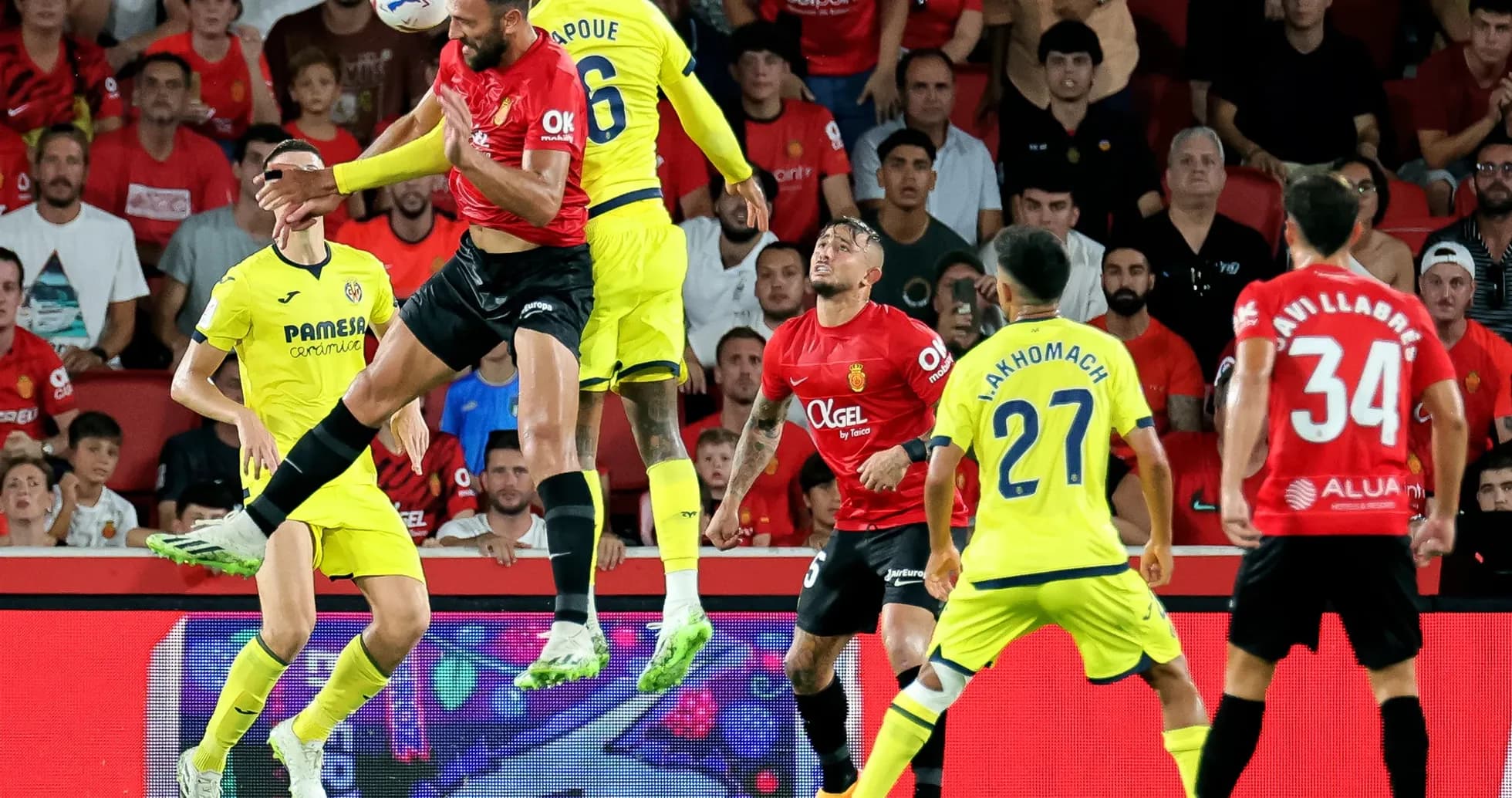
The headline duel was always going to be Vedat Muriqi against Villarreal’s back line. Muriqi has been one of La Liga’s deadliest forwards this season: 22 goals and 1 assist in 34 appearances, with 85 shots (47 on target) and a bruising 416 duels contested, 214 of them won. He is not just a finisher; he is a reference point who draws fouls (59 this season), occupies centre-backs and creates chaos.
Villarreal’s away defensive record – 25 goals conceded in 18 matches, an average of 1.4 – suggested that Muriqi would find moments. He did, repeatedly pinning R. Marin and R. Veiga, using his 194cm frame to turn long balls into second balls for Z. Luvumbo and P. Torre. Even when he did not score, his presence bent the game around him. Notably, his penalty record this season is imperfect: 5 scored but 2 missed, a reminder that even Mallorca’s talisman carries risk from the spot.
On their travels, Villarreal usually trust their attack to outgun whatever they concede, and that pattern held. The 1-1 scoreline mirrored their season-long balance away from home: they threaten constantly but leave doors open, particularly when chasing a winner.
The engine room: Samu Costa vs Comesaña and Partey
If Muriqi was the spear, Samu Costa was Mallorca’s shield and metronome. The Portuguese midfielder has been one of the league’s most industrious figures: 7 goals, 2 assists, 62 tackles, 13 blocked shots and 25 interceptions, plus 400 duels contested (207 won). His 10 yellow cards underline how often he operates on the edge.
Opposite him, Santi Comesaña and Thomas Partey formed Villarreal’s central axis. Comesaña’s numbers tell the story of a modern two-way midfielder: 1169 passes at 82% accuracy, 45 tackles, 15 blocked shots and 30 interceptions, alongside 6 assists. He is also on the disciplinary radar, with 5 yellows and 1 red this season. Partey, stationed slightly deeper, gave Villarreal their platform to circulate the ball and find the flanks, where T. Buchanan and A. Gonzalez tried to isolate Mallorca’s full-backs.
The battle between Samu Costa and Comesaña was the game’s true heartbeat. Whenever Costa stepped high to press, Villarreal looked to play around him, using quick wall passes into A. Perez and T. Oluwaseyi. When he held his position, Mallorca’s block compressed, forcing Villarreal to funnel attacks wide and swing in crosses that Valjent and Mascarell could attack.
On the creative side, P. Torre’s role as the “1” in the 4-3-1-2 was to link midfield to the front two, threading passes into Muriqi’s feet and exploiting the half-spaces behind Villarreal’s central midfielders. For Villarreal, the absence of N. Pépé from the starting XI meant they lacked their most prolific creator (6 assists, 53 key passes) from the outset, though his presence on the bench gave Marcelino a late-game weapon if the match required extra invention.
IV. Statistical prognosis – what this draw tells us about both sides
Following this result, the numbers still paint Mallorca as a team built on home resilience and narrow margins. Overall they average 1.2 goals scored and 1.5 conceded per match, but at home that flips closer to parity: 1.6 for, 1.2 against. This 1-1 fits snugly into that pattern. Their 5 clean sheets in total, just 3 at home, underline that they rarely shut opponents out entirely; instead, they rely on scoring enough, often through Muriqi, to make every game a contest.
Villarreal, with 65 goals in total and an average of 1.9 per game, usually tilt matches into high-event territory. Their defence, conceding 1.1 per match overall and 1.4 away, is solid but not watertight. A draw with one goal each away from home is slightly below their usual attacking output but consistent with their defensive baseline on their travels.
In xG terms – even without exact figures – the tactical pattern suggests a relatively even exchange. Mallorca’s direct play into Muriqi, supported by Luvumbo’s runs and Torre’s passing, would have generated a handful of high-quality chances rather than volume. Villarreal’s more structured 4-4-2, with overlaps from S. Cardona and late runs from Comesaña, likely produced a steadier stream of medium-quality opportunities.
Defensively, Mallorca’s makeshift back line held up admirably against one of the league’s most potent attacks, helped by disciplined central work from Samu Costa and S. Darder. Villarreal, meanwhile, again showed that while their away defence can be breached, it bends more than it breaks, especially with Mourino’s aggression and A. Tenas’ presence behind them.
The draw keeps Mallorca edging towards safety and Villarreal on course for the Champions League, and it does so in a way that feels entirely in character. Mallorca remain the scrappers who turn Son Moix into a grind, leaning on Muriqi’s presence and Costa’s steel. Villarreal continue to be the side whose 4-4-2 hums with attacking intent but must always live with the risk that, away from home, they will give up just enough to keep opponents believing.