Juventus Controls Match Against Lecce with 1-0 Victory
Lecce 0–1 Juventus at Stadio Ettore Giardiniero – Via del Mare unfolded as a classic Serie A control-versus-containment contest. Juventus, chasing points late in the Regular Season - 36 round, struck almost instantly and then managed the game with territorial dominance and structural discipline. Lecce, under Eusebio Di Francesco, stayed in their 4-2-3-1 throughout, looking to counter through wide runners but ultimately struggled to convert sporadic breaks into clear chances. The half-time and full-time scores matched at 0–1, reflecting a match where Juventus’ early incision and superior field position outweighed Lecce’s late adjustments and isolated moments of pressure.
Scoring Sequence
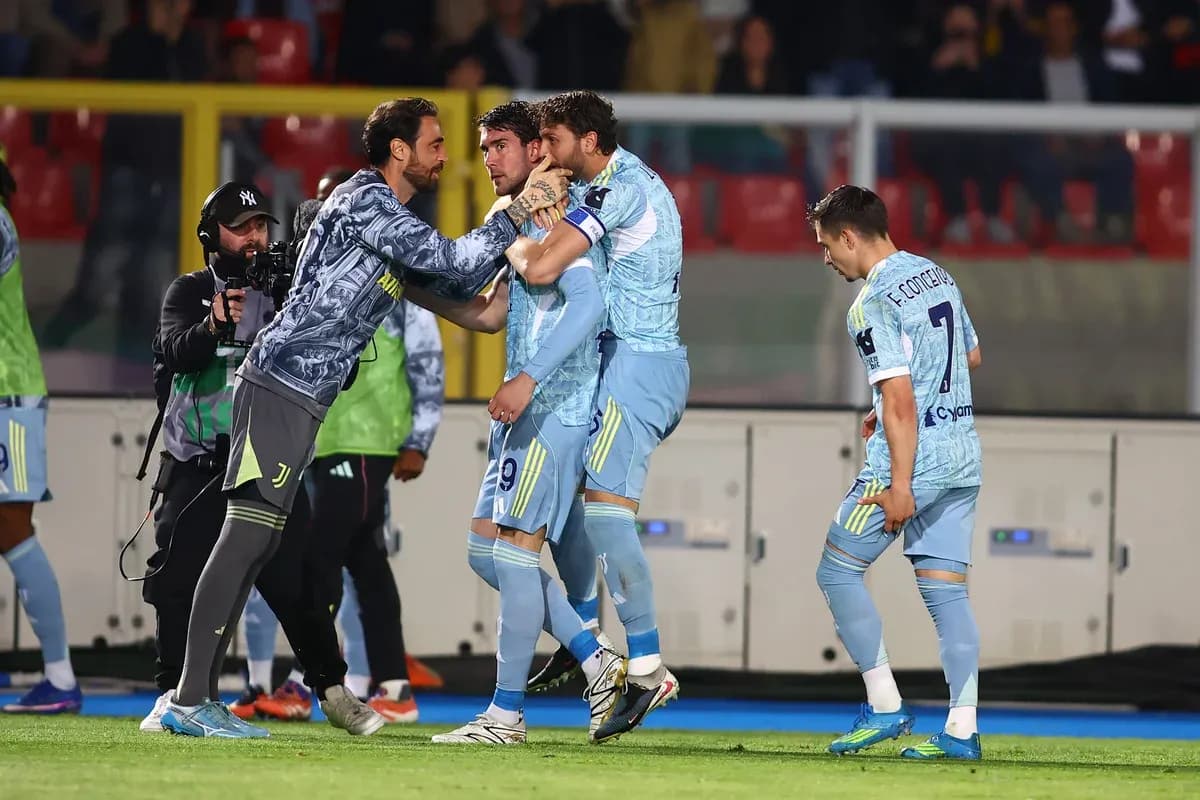
The scoring sequence was brutally simple and decisive. At 1', Juventus went ahead when D. Vlahovic finished a move supplied by left-back A. Cambiaso. The goal, recorded as a normal goal with no VAR intervention, immediately tilted the tactical landscape: Juventus could now lean into their possession structure, while Lecce were forced to chase the game against a side well built to play with a lead.
VAR Interventions
Two key VAR interventions shaped the perception of Juventus’ attacking threat in the second half. At 50', a Juventus goal was cancelled after a VAR review involving Dusan Vlahovic. Again at 61', another Juventus goal was cancelled by VAR, this time with Pierre Kalulu at the heart of the incident. Both moments underlined Juventus’ capacity to get the ball into scoring zones repeatedly, even if the scoreboard did not move beyond 0–1.
Disciplinary Incidents
Disciplinary incidents were few but clear. The exact card log is:
- 80' Francisco Conceição (Juventus) — Foul
- 82' Gaby Jean (Lecce) — Argument
Each side finished with one yellow card: Juventus for a foul by Francisco Conceição, Lecce for an argument involving Gaby Jean. No reds were shown.
Substitution Patterns
Substitution patterns told the story of adaptation and game management. Di Francesco’s first move came at 62': G. Jean (IN) came on for O. Ngom (OUT), a like-for-like adjustment at right-back that also introduced fresh energy and, later, disciplinary edge. At 70', T. J. Helgason (IN) came on for D. Veiga (OUT), pushing Lecce toward a more aggressive midfield configuration as they tried to link play between lines. The double attacking change at 76' — F. Camarda (IN) for W. Cheddira (OUT) and K. Ndri (IN) for L. Banda (OUT) — was a clear shift to chase the equaliser with new legs up front and out wide.
Luciano Spalletti’s changes were about preserving structure and energy. At 77', E. Holm (IN) came on for D. Vlahovic (OUT), sacrificing a pure striker for a more balanced, workmanlike profile on the flank, with the lead already secured. Then came a triple wave at 83': J. David (IN) for A. Cambiaso (OUT), J. Boga (IN) for K. Yildiz (OUT), and E. Zhegrova (IN) for F. Conceicao (OUT). This reshaped the attacking band with fresh dribblers and runners while maintaining the 4-2-3-1 shell. Finally, at 86', F. Gatti (IN) came on for W. McKennie (OUT), a classic late-game defensive reinforcement to help defend the box and aerial deliveries.
Tactical Analysis
Tactically, both teams started in a 4-2-3-1, but the execution diverged sharply. Juventus’ double pivot of M. Locatelli and T. Koopmeiners controlled rhythm. With 65% possession and 501 total passes at 86% accuracy, they established a stable base in the middle third. Locatelli often dropped between Bremer and L. Kelly to form a three-man first line, allowing full-backs Kalulu and Cambiaso to advance high and pin Lecce’s wingers. This created a consistent 2-3-5 or 3-2-5 attacking shape, with K. Yildiz tucking inside to overload central lanes and F. Conceicao stretching wide on the opposite side.
Juventus’ territorial control translated into shot volume and quality: 15 total shots, 6 on target, and a heavy bias towards shots inside the box (14 of 15). Their expected goals of 2.16, combined with two VAR-disallowed goals, indicated that the 1–0 scoreline flattered Lecce’s defensive resistance. The visitors repeatedly accessed the half-spaces between Lecce’s full-backs and centre-backs, with Vlahovic as a central reference and late runners from McKennie and Koopmeiners attacking the box.
Lecce’s 4-2-3-1, with Y. Ramadani and O. Ngom as the double pivot, was more reactive. They had only 35% possession and 267 passes at 73% accuracy, reflecting a game spent mostly without the ball. The plan hinged on quick transitions via L. Banda on the left and S. Pierotti and L. Coulibaly supporting W. Cheddira. However, with just 8 total shots (3 on target) and 0.88 xG, Lecce struggled to progress centrally through Juventus’ compact mid-block. When they did reach the final third, the lack of sustained pressure and limited numbers in the box made it easier for Bremer and Kelly to clear.
Defensive Strategies
Defensively, Lecce’s back four of A. Gallo, Tiago Gabriel, J. Siebert, and D. Veiga tried to stay narrow, but Juventus’ full-backs and attacking midfielders consistently forced them to shift laterally, opening seams. The 7 fouls committed by Lecce, compared to Juventus’ 18, suggest Lecce were more often chasing and delaying rather than breaking up play aggressively. Juventus’ higher foul count was more a by-product of their constant counter-press and willingness to stop transitions early.
Goalkeeping Performances
In goal, W. Falcone’s 5 saves were crucial in keeping the match alive; given Juventus’ 2.16 xG and Lecce’s goals prevented value of 0.64, his interventions aligned with a goalkeeper slightly outperforming baseline expectations. At the other end, M. Di Gregorio faced only 3 shots on target and made 3 saves, with Juventus’ own goals prevented also at 0.64, indicating he handled what little he had to without being overworked.
Statistical Overview
Statistically, Juventus’ superiority was clear: more possession (65% to 35%), more shots (15 to 8), more corners (7 to 1), and a significantly higher xG (2.16 to 0.88). Lecce’s single yellow card versus Juventus’ single yellow mirrored a game that, while physically competitive, never descended into ill-discipline. Overall form and defensive index both point in the same direction: Juventus imposed their game, created enough to win by a larger margin, and then managed the closing stages with professional control, while Lecce’s late attacking changes could not overturn the structural imbalance established from that first-minute goal.