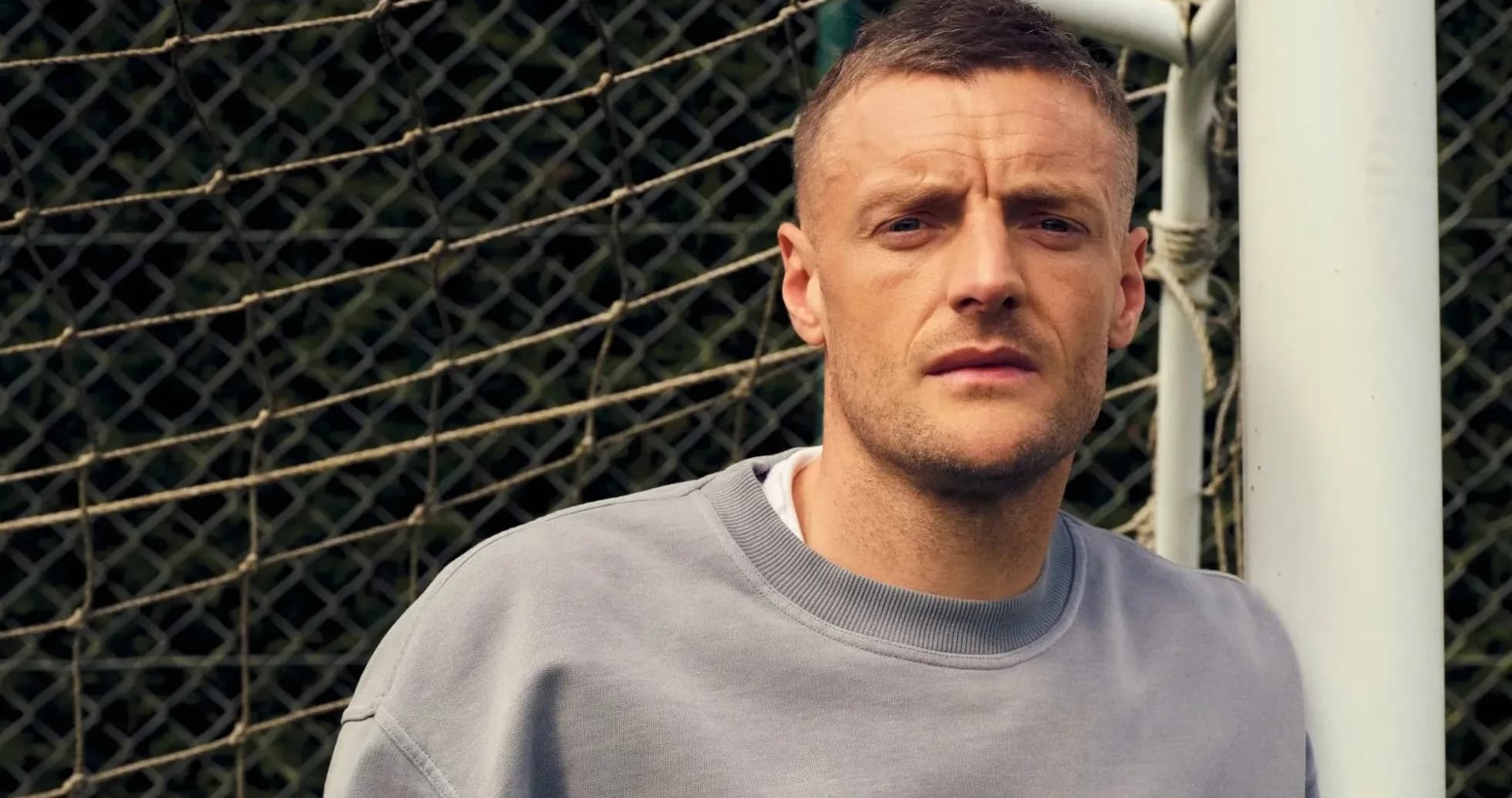
Jamie Vardy: From Factory Floor to Football Glory
Jamie Vardy has spent a career tearing up football’s script. Now he is rewriting his own.
In a new Netflix documentary, Untold: Jamie Vardy, the former England striker steps out from behind the goals and the glory to talk about the chaos, the drinking, the ankle tag – and the woman he insists dragged him away from self-destruction and towards a Premier League title.
This is the story of an eight-tier climb through English football in six years, from £120-a-week on a factory line to lifting the trophy with 5,000-1 outsiders Leicester City. But Vardy is clear: without Rebekah, it might never have happened.
Beer, Bluntness and a Reluctant Star
Speaking about his life has never come easily to the Sheffield-born forward. Cameras roll. Vardy reaches for a beer. He even has to ask a crew member to fetch a bottle opener from his kitchen – a “giant wooden cock”, he notes, with the sort of deadpan delivery that has always separated him from the media-polished elite.
Asked to sum himself up in one word, others offer the usual labels: “loyal”, “legend”, “goals”. Vardy’s own answer is far less romantic: “twat.”
Then the jokes fade, and the graft takes over.
Before the stadiums and the songs, he was making crutches and Zimmer frames, living with his parents, playing semi-professional football for Stocksbridge Park Steels after being released by boyhood club Sheffield Wednesday. His wages were small, the dream even smaller. The nights out were not.
Saturday and Sunday meant heavy sessions with a group of close mates he called “The Inbetweeners”. They called him “Sicknote” because, as he admits, he had a talent for skipping Mondays.
One of those nights changed everything. A fight broke out after someone mocked a deaf friend. Vardy stepped in. The result: an assault charge, an ankle tag, a six-month curfew.
The punishment forced him to grow up. “The mindset going forward was, ‘Don’t be a dick and do it again’,” he says in the film. It was a line in the sand – and the start of a climb that would defy logic.
The Record Fee, the Nightclub and a Player on the Brink
From Stocksbridge he moved to Halifax Town in the Northern Premier League, then to Fleetwood Town in the Conference Premier. His goals there earned him a £1million move to Leicester City, then in the Championship – a record fee for a non-league player.
The fairytale was supposed to start there. Instead, he hit a wall.
Vardy struggled for form, and reached for the bottle to drown it out. When he first crossed paths with Rebekah, he was, in his own words, “absolutely steaming”.
She was 44, a working mum with a young son, fresh from a bad relationship and running events at a Sheffield nightclub. She got a call to organise a birthday party for a client whose name she wasn’t told.
Then she found out. Jamie Vardy.
Her reaction? “What’s the big deal?” She didn’t even know who he was. Once she learned he was a professional footballer, instinct told her to run. “There’s this preconception that they’re all idiots, they are all a**holes,” she says.
His entrance did nothing to change that view. Vardy turned up “s**tfaced”, propped up by two friends. His mates ordered big bottles of champagne and ended up on the dancefloor pouring them over random club-goers.
“I’m actually f***ing over this now,” Rebekah recalls. “They’re like mental cases, they’re like yobs.”
Vardy listens to that description in the documentary and just laughs: “That sounds like my mates.”
He was eventually carried out by two friends. Rebekah felt relief that at least one problem had left the building. Then her phone buzzed. A text from Vardy: “I really want to see you.”
Her response at the time? “Delete!”
Only he didn’t give up. “I weren’t letting it go, there was no chance of that happening,” he says.
Behind the Party Boy
His persistence wore her down. She agreed to meet him, expecting to tick a box and move on.
“It got to a point where I was like, ‘Oh f* it, just go and meet him and that would be the end of it’,” she says. It wasn’t.
“The more I sat with him, the more I realised, actually, behind this crazy, alcohol-loving wild partyboy was a guy that was really kind, really good at listening and he was really good to talk to. We decided to go on a couple of dates.”
Not long after, Rebekah fell pregnant. Both were shocked. They chose to keep the baby and build a life together. Two more children would follow.
That decision forced another. The drinking had to change.
The breaking point came before a baby scan, when Vardy went missing. Rebekah found him in a bar, boozing with his mates. She stormed in.
“You, me, conversation, now,” she told him.
He opened up. The pressure of the £1million fee. The fear of not being good enough. The weight of expectation he didn’t believe he could carry.
“I’m like, ‘Why do you doubt yourself so much? You have an incredible opportunity to do something really special. How do you feel about that?’” she says.
His reply was bleak: “Probably never going to work.” Years of rejection had drilled into him the idea that he would always fall short.
Her warning cut through: “You are going to screw up everything you’ve worked so bloody hard for if you don’t change your lifestyle choices. I’m not telling you to stop drinking, just rein it in.”
Vardy listened. “What she was saying was right, it needed to stop. It really did. I needed to hear it,” he says. “I knew I could tell her anything and it was never too much for her. She would always be pushing me to go in the right direction and it was 100 per cent what I needed.”
The shift was immediate. Leicester captain Wes Morgan noticed it from the dressing room.
“Jamie pre- and post-Becky is like two different people,” Morgan says. “Having that stability and calmness in his life reflected in his performance.”
From Curfew to the Crown
The reborn Vardy looked like the ruthless non-league finisher again. Leicester surged out of the Championship and into the Premier League in 2013/14.
The next season, with the club staring relegation in the face under Nigel Pearson – a man Vardy had grown up watching at Sheffield Wednesday – he led the charge to survival. That summer, England called.
Then came the explosion.
Under Claudio Ranieri, Vardy spearheaded the greatest underdog story the Premier League has ever seen. He scored in 11 consecutive league games, a record-breaking run that powered Leicester to a title nobody believed possible.
He added an FA Cup winner’s medal later in his career, and his personal milestones are just as outrageous. “Only player to score 100 Premier League goals after the age of 30? And the oldest player to win the Premier League Golden Boot?” he says.
“The main thing is no one can take it away. It happened. Should it have happened? Probably not. But it did.
“I’m not normal. It’s good to be different. If every footballer was the same, it’d be a conveyor belt of robots.”
Life in Lombardy and the Wagatha Shadow
The Vardy story is not done. Far from it.
Now 39 and playing for Cremonese in Serie A, he and Rebekah have swapped the Midlands for a villa on the edge of Lake Garda. Their new life in Lombardy will be the focus of an ITV1 fly-on-the-wall series, The Vardys, following the family as they settle into Italian life.
That show will also reopen a very public wound. Rebekah is expected to give her side of the infamous Wagatha Christie saga with Coleen Rooney, which ended with her losing a 2022 libel case after Rooney accused her of leaking stories to the press. The rivalry has simmered ever since, while the Rooneys’ own Disney+ documentary is still to come.
For all the noise, the Vardys insist their focus is on their family and their future abroad.
A Family Fractured
Not every relationship in Vardy’s life has been repaired.
In the Netflix documentary he reveals he remains estranged from his parents after a bitter rift over his biological father. The issue is simple and raw: he believes he should have been told the truth before the newspapers did.
“I had a slight inkling when I was younger, had people coming on to me saying, ‘We know your dad’ but we’re from completely different areas. I used to just bat it off, I didn’t want to know,” he says.
When it emerged that a labourer named Richard Gill was his father, Vardy confronted his mum, Lisa. He “had a pop” at her for never confirming it. He no longer speaks to her or his stepdad Phil, the man who raised him and whose surname he took.
“I did have a pop at my mum, I should have been told if it was true,” Vardy says. “I’ve still not heard it from them, they’ve still not seen the kids – I’ve made the decision, I was done with it.
“I’ve got my wife, my children, we’re here, we’re happy. That’s all that matters to me, making sure they’re happy.”
As for his biological father’s side, he has shut that door as well. “I was then getting letters sent to the club by my so-called dad’s family saying, ‘If you do want to speak, I’m your auntie’,” he recalls. “No, not for me.”
From a factory floor to Lake Garda, from ankle tags to Golden Boots, Vardy has built a life on his own terms. Now he is letting the cameras in. The question is not whether his story is extraordinary. It’s how many more chapters he still has left to write.