
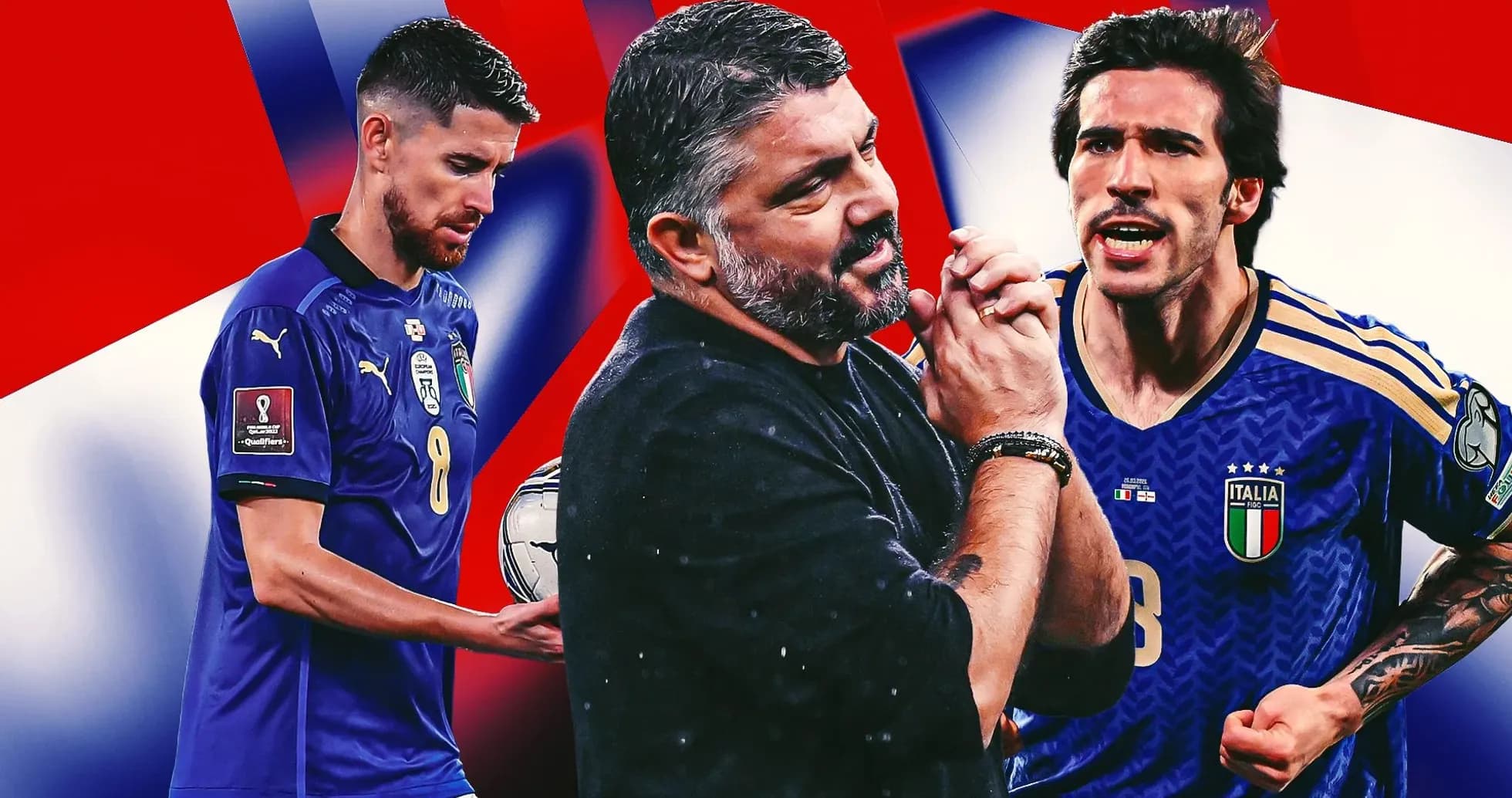
Italy's Journey from Crisis to World Cup Hope
There was a moment, not so long ago, when Italy weren’t just drifting. They were sinking.
The reigning European champions had stumbled out of Euro 2024 with barely a whimper, the title defence ending in a meek surrender to Switzerland that felt like the closing chapter of an era. Luciano Spalletti, the man who was supposed to restore order after Roberto Mancini’s abrupt exit, left with his reputation dented and his squad exposed. The doubts that followed were not melodramatic. They were real: would Italy even reach the World Cup play-offs?
From the wreckage of that summer, the Azzurri lurched straight into a qualifying campaign that seemed determined to underline their decline. On June 6 in Oslo, Norway tore them apart 3-0. The scoreline flattered Italy. Spalletti’s side were lifeless, overrun, and stripped of any sense of identity.
"I have no words," Gigi Donnarumma said afterwards, stunned and hollow. "Our fans don't deserve this."
Spalletti didn’t disagree. "We need to find something more," he admitted. "Otherwise, something has got to change."
Something did. It was him.
From crisis to Rino
The FIGC allowed Spalletti to oversee one last game – a 2-0 win over Moldova – in an attempt to limit the shock to the system. The bigger problem, though, lay beyond the dugout. Italy’s qualification prospects looked bleak, and the pool of credible successors was worryingly shallow.
Claudio Ranieri, the romantic choice, politely declined a return to the frontline, staying loyal to his advisory role at Roma after ending his coaching career. Stefano Pioli chose Fiorentina. The federation turned to the past, searching for the spirit of 2006.
Daniele De Rossi and Fabio Cannavaro were discussed. In the end, president Gabriele Gravina picked Gennaro Gattuso – the snarling midfielder of Berlin fame, now a coach with a patchy résumé but a fierce reputation.
"He has the qualities, the determination and above all the desire to achieve something great for the Azzurri and our country," Gravina insisted. He spoke of sacrifice, professionalism, preparation. Of a man who put "us" before "I". Of someone who knew the pressures of Milan and Napoli, who understood young players and the weight of the shirt.
Gattuso, as ever, didn’t hesitate. He answered the call as if he were still a player.
Whether he can take Italy all the way back to the World Cup remains an open question. What is clear is that he has at least dragged them back to the brink of qualification, something that felt remote in the aftermath of that Oslo humiliation.
Progress, but not perfection
Look at the bare numbers and the sceptics have ammunition. Italy’s group campaign started and ended with heavy defeats to Norway, both by three goals. Even Gattuso admitted his team folded in the second half of November’s 4-1 loss at San Siro once Erling Haaland and company turned up the intensity.
Yet beneath the scorelines, there has been movement. The two meetings with Israel tell the story.
In Debrecen, Italy were chaotic and exposed, somehow stumbling to a 5-4 win that felt more like survival than control. By October in Udine, they were unrecognisable: compact, assured, and in command during a 3-0 victory. Mistakes had not vanished, but there was structure. There was belief.
The most striking shift has been psychological. Sandro Tonali spoke of "feeling positive since the coach arrived". It shows. This is a group that looks like it actually wants to suffer together.
Moise Kean put it more bluntly. "The coach has so much love for the Azzurri shirt," he told Sky Sport Italia. "He pushes us to never give up."
Gattuso’s reputation has long been built on fire and fury, on veins bulging and touchline explosions. Yet his work with this Italy has carried a quieter intelligence too.
Bergamo, not San Siro
Take the play-off semi-final against Northern Ireland. The tactical tweaks mattered, but so did the postcode.
Gattuso pushed hard for the New Balance Arena in Bergamo instead of the vast, unforgiving bowl of San Siro. He knew what a restless 70,000 could do to a fragile team if the game turned cagey.
"If there had been 70,000 in the stands, trust me, a good 30 percent would've started jeering at half-time," he said afterwards. At the break, the score was 0-0 and the tension was thick. Bergamo stayed with them. That patience mattered.
So did the coach’s composure. He called the first half "a struggle", and he was right. Kean later admitted he felt the weight of the World Cup on his shoulders until he scored the second goal. Tonali spoke of the pressure suffocating the squad until he finally broke the deadlock in the 56th minute.
"There was some nervousness at the start of the second half," Tonali told RAI Sport. "But after taking the lead, we really started to feel free of pressure with our mentality."
That release did not happen by accident. In the dressing room, Gattuso had reminded his players that this was never going to be straightforward. "You didn't think it was going to be easy, did you?" he asked them. No panic, no rage. Just a demand for clarity.
He also made a key tactical switch, urging Manuel Locatelli to push higher instead of sitting deep.
"I had the feeling on the pitch that I could help the team more from there," the Juventus midfielder told RAI. "But the coach told me to get into a more advanced role, and we did better in the second half."
Italy emerged with a 2-0 win, a performance that was far from flawless but rich in something they had lacked in those grim nights against Sweden and North Macedonia: collective resolve.
Locatelli, though, cut through any temptation to relax. "We haven’t taken a weight off our shoulders yet," he said. "Because we still have a play-off final to play."
Bosnia, the rankings and the reality
That final will not be in Cardiff, and that suited Italy just fine. Bosnia and Herzegovina’s shootout win over Wales sparked visible celebrations in the Azzurri camp. On paper, it’s the softer assignment.
Bosnia sit 66th in the FIFA rankings. Italy, despite everything, are 12th. Sergej Barbarez’s side still lean heavily on Edin Dzeko, their 40-year-old captain, all-time top scorer and record appearance holder. This is not a golden generation.
Yet the story of their campaign warns against complacency. Bosnia were 13 minutes from automatic qualification before surrendering their lead to Austria in the final group game. In Cardiff, they fell behind both in the match and in the shootout, and still clawed their way through.
They are stubborn. They are battle-tested. And they have nothing like the weight of history bearing down on them.
Italy, by contrast, are carrying a decade of disappointment. Two missed World Cups. A domestic league under scrutiny after failing to place a single club in this season’s Champions League quarter-finals. A generation of children who have grown up with the World Cup as something other countries do.
The pressure is suffocating. The opportunity is enormous.
Heart, soul and demons
There is, at least, a flicker of optimism around this team again. Tonali is playing like a man auditioning for those Premier League clubs circling in the summer. Alessandro Bastoni’s timely return from injury has restored authority to the back line. Across the pitch, man for man, Italy are stronger than Bosnia.
They also have something less tangible but just as important: a sense of togetherness that had deserted them in previous play-off failures.
Fabio Capello, never one for easy praise, saw it against Northern Ireland. "We saw a team that put its heart and soul into it," he told Gazzetta dello Sport. That was not the case against Sweden. It was not the case against North Macedonia.
The challenge now is to repeat that level of commitment in Zenica, where the contest will be as much internal as external. Bosnia and Herzegovina will be the opponent on the pitch. The "demons", as Tonali called them, will be waiting in the players’ minds.
"I'm not saying we were scared," the midfielder said of the build-up to the semi-final. "But, unfortunately, it can happen to think about those past defeats."
Those memories will be there again in Zenica. So will the knowledge that this time, there really is no safety net.
"There’s no option but to win," Tonali stated. No dressing it up. No room for excuses.
They owe that victory to themselves, to the coach who has stitched this fractured group back together, to a football culture desperate for a sign that its proudest stage is not lost forever.
Most of all, they owe it to the kids who have never seen Italy walk out at a World Cup and wonder, quietly, what it feels like when the anthem plays and their country is actually there.



