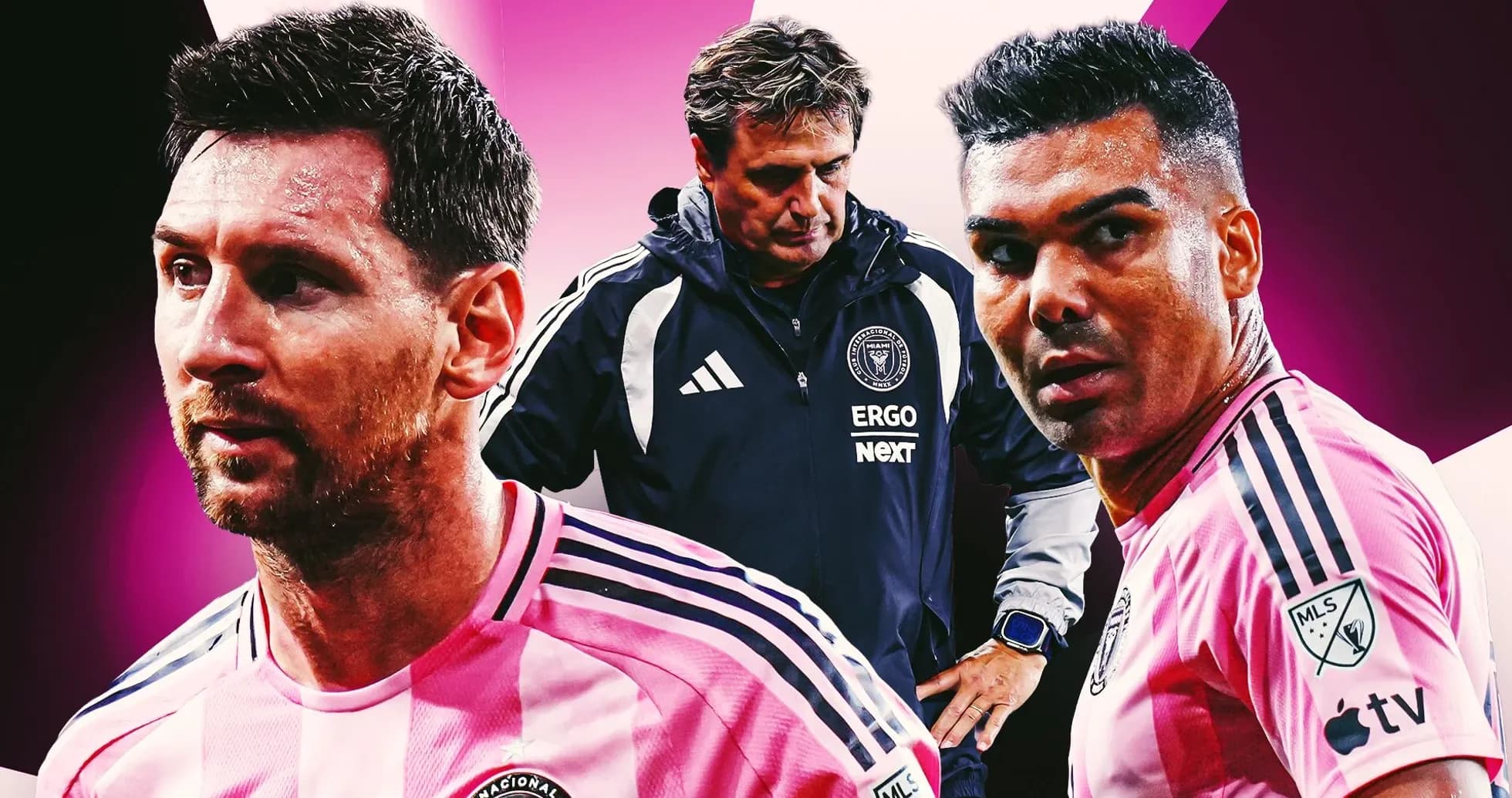
Inter Miami’s Flaws Exposed in Nashville Defeat
Inter Miami’s reality is getting harder to dress up. Strip away the Messi glow and what’s left looks painfully ordinary.
The 4-1 hammering at Nashville on Saturday night didn’t just sting. It explained everything.
Miami hogged the ball, but every turnover felt like a countdown to disaster. Nashville waited, pounced and sliced through them on the break. The gaps between Miami’s lines were huge, the midfield labored, the recovery runs half a beat too slow.
Hany Mukhtar, one of MLS’ sharpest No.10s, treated it like a training drill. He toyed with them, drifting into space, punishing every misstep, scoring twice. Sam Surridge added another. Andy Najar, a right back in name only on this evidence, stormed forward to grab the fourth while Miami’s defensive shape simply dissolved.
In the middle, Eddi Tagseth and Matthew Corcoran ran the game, pulling Miami apart with the kind of energy and discipline the Herons badly lack. It was a miserable night, but also a brutally clear blueprint: limit Lionel Messi, and the rest of Miami crumbles.
A team built to serve one man
This version of Miami only really works when Messi bends games to his will. When he doesn’t, the flaws scream.
Messi doesn’t defend. Luis Suarez, 39 and still straining every sinew, can’t cover ground like he once did. Rodrigo De Paul empties the tank on the right, but Casemiro, a marquee post-World Cup signing, moves as if he’s wading through mud in central midfield.
The drop from Jordi Alba to Sergio Reguilón has been just as stark. Alba’s understanding with Messi once stitched this team together. Reguilón, who hasn’t played regular football since 2022, simply cannot replicate that influence. No tweak of the whiteboard fixes this. At best, Miami resemble an average playoff side being dragged upward by one extraordinary player.
On paper, the problems are fixable. Any neutral observer can see where the holes are: legs in attack, legs in midfield, a spine that can run as well as pass. Miami have never been shy about bending the roster rules to chase big names. They have worked the salary cap, pushed at the margins, annoyed half the league in the process.
But some of the calls look questionable now. Elite central midfielders don’t just appear, and they rarely choose MLS in their prime, but there was a world where N’Golo Kanté arrived instead of Casemiro. The club spent around $15 million on German Berterame, a forward who doesn’t dominate in any one area. That money now feels misallocated.
Benjamin Cremaschi, a homegrown midfielder with energy and upside, openly admitted feeling misused under Javier Mascherano. A more careful development path might have given Miami exactly what they now lack: a young, dynamic central midfielder to build around.
The Messi veto
Run the tape back to 2023 and the pattern is obvious. This squad has been built around Messi’s wants and needs.
Sergio Busquets and Alba were reportedly signed, in part, to help lure him to South Florida. De Paul has said his move from Atletico Madrid was driven by a desire to play with Messi and stay sharp ahead of the World Cup; the two were reportedly putting in extra training sessions together before Qatar.
Even Casemiro, a long-time rival in the Real Madrid–Barcelona wars, framed his arrival in Messi-centric terms.
“For me, without a doubt, I am coming only to play with the best player of all time,” he told reporters at his introductory press conference. “I want to enjoy, I want to help him to keep winning because he is a winner. Another player is joining who wants to win, who wants to compete.”
Whether Messi is personally making the recruitment calls or simply setting the tone almost doesn’t matter. The effect is the same: Miami have built a squad to keep him happy, not a sustainable winner.
And that leaves a brutal question hanging over the club: what happens when he goes?
A league on the brink of change
All of this is unfolding as MLS itself prepares for a reset. The league is set to move to a fall-spring calendar in 2027-28, aligning with the European window and opening the door to more aggressive transfer moves. Owners have already heard pitches about loosening salary rules to allow more spending.
This is the moment when ambitious clubs can get serious.
Messi is under contract through the end of the 2028 season. That covers next year’s abbreviated “sprint season” and the first full fall-spring campaign. On paper, Miami have at least one full season, a shortened one and what’s left of this year with their main attraction.
But if Messi decides he’s done at the end of this year? The picture darkens quickly.
Miami would be stuck with expensive Designated Players who don’t quite fit a post-Messi identity. De Paul is on DP money through 2029. So is Berterame. Casemiro doesn’t currently occupy a DP slot, but Miami have already shown with De Paul that they can start a player on a lower number and bump him up later. That flexibility could easily be used again.
In a worst-case scenario, Miami end up with a roster loaded with aging, high-earning stars, no Messi and little room to maneuver.
The elusive heir
What Miami truly need is not just another top-level player, but a new face of the club – someone who can carry both the sporting load and the commercial weight.
Julian Alvarez is the dream. He won’t replicate Messi’s box-office power – nobody will – but his age, quality, work rate, Argentine roots and marketability make him the one name who resembles a genuine succession plan.
The numbers, though, are daunting. Atletico Madrid paid an initial €75 million, plus up to €20m in add-ons, to sign him from Manchester City in 2024. This summer they reportedly turned down a €150m bid from Real Madrid. For Miami to even enter that conversation, they’d need to smash anything MLS has ever done in the transfer market, then navigate the salary demands on top.
Beyond Alvarez, the options thin out fast.
If that kind of move proves impossible, the logical pivot is toward an American star. Christian Pulisic and Weston McKennie are the only two who truly fit the bill. Pulisic is the most recognizable active American player. McKennie brings quality, charisma and a personality that would land well in the U.S. market.
They could headline the next version of Inter Miami. They cannot replace the global phenomenon the club has built itself around.
Locked into the Messi economy
That’s the heart of the dilemma. Miami are tied to Messi not just on the pitch, but on the balance sheet.
He drives sponsorships. He sells out stadiums. He drags global cameras to every game. A stand at Nu Stadium carries his name. His compensation reportedly includes ownership shares. This is not a normal player-club relationship. Messi is the foundation of the entire project.
And Miami have yet to show what the blueprint looks like when that foundation disappears.
The recent past offers a warning. Before Messi arrived, Miami were one of the league’s worst teams. They had already tried the star route with Blaise Matuidi and Gonzalo Higuaín, but neither shifted the club’s fortunes. Attendance sat in the bottom third of MLS. By July 2023, when Messi signed, Miami were effectively out of the playoff race and had never lifted a trophy. Phil Neville had been fired. The roster was riddled with holes. The project felt stalled.
The risk is obvious: once Messi exits, Miami slide straight back into that version of themselves.
The transition is coming, whether the club is ready or not. The Herons have poured so much of their sporting and commercial identity into one man, and that man ultimately controls the timing of his own exit. That leaves Miami with precious little runway to prepare for what follows.
Messi may still have one last Herculean run in him, one more stretch where he drags this incomplete side to another trophy. But nights like the one in Nashville, when the team around him collapses, show how enormous that task has become.
For now, Miami can only watch their No.10 disappear down the tunnel after each bruising defeat and wonder: when he walks that path for the final time, what exactly will be left behind?