Harry Kane: Bayern Munich's Best Transfer Ever
Uli Hoeness has never been shy of a grand statement. The Bayern Munich president has spent a lifetime dealing in big emotions and bigger declarations, so when he emerged from the DFB-Pokal final and called Harry Kane “the best transfer the club has ever made” after a Kane hat-trick sealed a 3-0 win, it sounded like more of the same. Heat of the moment. Trophy in hand. Microphones in his face.
A month on, with the confetti swept away and the champagne flat, nobody at Bayern is rowing back. If anything, the conviction has hardened. “He absolutely is the best we’ve had,” says one senior figure at the club. No hesitation. No caveat.
Kane has not just won over Bayern. He has quietly bent the wider football conversation around him.
For years, the perception clung to him: prolific, admirable, but ultimately empty-handed. Euro 2024 framed him as a nearly man, dragging his way through another tournament without a medal to show for it. The Golden Boot at Russia 2018 was greeted in parts of Europe with a raised eyebrow rather than applause – “top goalscorer despite not having scored from the quarter-finals on,” sniffed Le Journal du Dimanche – as if his most productive years might end up as a monument to effort rather than achievement.
That version of Harry Kane feels a long way away now.
When Time picked out the faces to front this World Cup – Lionel Messi, Cristiano Ronaldo, Neymar, Kylian Mbappé, Lamine Yamal, Jude Bellingham – the roll call felt familiar. Yet there, among the generational icons and rising prodigies, stood Kane. Finally seated at football’s top table, not as a token English goalscorer but as an equal.
Hoeness knows exactly what that image represents, and what Bayern risked to get there. “When we bought him for more than €100m, that was new territory for us and a crazy risk,” he said. “But he’s paid back every single euro. Not just because he scores so many goals, but because he is a role model in the dressing room.”
The stories from inside Säbener Straße are consistent. Kane cajoling younger players. Quietly pulling aside those struggling for form. Offering a word, a gesture, an arm around the shoulder. The language barrier? More of a footnote. His contract obliges him to take German lessons and he does, but Bayern’s dressing room is already heavily Anglophone and Vincent Kompany conducts most of his business in English.
Hoeness, a World Cup winner in 1974, views it with a veteran’s eye. What impresses him most is not just the finishing, the movement, the numbers. It’s the punishment Kane absorbs. The kicks in the back, the late challenges, the constant grappling that comes with being the focal point in the Bundesliga. “I think you’d have to cut off his head or his arm to stop him playing,” Hoeness said. It sounds extreme, but it fits the image Bayern now have of their centre-forward: relentless, unflinching, almost stubbornly present.
Inside the club, only Manuel Neuer and Thomas Müller are spoken of in similar terms when it comes to dressing-room influence. Both are Bayern through and through, raised in the club’s culture, steeped in its mythology. Kane has walked in from the outside and, in barely two years, been placed in that company.
The fear, when his family initially delayed moving fully to Munich, was that this might be another Englishman abroad story. The old cliché, Ian Rush supposedly saying that life at Juventus was “like living in a foreign country” – a line he never actually uttered, but one that came to define a type. Kane has dismantled that stereotype with the same calm efficiency he shows in front of goal.
He and his wife, Kate, have settled into a rural home once owned by Lucas Hernández, tucked near the plush suburb of Grünwald. Talk to Kane about life off the pitch and the details matter. Kate and the children – Ivy, 9, Vivienne, 7, Louis, 5, and Henry, 4 – throw themselves into Bavarian routines. Skiing trips in winter. Local customs. Alpine weekends in Garmisch. Kane can’t ski – club rules draw a hard line there – but he goes along, present in the background, content just to be part of the scene.
The bond with Bavaria has not been confined to the elite and the affluent. At a fan day in Kirchweidach, a village of 2,000 people near the Austrian border, Kane stood over a bubbling pot of soup, seasoning it as Bavarian wedding couples traditionally do to symbolise unity. He joined in a rustic version of skittles, using litre beer steins instead of bowling balls. “A bit crazy,” he called it with typical British understatement, but he didn’t stand on the edge and observe. He stepped in. That matters in these parts.
On the pitch, Bayern knew they were signing a world-class striker. They did not fully grasp just how dominant he would become, nor the breadth of his technical influence.
Once the long wait for silverware finally ended with the Bundesliga title in 2025, the dam broke. Another league title followed. Another DFB-Pokal. With the drought behind him, Kane didn’t relax; he accelerated. Over the past two seasons he has looked leaner, quicker, sharper than at any previous point in his career.
His catalogue of goals in Munich is already extensive, but a couple of moments stand out. The strike against Atalanta in the Champions League – a drag-back and turn that removed two defenders from the equation, followed by that crisp, unfussy finish – felt like a personal highlight reel condensed into five seconds. The second goal in the recent cup final might be even more telling.
Eighty minutes on the clock, Bayern in control but not yet safe. Kane steps up from distance, unleashes a vicious curling effort that cannons off the bar. Many forwards would pause, lament the near-miss. Kane doesn’t. He reacts first, collects the rebound, executes another drag-back and turn to carve out space in a crowded box, then buries the chance. A goal that starts outside the area and ends in the six-yard box, authored entirely by his own persistence and craft.
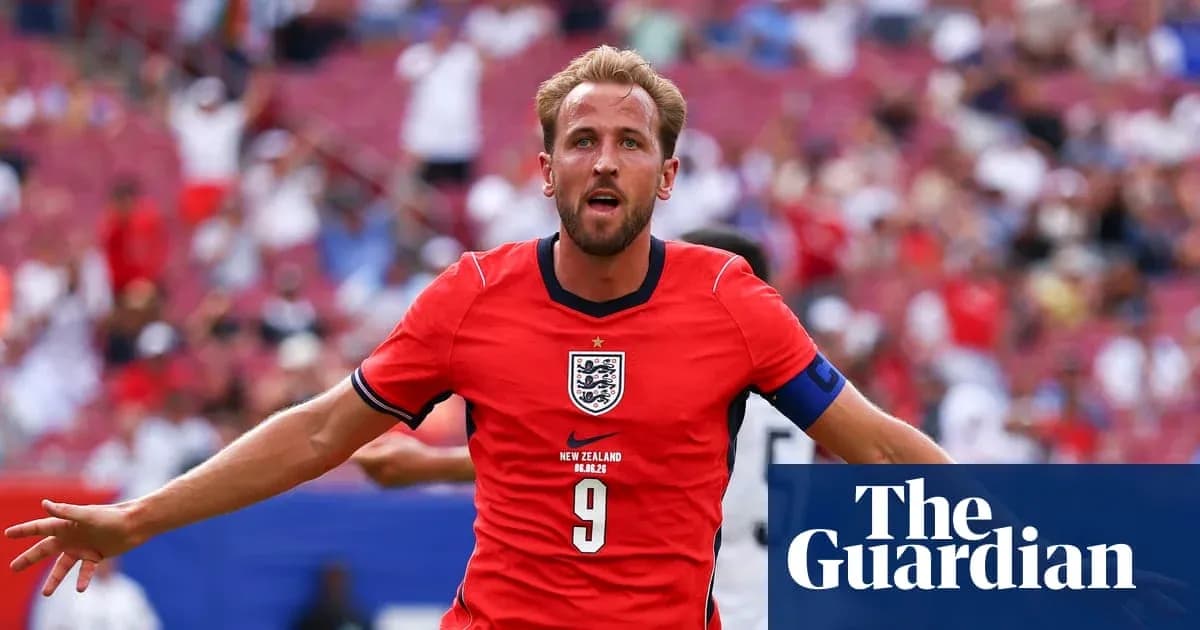
The numbers that sit behind the artistry are staggering. With 61 goals for Bayern, he stands as the only player in Europe’s major leagues consistently echoing the statistical madness of Messi and Ronaldo in their prime, with only Erling Haaland even in the same conversation. Ronaldo once hit 66 in a season, in a year without a major tournament. Messi reached 73. Kane, after the weekend’s game against New Zealand in Tampa, sits on 67.
Yet he is not simply a penalty-box predator racking up tap-ins. At Bayern he often drops so deep he briefly resembles a No 6, collecting the ball from the back line, dictating tempo, spraying passes. His assist for Luis Díaz in the Champions League semi-final first leg against Paris Saint-Germain – a measured, visionary ball that split the defence – underlined just how complete his game has become. It is little wonder Thomas Tuchel is expected to lean heavily on the Bayern blueprint at the World Cup.
At Tottenham, Kane’s name never seriously entered the Ballon d’Or debate. Too few trophies. Too many early exits. Now, as a regular presence in the latter stages of the Champions League and finally decorated with major honours, he stands among the contenders. How high he climbs will likely hinge on this World Cup.
If you were inclined to stitch a narrative across his career, this summer feels like the culmination of a long, patient climb. Kane is not the prodigy who burst through the door at 19, all fireworks and instant coronations. He is the slow burner, the one who kept turning up, kept improving, kept refusing to accept that his story had already been written. In football’s fable of hare and tortoise, he has always looked more shell than sprint.
Those who worked with him at Spurs in his teens remember a very different figure. Slightly overweight by elite standards. Lacking pace. Not the cleanest technician in the group. “You would never have thought that he would be what he is now,” one youth coach recalled. The turning point came around 14, when a growth spurt met an uptick in technical ability. The ball started to fly truer from his boot. The quality of his striking became impossible to ignore. And there was something else: his capacity to absorb information. “Any message you relayed to him, he only needed telling once, whether that was gym work or finishing practice.”
The road from there was not smooth. A bleak loan at Norwich left scars. His debut brought an awful, high-profile miss against West Ham. His final appearance came in an FA Cup humiliation against non-league Luton, when he was hooked at half-time. Between those low points he was even dropped to the under-21s, where he wasn’t trusted to take penalties. Not considered good enough. At Leicester, during another loan, he started both legs of the 2013 Championship playoff semi-final against Watford on the bench, alongside Jamie Vardy. The future of English goalscoring, watching on.
Even back at Spurs, the belief was not universal. Mauricio Pochettino did not initially see a cornerstone of his project. Kane’s own recollection of that 2014 pre-season is revealing. “We had our body fat test done and I was the highest in the team, something like 18%,” he said. He went to see Pochettino, who delivered his verdict without sugar-coating. The numbers were too high. The work-rate was not where it needed to be. The message was blunt but balanced. “He was just straight up [but] he told me: ‘You can be the best striker in the world.’”
At the time, it sounded like the kind of motivational exaggeration managers use to jolt a young player awake. Just as Hoeness’s claim about the greatest transfer in Bayern’s history sounded like the exuberance of a president basking in another trophy.
Years later, both statements look less like hyperbole and more like prophecy.