
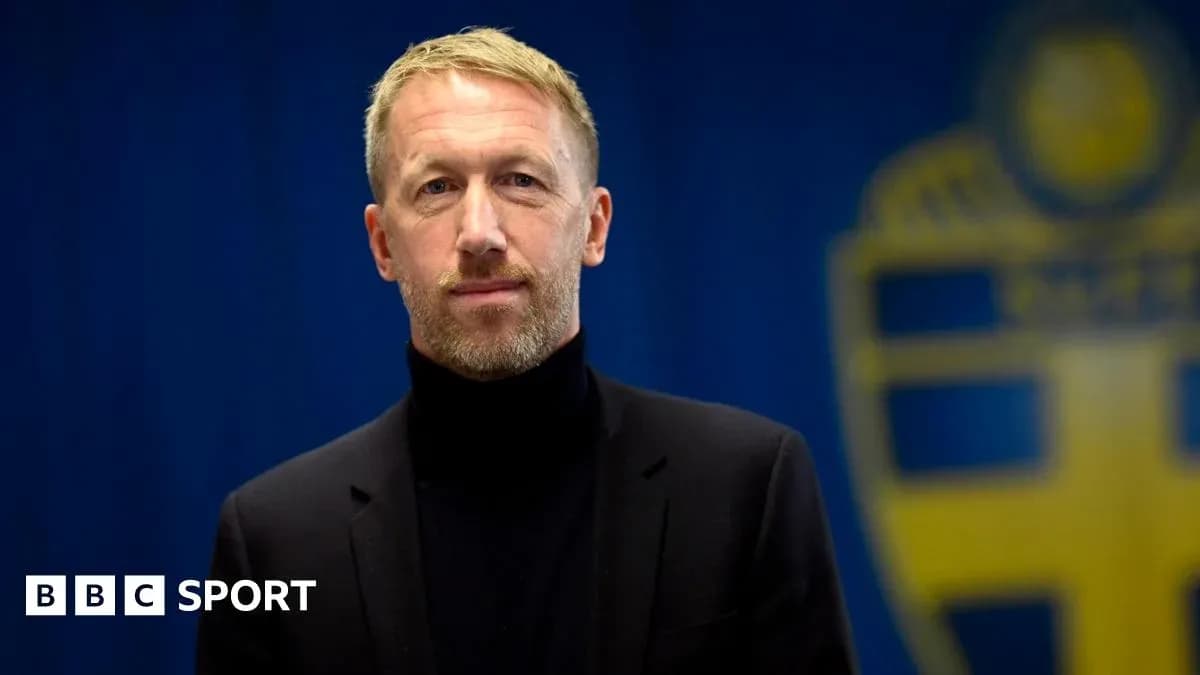
Graham Potter Leads Sweden to World Cup Glory
Graham Potter stood on the touchline in Stockholm, 88 minutes gone, the noise rising and the clock draining. Then Viktor Gyokeres struck, and everything that had weighed on him for the past two years blew away in a single, wild roar.
"We are going to the World Cup, baby."
The Englander who once left Chelsea bruised and West Ham battered had just led Sweden to a 3-2 play-off win over Poland in front of 50,000 at Strawberry Arena. Gyokeres, already fresh from a hat-trick against Ukraine, lashed in the decisive goal and hurled a coach’s career back into the light.
Potter called it "the best night of my career". Given what came before, it is not hard to see why.
From failure to euphoria
His dismissal from Chelsea after seven months, then another short, punishing spell at West Ham that ended last September, left scars.
"It hurt. They are painful experiences," he admitted. "I have lived failure. I've had quite a bit of success too. That's what life is."
He talks now like a man who has been through the furnace and decided to use the heat. Perspective, feedback, the right voices, the need to be grateful for even the worst of it – this is the language of someone who has stared at the bottom and chosen to climb.
"You have to deal with the failure, but you become a better person for it, that's for sure."
Then came that night in Stockholm. Arsenal’s Gyokeres, the new star of north London, racing away and scoring, the stadium exploding, the dugout emptying.
"Viktor scores and it's like an out of body experience," Potter said. "All our subs are running on the pitch. There's 15 players on the pitch and I'm thinking, 'That's yellow cards, that's problems'. But of course it's a World Cup, so all the rules are out the door."
The final whistle only deepened the surge.
"The feeling in the stadium was just incredible," he said. "It's so nice to have to experience positivity through football, because obviously recently I haven't had too much of that."
How did he celebrate? He grinned when asked. "What do you think I did?" A few drinks, a rare chance to let the moment breathe. Then, typically, he reined himself back in.
"You're never quite as good as you say when you're there [high], and you're never quite as bad as they say when you're there [low]. So, you've got to find some way of keeping some perspective."
The Englishman who feels Swedish
This is not a stranger parachuted into a foreign job. Potter’s coaching life was forged in Sweden. He built Ostersunds FK from the obscurity of the fourth tier to the Allsvenskan, won the domestic cup, and took them into Europe. Seven years of graft, culture and language left a mark.
"I feel very Swedish when I'm working," he said. He even sings the national anthem before matches. "I even look a bit Swedish. Two of my children were born in Sweden. I had seven unforgettable years at Ostersunds, with memories that will stay with me for life."
He climbed every rung of the country’s football ladder, from the depths of Division 2 to the top flight, and it changed him.
"You almost become Swedish in a coaching sense because of the experiences you have. I think it has definitely helped. Now I'm working for the Swedish FA as head coach of the national team, so I feel very Swedish."
His affection runs deeper than tactics. Mention Sweden’s most celebrated modern campaign – USA 1994, bronze medals, Tomas Brolin and all – and his eyes go back to the soundtrack. He can still recall the tournament anthem, "När vi gräver guld i USA", a song that, like "World in Motion" or "Three Lions", has embedded itself in a country’s football memory.
This is the backdrop to his decision to accept the Sweden job on a short-term deal in November, replacing Jon Dahl Tomasson. It was not a leap into the unknown. It was a return.
The gamble paid off quickly. Before the March international break, and before qualification was confirmed, he extended his contract to 2030. He will lead Sweden at this World Cup, and, if they make it, at Euro 2028 and the 2030 World Cup as well.
"Maybe in England we have taken it for granted because we usually qualify," he said. "But the reality is that many countries do not, so it is special when they do. It is also very important for the finances of the football structure."
Even Zlatan Ibrahimovic, the country’s great modern icon, took time to send a congratulatory message. Potter called him "one of the kings of Sweden". Approval does not come much higher in these parts.
Isak and Gyokeres: twin weapons for Group F
Now the conversation shifts from redemption arcs to hard, tournament reality. Sweden land in Group F with Tunisia, the Netherlands and Japan. To go deep, they will lean heavily on two of the Premier League’s biggest recent imports.
Liverpool forward Alexander Isak and Arsenal striker Viktor Gyokeres give Potter a frontline that can frighten anyone.
"I think they are different in their styles, which is good for us because you can hopefully use them effectively," he said. "The honest truth is that we haven't played them together yet in my time, so that will be exciting to develop. If we can get them enjoying their football and firing, they are top players."
Isak has yet to start under Potter, his first season after a £125m move from Newcastle to Liverpool disrupted by injuries.
"It can take a bit of time," Potter said. "At the biggest clubs there is pressure and expectation, and when expectation and reality begin to diverge, it can create problems. His injuries have been disappointing, but I know him well. He is a top professional who wants to play and help his team."
Gyokeres, by contrast, has ridden a wave. Twenty-one league goals, a Premier League title, and a Champions League final in his first season at Arsenal after a £55m switch from Sporting. On paper, a dream. In reality, even he has not escaped criticism.
"It is a good example of the modern game," Potter said. From his vantage point, there is no debate. "From our perspective, he has scored four goals in two matches and helped take us to the World Cup, so his impact has been significant."
Potter’s history with Swedish forwards stretches back. He remembers a 16-year-old Isak scoring on his professional debut for AIK against his Ostersunds side. Talent, he knows, does not appear out of nowhere.
San Diego heat, Stockholm calm
As one of the last nations to qualify, Sweden had to take what was left in terms of World Cup bases. They ended up at SDJA, a high school facility in San Diego. On paper, it sounds modest compared to some of the sprawling, purpose-built compounds the giants will enjoy. Potter is not complaining.
He has highlighted the importance of set-pieces in the heat, the small edges that become decisive in tournament football. The pitch, the climate, the details – all matter.
The hardest part, though, has not been logistics. It has been the human side.
Squad selection, he admitted, brought "the toughest conversations as a father and human being". Careers shaped, dreams parked, futures altered in a single phone call. Those choices never get easier, no matter how many teams you pick.
Where England will base themselves in Miami before the tournament, Sweden will stay closer to home. Stockholm will be their camp, their players allowed to spend time with family and friends, to clear their heads after long club seasons before they fly out.
Before it all begins, there are friendlies against Norway and Greece. Then, on 15 June, a return to the sport’s biggest stage against Tunisia.
For Potter, the journey stretches back to a living room in 1986, an 11-year-old watching Diego Maradona bend a World Cup to his will.
"My first football memory is from 1986 – I was 11, watching Diego Maradona," he said. "That was when I realised how special the game was. To work in that environment now is a dream."
From the fourth tier in Ostersund to the World Cup in San Diego, via Chelsea, West Ham and a night of chaos and catharsis in Stockholm. The dream is his again. What he does with it now belongs to the next 90 minutes.



